Building hardware has always been the exclusive domain of specialists with years of training and deep technical expertise. While software development has become increasingly accessible over the past decade, creating physical prototypes still requires significant investment in engineering talent and specialized knowledge. A Stockholm-based startup is now trying to change that equation.
AI hardware startup Atech has raised a pre-seed funding round with participation from Nordic Makers, Emblem, Lovable, Sequoia Scout Fund, and Andreessen Horowitz Scout Fund. The company is building a platform that transforms natural language descriptions into working hardware prototypes within minutes.
The timing of Atech’s approach aligns with a broader shift toward what the industry calls Physical AI – intelligent systems that can sense, interact with, and manipulate the real world. This trend is creating new demand for hardware development skills across industries, from robotics and autonomous vehicles to smart home devices and industrial automation.
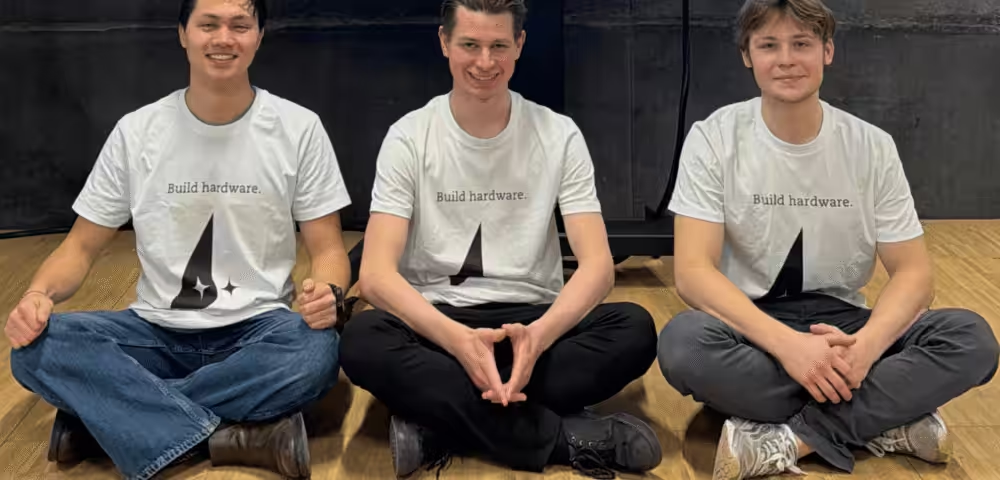
Founded by Vladimir Baran (CCO), Tomas Erik Harmer (CEO), and David Stålmarck (CTO), Atech aims to remove what has historically been one of tech’s highest barriers to entry. The platform handles the underlying technical complexity while users simply describe their hardware concept in plain language.
“Software has an entire stack of tools that lets a teenager build an app in a weekend, hardware doesn’t, and we’re still working at the first level of abstraction,” explains CEO Tomas Harmer. “Atech is building the missing layers, so creating in the physical world can feel as fast and joyful as writing code.”
The company describes its approach as ‘vibe-engineering’ for hardware – a concept that mirrors how modern AI coding tools have made software development accessible to non-programmers. Users can describe their vision in natural language and receive a functional prototype without needing to understand circuit design, component selection, or manufacturing processes.
This democratization of hardware development could have significant implications for innovation cycles. Currently, many hardware ideas never move beyond the conceptual stage because the technical barriers are too high for individual creators or small teams. By lowering these barriers, Atech could enable a new wave of hardware innovation similar to what happened in software development with the rise of accessible programming frameworks and tools.
The startup has caught the attention of industry players who have navigated similar challenges in the software space. “I am seeing the same patterns Lovable had, but for hardware. I’m really excited to see Atech’s journey. The team is one of a kind,” shared Anton Osika, CEO of Lovable, referencing his company’s approach to AI-powered software development.
The broader context for Atech’s platform reflects a growing recognition that hardware control and development will become foundational skills rather than niche specialties. As Physical AI systems become more prevalent across industries, the ability to rapidly prototype and iterate on hardware designs could become as important as software development skills are today.
The company’s approach also addresses a key bottleneck in the current AI hardware ecosystem. While software AI capabilities continue to advance rapidly, translating these capabilities into physical systems often requires months or years of development time. Atech’s platform could potentially compress these timelines and enable faster experimentation with AI-powered physical devices.