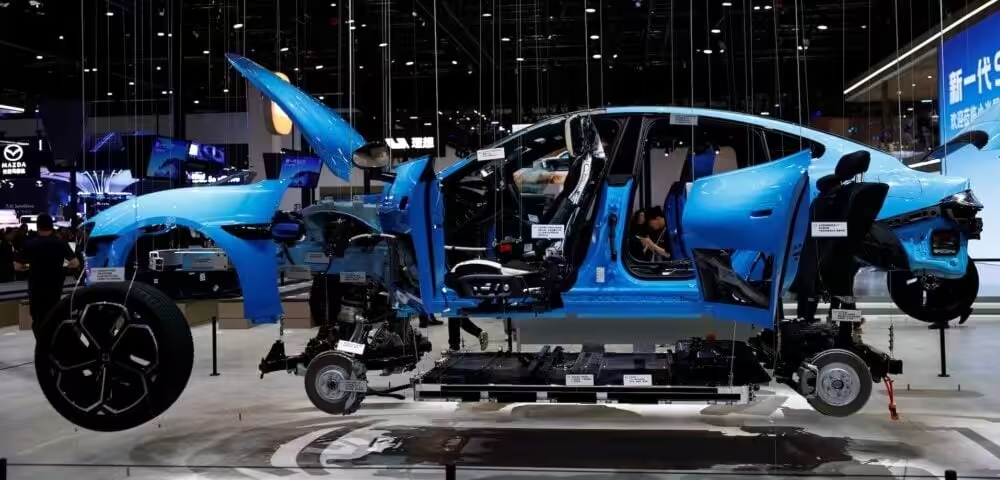
China dominated the electric vehicle market in just 25 years. Now the country’s auto industry is chasing the next big disruption: turning cars into AI-powered, self-reasoning machines that run on Chinese chips and software.
This push comes directly from Beijing’s latest five-year plan, which calls for “AI Plus” – a national project to embed artificial intelligence across manufacturing, healthcare, and virtually every sector of the economy. The strategy aims to break China’s reliance on high-end semiconductors, a trade chokepoint controlled by the United States.
The lines between tech and auto companies disappear
“There’s no longer a distinction between a technology company and a car company,” Nissan Motor China chief Stephen Ma told reporters at the Beijing Auto Show. “The AI-developed vehicle is much faster and it’s quicker in China.”
The transformation is so rapid that industry experts are calling it more than just change. “There is no transition,” Francois Roudier, secretary general of the International Organisation of Motor Vehicle Manufacturers, told Reuters in Beijing. “It’s a revolution.”
Chinese automakers have become so advanced that they’re upending the global car industry, according to Roudier’s trade federation that represents the world’s auto manufacturers.
Cars that understand complex commands
Chinese automakers are moving beyond basic connectivity to create vehicles that can handle sophisticated tasks. Xpeng’s updated AI model lets drivers give natural commands like “park near the entrance to the shopping center” instead of pointing to spots on a map. The cars can navigate using just cameras, even without mapping data or GPS coordinates.
Xiaomi, the phone and appliance maker that jumped into EVs three years ago, released a new AI model at midnight on Thursday. The company’s HyperOS operating system can handle complex to-do lists including:
- Making restaurant reservations
- Placing coffee orders
- Compiling notes from road trips
- Detecting when drivers seem stressed and adjusting lighting and music accordingly
“So much focus on AI in other parts of the world has been on how can we use it to improve business? That’s not what Chinese automakers are talking about,” said Dan Hearsch, global co-leader for automotive at advisory firm AlixPartners. “The AI they’re building in is going to make the car easier to drive, easier to interact with, easier to do all of the things that otherwise take effort.”
Massive investments in homegrown chips
The investment commitments are substantial. Huawei, which has shifted from telecommunications into chips, AI, and connected cars, plans to invest more than $10 billion over the next five years to boost computing power for smart driving. While automotive makes up a small part of Huawei’s business, it’s the company’s fastest-growing segment.
Horizon Robotics, a Chinese chipmaker competing with Qualcomm, launched its Starry 6 processor just before the auto show. The chip integrates cockpit and driving functions while handling up to 12 screen displays in a single vehicle.
Several Chinese EV companies are following Tesla’s playbook by designing their own chips to reduce dependence on Nvidia. The list includes Xpeng, Li Auto, BYD, Geely, and Leapmotor.
NIO spun off its chip unit entirely. CEO William Li sees developing semiconductors as a way to cut costs and boost profits by replacing Nvidia chips. “We are open to the whole industry and we welcome them to use our chips,” Li said.
State-owned companies answer Beijing’s call
Some automakers used the Beijing auto show to signal they heard Beijing’s message loud and clear. Dongfeng Motor, one of China’s Big Four state-owned carmakers, said it would build cars using “embodied AI technology” aligned with China’s long-term sector plans.
Dongfeng has been working with Huawei on smart driving systems to compete with privately owned rivals. “When the nation calls, Dongfeng answers,” Chairman Yang Qing said.
The rapid development reflects China’s broader strategy to achieve technological independence while creating new competitive advantages in the global auto market. What started as a push into electric vehicles has evolved into a comprehensive effort to redefine what cars can do.