An AI research assistant that uses language models to help you automate research workflows
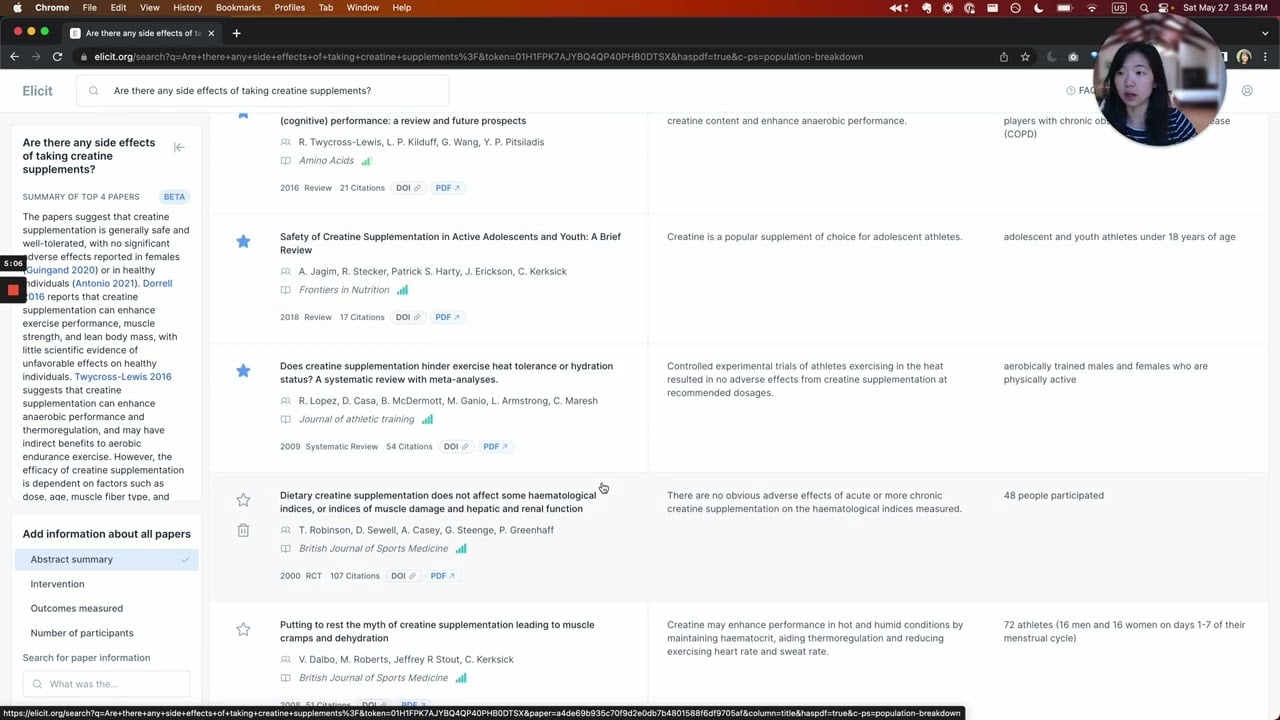
Elicit is an online tool designed to assist with research, particularly in analyzing academic papers rapidly. It uses AI to automate tasks like summarizing research, extracting key data, and integrating findings. As such, the service is especially helpful for researchers, saving them time and effort in reviewing literature.
The platform offers a robust search function, capable of handling complex research queries and providing relevant paper summaries from a vast database. This, in turn, helps users quickly identify and select pertinent research articles, streamlining their review process.
Elicit also excels in synthesizing information from multiple papers, identifying common themes and concepts. This is useful for understanding broad topics, such as the various impacts of a drug or the range of datasets used in a particular field.
The service includes features for uploading personal PDFs, getting quick summaries, viewing source citations, and asking questions to papers. Combined, these functionalities enhance research efficiency, allowing for a more in-depth and organized study approach.
Elicit is available in a few different pricing plans designed to cater to different needs. So whether you need it for your own (personal) research or for your organization, you will find the plan that works for you. Check it out.
FAQs
💬
What is Elicit AI and who is it designed for?
Elicit AI is an AI-powered research assistant that automates tasks like searching academic papers, summarizing findings, and extracting data for literature reviews. It targets researchers, academics, students, and professionals in fields like pharmaceuticals, policy, and tech, helping them handle over 138 million papers efficiently. I think it's especially handy for anyone new to a topic who wants quick evidence-based overviews.
How does Elicit's search feature work differently from Google Scholar or PubMed?
Unlike keyword-based tools like Google Scholar, Elicit uses semantic search powered by language models to understand your research question in natural language and find relevant papers even without exact matches. It pulls from databases like Semantic Scholar and clinical trials, often surfacing up to 1,000 results with sentence-level citations. Users on Reddit note it saves time but might miss some niche papers, so it's best as a starting point.
Can Elicit help with systematic literature reviews?
Yes, Elicit automates screening, data extraction, and report generation for systematic reviews, claiming up to 80% time savings based on user reports and a 2025 medRxiv study. You can customize criteria and override AI decisions, making it reliable for evidence synthesis. That said, a BMC study from March 2025 found it identifies about 50% of key articles accurately, so verify outputs for rigor.
What accuracy can I expect from Elicit's summaries and data extraction?
Elicit achieves around 80-90% accuracy in extracting and summarizing data, per 2025 evaluations like one in AI Flow Review, with transparent citations to original sources. It's strong in empirical fields like biomedicine but less so for abstract topics. Reviewers suggest cross-checking, as occasional nuances get lost, but the tool's validation beats general AI like ChatGPT.
Does Elicit support collaboration or integrations with other tools?
Elicit allows sharing projects and libraries internally, and it integrates with Zotero for reference management, but lacks open APIs or deep third-party syncing as of late 2025. Team plans enable shared quotas for group reviews, though Reddit users say it's not fully collaborative like Google Docs. It works well for solo or small-team workflows.
How does Elicit handle privacy and data security for uploaded papers?
Elicit doesn't use uploaded PDFs or queries to train its models, keeping your research confidential, as confirmed in their privacy policy and 2025 reviews on Paperpal. It's above average for academic tools, with no reported breaches, but always review terms if handling sensitive data. I probably wouldn't hesitate for most projects.
What are the main limitations of using Elicit for research?
It relies heavily on Semantic Scholar, so it might overlook papers from paywalled or non-English sources, and sensitivity in finding all relevant studies hovers at 39.5% per a 2025 academic eval. Also, searches aren't always reproducible, which matters for formal reviews. Users on X praise its speed but warn it's a supplement, not a replacement.
Can Elicit generate customizable research reports?
Absolutely, Elicit Reports create structured briefs inspired by systematic reviews, letting you tweak included papers, add columns for data like sample sizes, and export in PRISMA format. PhDs in a 2025 Reddit thread ranked it higher than OpenAI's tools for quality, and it's free for basic use. Great for brainstorming angles you hadn't considered.
Is Elicit suitable for non-academic users, like journalists or analysts?
Yes, it excels at fact-checking and quick insight gathering from papers, with features like alerts for new research. Reviews from Daly AI Tools highlight its use in policy and consumer goods for evidence-based decisions. That said, it shines more in scientific domains, so general queries might need pairing with broader search engines.
How has Elicit evolved in 2025, and what new features should I look for?
In 2025, Elicit added an AI systematic review workflow in February for living reviews, plus enhanced reports with human-level synthesis. Blog updates focus on accuracy improvements, and user feedback on forums notes better nuance handling. It's iterating fast, with weekly features, making it more robust for complex queries.