Jenni
An AI research and writing assistant that uses the latest research as well as your own files for citations
Jenni is an AI-powered service for researchers, designed to help them “supercharge their next research paper.”
Instead of doing it all by yourself, you can use Jenni’s AI assistant to get suggestions whenever you are stuck or expand your notes into full paragraphs. As a result, you can write up to 10 times faster while making sure you are crafting the original work.
This is made possible with Jenni’s autocomplete features, as well as its ability to paraphrase and rewrite content for you. Heck, you can even start with your PDF files and even chat with them to uncover insights with ease.
All in all, there is a reason why Jenni is used by more than 1 million academics and writers. As of September 2023, it has helped write over 970 million words — from academic essays, journals, to top-ranking blog posts.
Among the organizations using Jenni are the University of Cambridge, MIT, Aston University, University of Melbourne, Harvard University, and Google, to name a few.
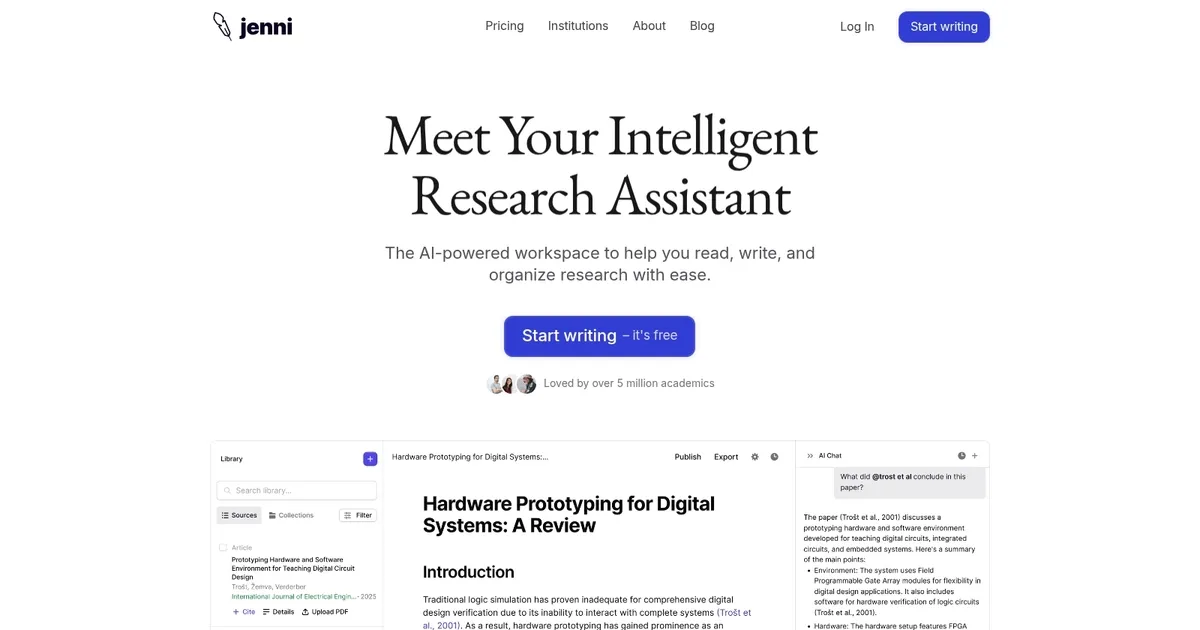
Homepage Screenshot 📸
What are the key features? ✨
- AI autocomplete: Jenni's autocomplete will write alongside you to beat writer's block whenever you need a helping hand.
- In-text citations: Jenni consults the latest research, and your PDF uploads. Easily cite in APA, MLA, IEEE, or Harvard style.
- Paraphrase & rewrite: Paraphrase any text in any tone. Rewrite the internet customized to you.
- Generate from your files: Bring your research papers to life with source-based generation.
- Chat with your PDFs: Quickly understand and summarize your research papers with Jenni's AI chat assistant.
- Outline builder: Enter your prompt and get a list of section headings ready for you to flesh out.
- Custom styles & tones: From academic to persuasive, pick the tone to suit your writing needs.
- Research library: Save and manage research in your library. Easily cite research in any document, fast.
Who is it for? 🤔
Examples of what you can use it for 💡
- Save hours writing your essay or thesis with Jenni
- Discover and write about relevant research
- Polish your writing to increase submission success
- Create a compelling college motivation letter
- Write blogs & articles faster with the help of AI
- Craft your next compelling speech in less time
Pros & Cons ⚖️
- Lets you write up to 10 times faster
- Includes support for multiple languages
- Chat with PDFs comes included
- Mobile support is still not there
FAQs 💬
Ready to try Jenni?
An AI research and writing assistant that uses the latest research as well as your own files for citations
Visit Jenni