Best AI General Use Tools

727 toolsRanked by traffic

General-use AI tools are all-purpose assistants you can reach for across almost any task, from answering questions and drafting text to summarizing documents and writing code. These are the everyday models people open first: ChatGPT, Gemini, Grok, and DeepSeek, built to be broad rather than specialized.

Most people start here before reaching for a niche tool, because one general assistant covers a surprising amount of daily work. When you're choosing one, the things that matter are how well it reasons through tricky requests, whether it can browse the web or read your files, and how much you can do on the free tier. The narrower sub-categories below, like chatbots and assistants, are spun out of this same bucket when you need something more focused.

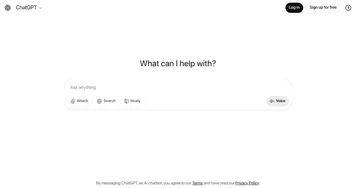
ChatGPT
ChatGPT - icon
ChatGPT
All-round AI assistant generating human-like responses to user queries and tasks
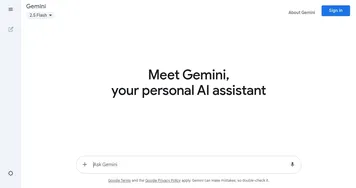
Gemini
Gemini - icon
Gemini
Generates responses from text, images, audio, and video inputs using advanced multimodal AI
Claude
Claude - icon
Claude
Assists users in reasoning, coding, writing, and analyzing data with advanced AI models
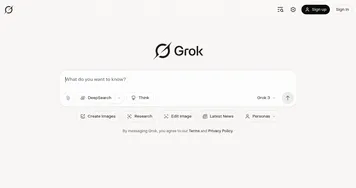
Grok
Grok - icon
Grok
Delivers witty, real-time AI responses with advanced reasoning and image generation
DeepSeek
DeepSeek - icon
DeepSeek
Delivers advanced AI models for coding and reasoning at low costs
Perplexity
Perplexity - icon
Perplexity
Delivers cited AI answers from web searches instantly
Black Forest Labs
Black Forest Labs - icon
Black Forest Labs
Generates high-quality images from text prompts with precision and speed
Poe
Poe - icon
Poe
Aggregates top AI models for seamless chatting and bot creation
Character.AI
Character.AI - icon
Character.AI
Generates interactive AI-driven chats with fictional characters.
GitHub Copilot
GitHub Copilot - icon
GitHub Copilot
Enhances coding with AI-driven completions and chat assistance
Stable Diffusion
Stable Diffusion - icon
Stable Diffusion
Generates high-quality images from text prompts with versatile styles
Bing
Bing - icon
Bing
Empowers searches with AI-driven insights and creative generation
Bing Image Creator
Bing Image Creator - icon
Bing Image Creator
Generates vivid images from text prompts instantly
SwiftKey AI Keyboard
SwiftKey AI Keyboard - icon
SwiftKey AI Keyboard
Enhances typing with AI-powered autocorrect and predictions
Brave Leo
Brave Leo - icon
Brave Leo
Assists with web queries, content creation, and document analysis in-browser

Frequently Asked Questions

What is the best general-purpose AI tool?
The best general-purpose AI tool depends on what you do most. ChatGPT is the most well-rounded all-rounder, Gemini works smoothly across Google apps, Claude is strong on long documents and careful reasoning, and Grok ties into real-time posts on X. Many people keep a couple open and switch by task.
What can general AI tools actually do?
General AI tools handle a wide mix of everyday work: answering questions, drafting and editing writing, summarizing long text, brainstorming ideas, translating languages, explaining concepts, and writing or debugging code. Newer ones can also read files, generate images, and browse the web, which is why one assistant often replaces several single-purpose apps.
Are general AI tools free to use?
Most general AI tools offer a free tier that covers casual daily use, with limits on how many messages you send or which model you reach. Paid plans, usually around twenty dollars a month, unlock the most capable models, higher usage caps, and extras like file uploads, image generation, and live web access.
What's the difference between a general AI tool and a specialized one?
A general AI tool is built to handle almost anything reasonably well, while a specialized tool is tuned for one job and usually does it better. You'd use a general assistant for everyday questions and drafting, then switch to a dedicated coding, image, or research tool when the task gets demanding enough to need the extra depth.
Can general AI tools make mistakes?
Yes, general AI tools can be confidently wrong, a problem often called hallucination. They predict plausible text rather than look up verified facts, so they sometimes invent details, dates, or sources. Treat their answers as a strong first draft, and double-check anything important before you rely on it.
Which general AI tool is best for privacy?
Privacy varies by provider and plan rather than by a single best pick. Many free tiers may use your conversations to train future models unless you opt out, and they tend to keep more data than paid plans. For sensitive work, turn off chat history or training where it's offered and avoid pasting confidential information.