logo-darklogo-darklogo-darklogo-dark
  • Home
  • Browse
    • Assistant
    • Coding
    • Image
    • Productivity
    • Video
    • Voice
    • Writing
    • All Categories
    • AI Use Cases
  • My Favorites
  • Suggest a Tool
✕
Home › Coding & Development ›

Hugging Face

Published by Dusan Belic on July 10, 2023

Hugging Face

Hugging
Hugging Face Homepage
Categories Coding & Development
Hosts and collaborates on machine learning models, datasets, and apps

Hugging Face

Hugging Face is a collaborative platform for machine learning models, datasets, and applications.

The Model Hub contains over 500,000 pretrained models. Each entry shows architecture details, benchmark scores, and sample code. Users can download weights directly or load them via the Transformers library in a single line.

Datasets Hub offers versioned data with browser previews. Load any dataset with the Datasets library; it streams large files and caches locally. Filters include size, task, and license.

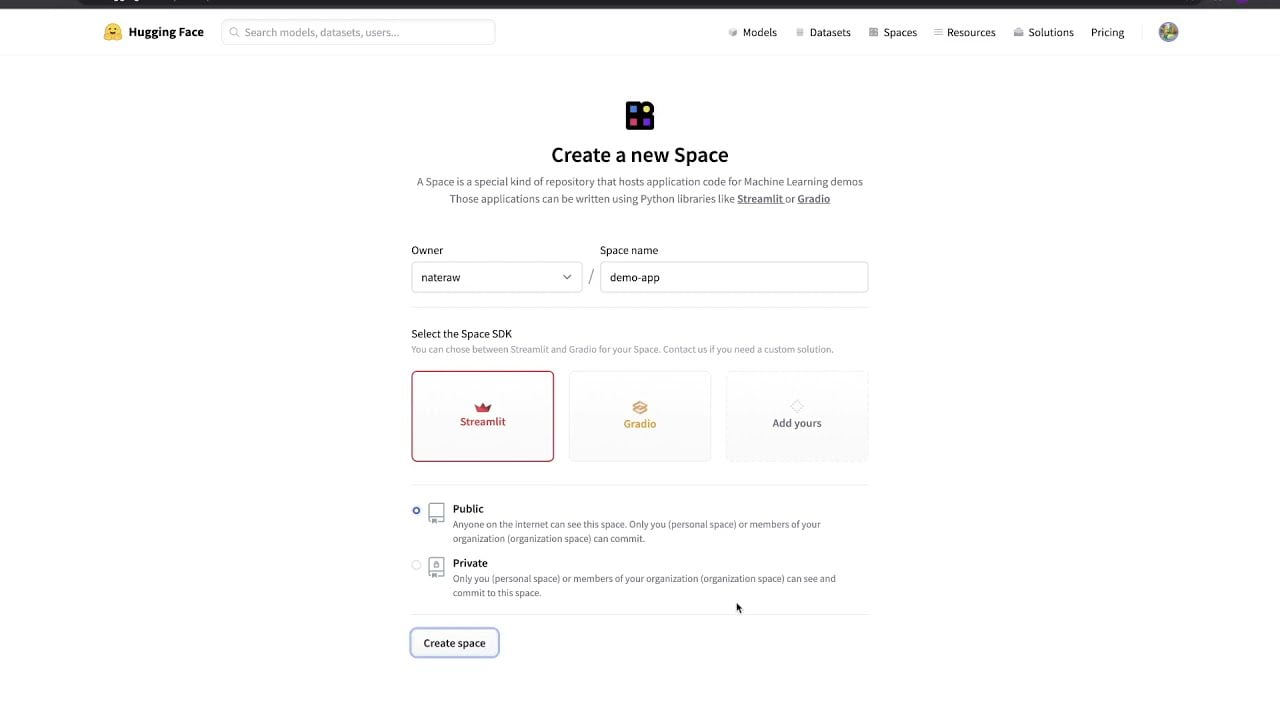
Spaces host interactive demos using Gradio or Streamlit. The free tier runs on CPU; paid upgrades add GPU acceleration, starting at $0.60 per hour. Deployment takes one click from the repo.

Enterprise plans provide private repositories, SSO, and dedicated inference endpoints. The Inference API accesses models without requiring infrastructure management.

Key libraries include Transformers for NLP and vision, Diffusers for generation, and Accelerate for training. All support PyTorch, TensorFlow, and JAX. Community contributions drive updates.

Compared to GitHub, Hugging Face adds model cards and built-in inference. Kaggle focuses on competitions rather than sharing. The search function works, but it returns many similar models; use task filters to narrow down the results.

Hugging Face Homepage
Categories Coding & Development

Video Overview ▶️

What are the key features? ⭐

  • Model Hub: Central repository with over 500,000 searchable, downloadable pretrained models and example code.
  • Datasets Hub: Versioned datasets with in-browser previews and streaming loading via library.
  • Spaces: Host interactive ML demos with Gradio or Streamlit, deployable in one click.
  • Transformers Library: Unified API for loading and running models across frameworks in few lines.
  • Inference Endpoints: Dedicated scalable deployment for models with pay-per-use billing.

Who is it for? 🤔

Hugging Face serves machine learning practitioners who need quick access to pretrained models, researchers sharing datasets, developers building demos, and teams requiring secure enterprise collaboration on AI projects.

Examples of what you can use it for 💭

  • NLP Researcher: Fine-tune a BERT model on custom text data and share the checkpoint publicly for citations.
  • Startup Founder: Prototype a sentiment analysis API using a Hub model and deploy via Spaces for investor demos.
  • Data Scientist: Load a large vision dataset in chunks, train a classifier, and track experiments in a private repo.
  • Student: Fork a text generation Space, modify prompts, and learn deployment without managing servers.
  • Enterprise Team: Host proprietary models privately with SSO and scale inference on dedicated GPUs.

Pros & Cons ⚖️

  • Vast open model library
  • One-click demo hosting
  • Strong community support
  • Flexible pricing tiers
  • Search can overwhelm
  • Free tier queues

FAQs 💬

Is Hugging Face free to use?
Yes, public models, datasets, and basic Spaces are free; paid plans unlock private repos and faster compute.
Do I need to install anything?
No, you can run models in the browser; install libraries via pip for local development.
Can I keep my models private?
Yes, Pro and Enterprise plans offer private repositories with access controls.
What frameworks does it support?
Transformers library works with PyTorch, TensorFlow, and JAX natively.
How much does inference cost?
Pay-per-use starts at fractions of a cent per query; dedicated endpoints bill by the hour.
Can I collaborate with my team?
Yes, organizations feature shared private spaces and discussion threads.
Are there GPU options?
Yes, upgrade Spaces or use Inference Endpoints with GPU acceleration.
Is there an API?
Yes, Inference API lets you query any public model programmatically.
How do I cite a model?
Each model card provides a recommended BibTeX citation.
Can I run 3D models?
Yes, the Hub includes 3D generation and processing models with examples.

Related tools ↙️

  1. AI2SQL AI2SQL Generates SQL queries from natural language inputs
  2. OnSpace OnSpace Builds AI-powered apps without coding in minutes
  3. fal fal Generative media platform providing various tools to create and manage AI-driven applications
  4. Continue Continue An open-source AI code assistant that enhances software development by integrating into IDEs
  5. Leap Leap Add AI to your app in minutes with best-in-class APIs and SDKs
  6. Cursor Cursor Supercharges coding with AI agents that build, edit, and review code autonomously.
Last update: October 30, 2025
Share
Promote Hugging Face
light badge
Copy Embed Code
light badge
Copy Embed Code
light badge
Copy Embed Code
About Us | Contact Us | Suggest an AI Tool | Privacy Policy | Terms of Service

Copyright © 2026 Best AI Tools
415 Mission Street, 37th Floor, San Francisco, CA 94105