Kaggle
Empowers ML projects with datasets, notebooks, and competitions
Kaggle is a comprehensive platform for data science and machine learning that hosts datasets, notebooks, models, competitions, and courses to support collaborative AI development.
It provides access to 516,000 datasets covering diverse topics such as healthcare, finance, and environmental science, enabling users to download or integrate data directly into projects. Notebooks offer an interactive environment based on Jupyter, supporting Python, R, and SQL with pre-installed libraries like Pandas, NumPy, Scikit-learn, TensorFlow, and PyTorch. Users receive up to 30 hours of free GPU and 20 hours of TPU compute per week, sufficient for prototyping models up to medium scale. Models section includes 26,800 community-contributed entries, compatible with frameworks for inference and fine-tuning.
Competitions number over 30,000, categorized as featured, research, getting started, and in-class, with evaluation metrics like RMSE or AUC determining rankings. Participants submit predictions via notebooks, and top solutions include detailed write-ups explaining techniques such as feature engineering or boosting algorithms. Courses total 70+ hours, structured in modules on topics including Python basics, intermediate ML, and computer vision, with integrated exercises linking to notebooks.
Key competitors include Google Colab, which excels in unlimited free sessions and Google ecosystem integration but lacks Kaggle’s datasets and competitions. Hugging Face focuses on model hubs and NLP tools, offering superior sharing via Spaces, though it has fewer general datasets. Papers with Code benchmarks research papers against code but omits interactive competitions.
Users appreciate the free resources and community forums for troubleshooting, with 25 million members from 190 countries contributing discussions and collaborations. Potential likes include the progression system awarding medals for achievements and the ability to fork notebooks for rapid iteration. Drawbacks involve compute limits restricting large-scale training and occasional interface slowdowns during high traffic. A surprise is the API for programmatic access to datasets and kernels, facilitating automation in workflows.
Pricing remains free for core features, with optional Google Cloud extensions for advanced compute, generally more accessible than paid alternatives in competitors.
For practical use, select a beginner competition, utilize provided starter notebooks, and engage forums for metric optimization to build foundational skills efficiently.
Homepage Screenshot 📸
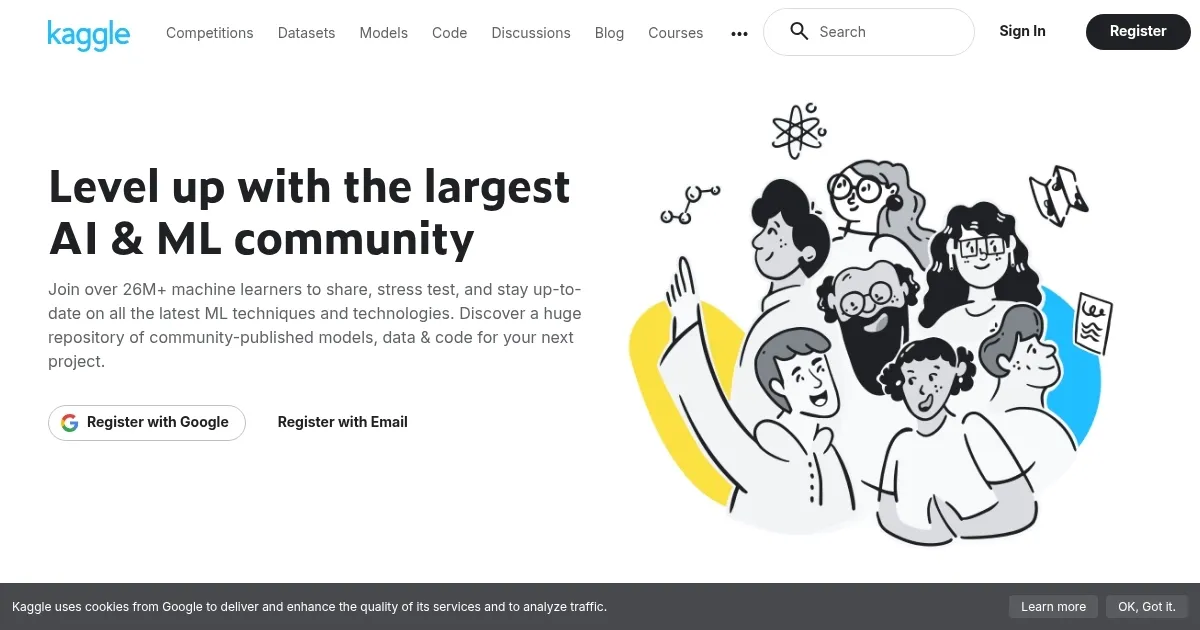
Video Overview 🎬

What are the key features? ✨
- Datasets: Hosts 516K public datasets for direct download or notebook integration, spanning AI/ML applications like image recognition and predictive modeling.
- Notebooks: Provides 1.5M interactive coding environments with GPU/TPU access, supporting collaborative editing and version control for Python/R scripts.
- Models: Features 26,800 community-shared models compatible with TensorFlow and PyTorch, enabling quick deployment and fine-tuning in projects.
- Competitions: Offers 30,000 events with real-world problems, leaderboards, and prizes to test ML skills against global participants.
- Courses: Delivers 70+ hours of structured tutorials on ML topics, integrated with hands-on notebook exercises for practical learning.
Who is it for? 🤔
Examples of what you can use it for 💡
- Student: Uses courses and getting-started competitions to practice Python and ML basics, building a portfolio for internships.
- Data Scientist: Analyzes public datasets in notebooks with GPU support to prototype predictive models for business problems.
- ML Engineer: Shares and fine-tunes community models, integrating them into deployment pipelines via APIs.
- Researcher: Joins research competitions to benchmark algorithms against peers, accessing diverse datasets for experiments.
- Educator: Runs in-class competitions with private datasets to teach teams collaborative ML techniques.
Pros & Cons ⚖️
- Vast datasets
- Free GPU/TPU
- Active community
- Compute limits
FAQs 💬
Kaggle alternatives 🔗