Best AI Research Tools

179 toolsRanked by traffic

AI research tools answer questions and gather knowledge by searching across sources and synthesizing what they find into a clear, cited reply. You ask in plain language and get back a sourced summary instead of a list of links to read yourself. The category includes answer engines like Perplexity, reasoning assistants like Claude and DeepSeek, and specialized tools like WarrenAI for financial questions.

This is general research, the kind you do when you need to understand a topic quickly, not the academic-paper work covered by the Research Paper category next door. People use these tools to get up to speed on a subject, fact-check a claim, or pull together background before a meeting. The single most important feature is whether the tool cites its sources, because that lets you verify an answer instead of trusting it on faith. Treat the response as a fast, well-organized starting point, then click through to confirm anything that actually matters.


Claude
Claude - icon
Claude
Assists users in reasoning, coding, writing, and analyzing data with advanced AI models
DeepSeek
DeepSeek - icon
DeepSeek
Delivers advanced AI models for coding and reasoning at low costs
Perplexity
Perplexity - icon
Perplexity
Delivers cited AI answers from web searches instantly
WarrenAI
WarrenAI - icon
WarrenAI
An AI tool for people who want to understand the stock market better
Britannica Chatbot
Britannica Chatbot - icon
Britannica Chatbot
A digital librarian drawing from over 130,000 meticulously fact-checked articles
Kimi
Kimi - icon
Kimi
An AI assistant that can interpret images, analyze code, and provide real-time information
LMArena
LMArena - icon
LMArena
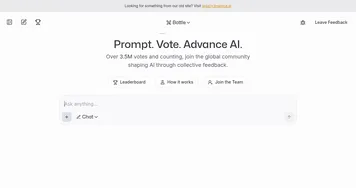
Test large language models (LLMs) by comparing their performance in real-time, side-by-side
Talk to Books
Talk to Books - icon
Talk to Books
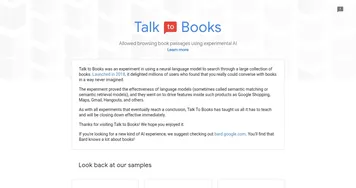
Google's experiment which allows users to interact with books in an entirely new way
Hugging Face
Hugging Face - icon
Hugging Face
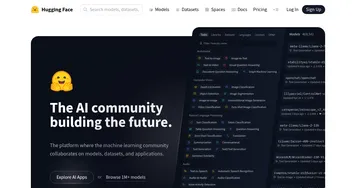
Hosts and collaborates on machine learning models, datasets, and apps
CoCounsel
CoCounsel - icon
CoCounsel
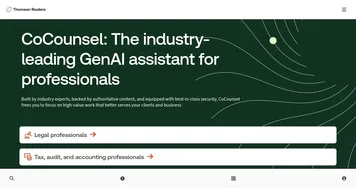
Tool for legal document review, research memos, deposition preparation, and contract analysis
NotebookLM
NotebookLM - icon
NotebookLM
Transforms uploaded documents into interactive AI-powered research assistants
Manus
Manus - icon
Manus
An AI agent designed to handle complex tasks all by itself
Genspark
Genspark - icon
Genspark
An innovative AI-powered search engine designed to improve how we access information online
LINER
LINER - icon
LINER
A web-based tool that combines searching and collecting information in a user-friendly interface
SciSpace
SciSpace - icon
SciSpace
Your AI assistant to discover and understand research papers

Frequently Asked Questions

What is the best AI tool for research?
The best AI research tool depends on the kind of question. Perplexity is excellent for quick, cited answers from the live web, while Claude and DeepSeek are stronger when you need careful reasoning over a topic or a long document. Many people use Perplexity for fast lookups and a reasoning assistant for deeper analysis.
Can AI research tools be trusted to be accurate?
AI research tools are a reliable first pass, but they can still get facts wrong or misread a source, so they should not be your final authority. The trustworthy ones show citations you can click to verify each claim. Use them to find and organize evidence quickly, then confirm anything important against the original source.
How do AI research tools find their information?
AI research tools either search the live web in real time, answer from the data they were trained on, or do both. Search-based tools like Perplexity retrieve current pages and quote them, which keeps answers up to date. Tools that rely only on training data can be confidently out of date, so check whether yours actually browses the web.
Are AI research tools free to use?
Most AI research tools offer a free tier that covers everyday questions, then charge for heavier use. Paid plans, often around twenty dollars a month, typically unlock the most capable models, more searches per day, and extras like file analysis. The free versions are genuinely useful for casual research before you decide to upgrade.
What's the difference between AI research tools and a search engine?
A search engine returns a ranked list of links for you to read and piece together yourself. An AI research tool reads across those sources and hands back a written answer with the key points already synthesized and cited. You trade some control over which pages you see for a much faster path to a usable summary.