NotebookLM by Google
Transforms uploaded documents into interactive AI-powered research assistants
NotebookLM is Google’s AI-powered research and note-taking assistant that grounds insights in user-uploaded sources. It analyzes documents, videos, and audio to generate summaries, answer queries, and create study aids. Powered by Gemini, it ensures that responses remain tied to the provided materials, reducing errors caused by external data.
Key features include the Chat panel for querying sources with citations and the Studio panel for outputs such as Audio Overviews, where AI hosts discuss content in a podcast-style format. Video Overviews add narrated visuals, while Study Guides produce flashcards and quizzes. The interface supports up to 50 sources per notebook in the free version, with Plus offering more.
Users appreciate the tool’s accuracy for academic tasks, such as synthesizing lecture notes into timelines or FAQs. Professionals use it for report analysis, extracting action items from lengthy PDFs. Recent 2025 updates enable chat saving and multi-angle query assessment for deeper responses. It integrates with Google Drive for seamless uploads.
Competitors like Notion AI excel in collaborative workspaces but lack NotebookLM’s source-grounded generation. Obsidian suits offline linking of notes, though it requires plugins for AI features. NotebookLM’s free tier suffices for light use, while Plus via Google One provides higher limits at a bundled rate.
Potential drawbacks include occasional source conflicts, which can lead to unclear outputs, and limited non-Google integrations. Mobile apps, launched in May 2025, enhance accessibility but may lag on complex renders. Featured notebooks from sources like The Economist offer pre-built insights on topics from longevity to 2025 predictions.
For education, it aids under-18 users with stricter policies, generating personalized learning paths. Businesses leverage shared notebooks for team knowledge bases. Start by creating a notebook, uploading core documents, and testing a simple query to build familiarity. Scale to advanced features like custom prompts for tailored results.
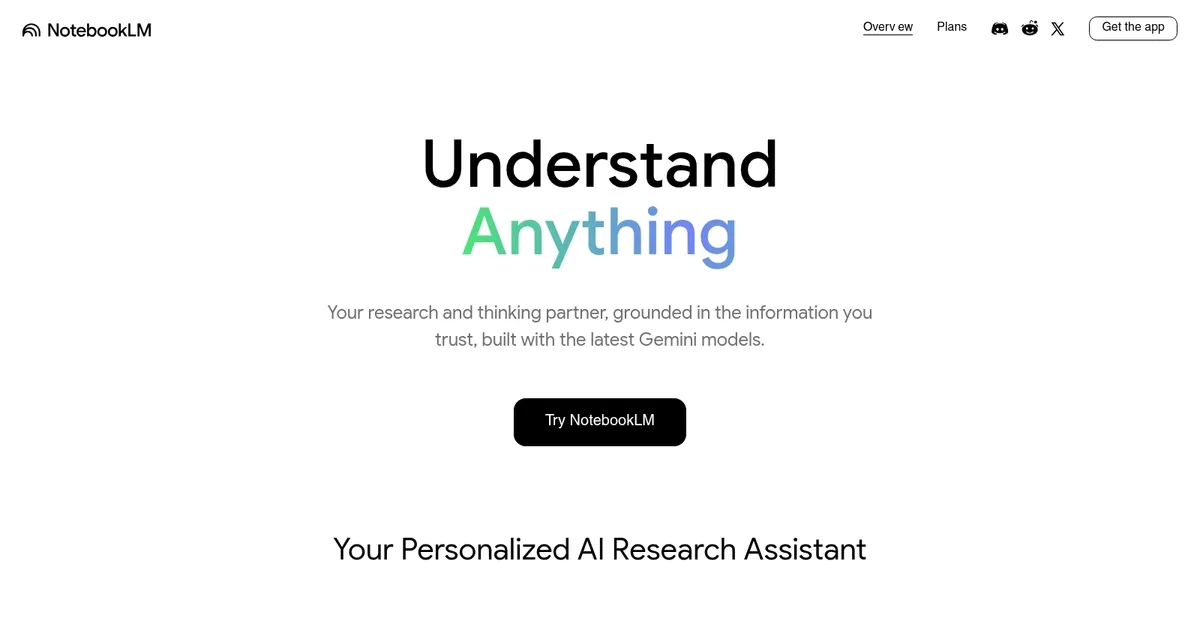
Homepage Screenshot 📸
Video Overview 🎬
What are the key features? ✨
- Source Guides: Automatically generates summaries, key topics, and suggested questions from uploaded documents.
- Audio Overviews: Creates engaging podcast-style discussions with AI hosts based on your sources.
- Video Overviews: Produces narrated video summaries with graphics to visualize complex information.
- Study Guides: Builds flashcards, quizzes, and timelines for effective learning and review.
- Chat Interactions: Allows natural language queries with cited responses grounded in provided materials.
Who is it for? 🤔
Examples of what you can use it for 💡
- Student: Uploads class readings to generate quizzes and flashcards for exam prep.
- Lawyer: Analyzes case files to extract key clauses and create briefing documents.
- Marketer: Processes competitor reports into timelines and audio overviews for strategy sessions.
- Writer: Synthesizes research notes into mind maps and FAQ outlines for articles.
- Business Analyst: Compares financial docs to highlight trends and risks in summaries.
Pros & Cons ⚖️
- Grounded insights
- Multimedia outputs
- Easy interface
- Free tier access
- Upload limits free
- Google ecosystem bias
FAQs 💬
Ready to try NotebookLM?
Transforms uploaded documents into interactive AI-powered research assistants
Visit NotebookLM