Copyleaks
Copyleaks is one of the most popular services for the detection of plagiarized and AI-generated content. As such, it is capable of detecting the “work” of OpenAI (GPT) and Google (Bard) across multiple languages.
Once you provide the Copyleaks with the content you want to check, it will return a precise probability score of AI-generated content and highlight specific elements written by a human and those written by AI. What’s more, it can also detect AI content that has been paraphrased.
You can either manually submit content to Copyleaks or use its API and integrate it into your own apps.
Speaking of integrations, the tool can be easily added to Learning Management Systems (LMS) to empower learning and error-free writing while “keeping everything you need in one convenient place.”
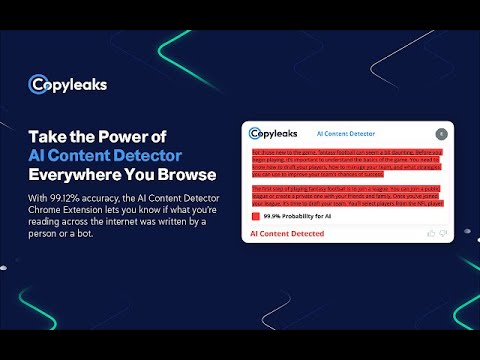
Or you can fire it up while browsing the web by installing the Copyleaks Chrome extension.
Copyleaks is used by many major websites and services, including SEMRush, Medium, emdentum, and Edgenuity.
Video Overview ▶️
What are the key features? ⭐
- AI content detector: Copyleaks claims to be the only enterprise solution that keeps you informed about what content was written by a human or generated by AI, including GPT-4 and Bard.
- Plagiarism detector: The company's plagiarism detection capability helps you identify potential plagiarism, detect AI-generated content, and more. With the provided API, Copyleaks can be integrated into existing Learning Management Systems (LMS).
- Gen AI governance: Copyleaks lets you confidently navigate generative AI and prevent potential data leaks with a full suite of enterprise-level protection.
- AI grader: The solution for quickly and accurately assessing tens of thousands of standardized tests at the state, national, and university levels.
- Multi-language support: Copyleaks goes beyond English and is capable of detecting AI-generated content in multiple languages.
Who is it for? 🤔
Examples of what you can use it for 💭
- Detect AI-generated content across the board
- Make sure the content produced is plagiarism-free
- Encourage students (and everyone else) to think for and rely on themselves more
- Use AI in the process of grading students' essays and open-ended questions
Pros & Cons ⚖️
- Works in multiple languages
- Chrome extension can be handy for quick checks
- API lets companies integrate AI detection in their own apps
- As an enterprise-level service, Copyleaks isn't cheap