An AI model from Lexica that generates photorealistic images from text descriptions.
Lexica Aperture is an AI-powered image generation model that can create photorealistic images from text descriptions. Developed by Sharif Shameem, the extensive AI image database Lexica Art creator, this tool allows users to input simple text prompts and receive realistic images as output.
The model leverages the power of Stable Diffusion, which has been fine-tuned on a vast dataset of high-resolution photos, enabling it to understand and replicate intricate details with exceptional accuracy.
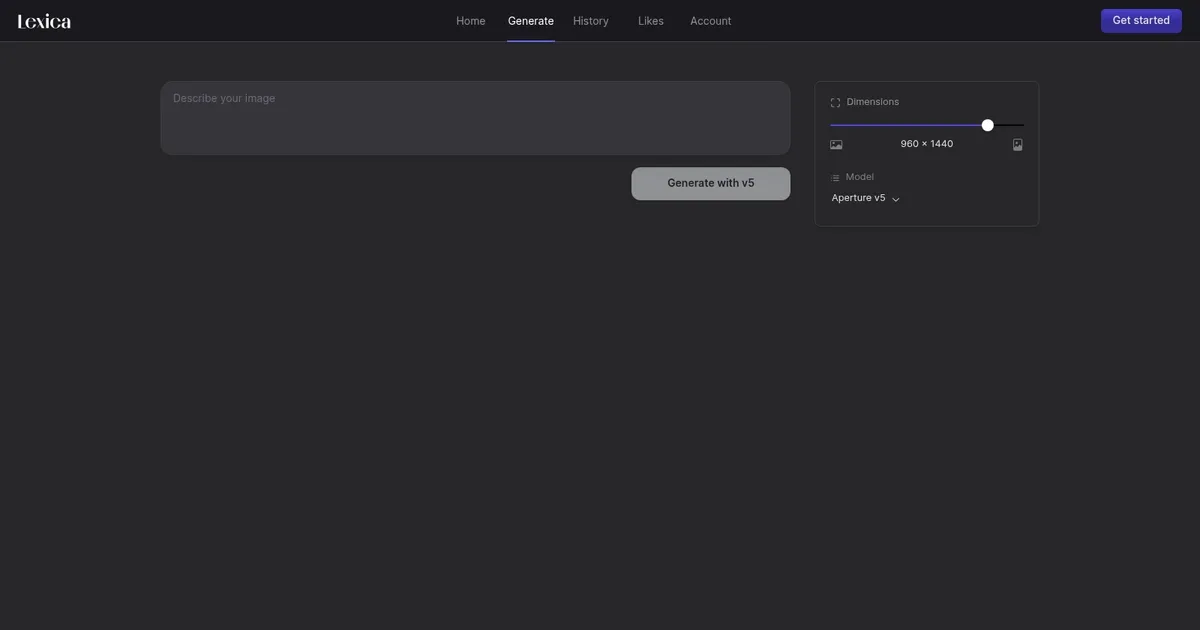
You can visit the straightforward web interface after logging in to use Lexica Aperture. After clicking “Generate,” the tool produces four results, which can be scaled up to a maximum size of 3,072 x 2,048 pixels. While the generated faces may appear realistic at first glance, closer inspection may reveal artifacts and inconsistencies that distinguish them from actual photographs.
Nevertheless, Lexica Aperture is a powerful tool for creating stunning visuals, especially when simulating shots reminiscent of older film styles.
Who is it for?
🤔
Lexica Aperture is designed for artists, graphic designers, content creators, educators, and hobbyists who are interested in leveraging AI tech for art generation. It is made to be accessible and user-friendly, making it suitable for both beginners and experienced professionals who want to quickly create high-quality, customized digital art.
FAQs
💬
What exactly is Lexica Aperture?
Lexica Aperture is an AI-powered text-to-image generator created by the team behind Lexica.art. It specializes in producing photorealistic images from natural language prompts, building on a fine-tuned Stable Diffusion model to deliver high-detail, lifelike results.
Who created Lexica Aperture?
It comes from Sharif Shameem and the Lexica.art team, the same group that built a popular search engine/database for AI-generated images and prompts.
What makes Aperture different from other AI image generators?
Aperture focuses heavily on photorealism, often described as feeling like prompting a "photorealistic 3D engine via text." It tends to produce clean, high-resolution outputs with smooth details, especially strong for realistic portraits and scenes.
What kind of images does it generate best?
It excels at photorealistic portraits, people, modern photography-style scenes, and high-detail realistic renders. Users frequently praise it for celebrity likenesses or natural-looking human faces, though it can handle other styles too.
Do I need technical skills to use it?
No, the interface is straightforward. You simply enter a text prompt, optionally add a negative prompt to avoid unwanted elements, choose basic settings like dimensions or guidance scale, and generate images right in the browser after logging in.
Is Lexica Aperture based on Stable Diffusion?
Yes, it's built as a fine-tuned version of Stable Diffusion, trained on high-resolution photos to push toward more photographic realism rather than artistic or cartoon styles.
Can I upload my own images to use with it?
Some versions and updates mention image upload support for img2img-style generation or reference, letting you start from an existing photo and guide the AI with a prompt.
What are negative prompts and why should I use them?
Negative prompts let you tell the AI what to avoid (like "blurry, deformed, extra limbs"). They're especially useful here to reduce common AI artifacts in realistic outputs, such as odd hands or facial inconsistencies.
How fast is image generation with Aperture?
It generates images quickly, often in seconds, and some updates highlight speed improvements while maintaining quality. You might choose faster or higher-quality modes depending on the version.
Is it suitable for beginners or just experts?
It's beginner-friendly thanks to the simple web interface, but experienced prompt engineers get even better results by tweaking guidance scale, negative prompts, and detailed descriptions.