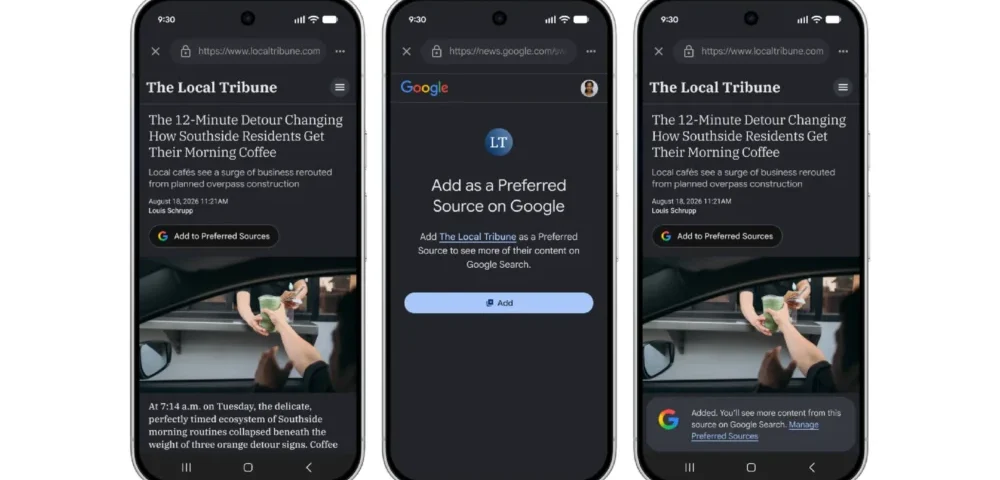
Publishers have been losing traffic to Google’s AI features for months, and Google’s answer is a button. It’s a small fix for what has become a serious structural problem, but it’s at least a signal that Google acknowledges the damage. As TechCrunch reported, Google is now letting publishers embed a “Preferred Sources” button directly on their own websites, allowing readers to mark them as a trusted source they want to see highlighted across Google Search, Discover, and Google News.
The timing matters. Google rolled out the Preferred Sources feature in May, initially inside AI Mode and AI Overviews, and it had already been available in Top Stories before that. The new piece is the embeddable button, which puts the opt-in action on the publisher’s own turf rather than burying it inside Google’s settings. Readers can also add a publisher manually by visiting Google’s source preferences page and searching by name or URL.
The business case for publishers is real, even if the scale is unclear. Google says people are twice as likely to click through to a preferred source when one is available in results. That’s a meaningful lift, especially for news sites that have watched referral traffic decline as AI Overviews answer questions directly on the search page. By May’s launch, users had already selected over 345,000 unique sources through the Preferred Sources system, which suggests at least some readers are actively engaging with it.
Still, it’s worth being clear-eyed about what this is. Google caused the traffic problem, and now it’s offering publishers a tool to partially mitigate it, one that requires readers to take an extra action. The publishers most likely to benefit are ones with strong brand recognition and loyal audiences, the outlets that probably needed the help least. Smaller, niche publishers without that kind of reader relationship may see less impact.
Alongside the Preferred Sources button, Google also announced two other personalization features. First, users will soon be able to customize their Discover feed using plain-language commands. Tap the three-dot menu on any card, describe what you want more or less of, and Google adjusts the feed in real time. Second, Android users will get the ability to customize their audio daily briefings inside the Google News app.
These additions fit into a broader pattern across the industry. Several major social platforms have been adding user-controlled algorithm tools in recent months, letting people steer their own feeds rather than relying entirely on opaque recommendation systems. Google is following that direction rather than leading it.
For developers building content or media products, the Preferred Sources API is worth watching. If Google gives it real weight in ranking signals, integrating that button early could matter. For publishers evaluating whether to add it, the friction is low and the potential upside is positive, so it makes sense to implement. But no one should treat this as a solution to the deeper problem of AI-driven search reducing the incentive to click through to external sites at all. That tension is not going away, and a loyalty button does not resolve it.