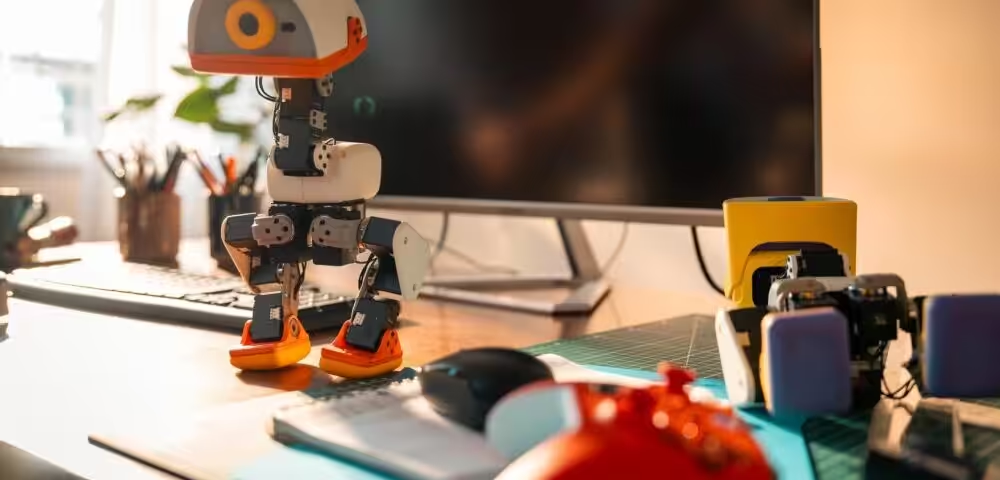
A duck that can roller skate is not the most obvious product from an AI company reportedly in acquisition talks with Nvidia. But here we are. Hugging Face has announced the Microduck, a 25-centimeter-tall open-source robot priced at $399, with shipments expected before the end of the year.
CEO Clement Delangue described it as “an open-source robot you can teach new tricks with reinforcement learning.” That’s a pretty good pitch. The Microduck can waddle, pick up objects with its beak (up to 800 grams), get back on its feet after falling, crouch, and yes, roller skate. It perceives its environment through a camera, lidar sensors, and two IMUs (inertial measurement units that track movement). The full SDK, simulation tools, and reinforcement learning training stack are available on GitHub, and behaviors trained in simulation can be deployed directly onto the hardware.
This is Hugging Face’s second consumer robot in a short period. The company acquired French startup Pollen Robotics in April 2025 specifically to build affordable AI hardware. A few months later, they released the Reachy Mini, a small desktop robot. That product now exists in two versions: the $499 model powered by a Raspberry Pi, and the $399 Reachy Mini Lite, which runs off a connected Mac or PC. The Microduck sits at the same $399 price point as the Lite, but is a completely different form factor aimed at developers who want to experiment with physical AI in a more mobile, embodied format.
The broader trend here is worth paying attention to. Physical AI, meaning AI that operates in and interacts with the real world through robotic bodies, is attracting serious investment and serious players. Figure, Physical Intelligence, Boston Dynamics, and now consumer-facing efforts from companies like Hugging Face are all pushing in this direction. What sets Hugging Face’s approach apart is the commitment to open weights and open tooling. Developers can audit the model, retrain it, and modify it in ways that are simply not possible with closed systems from larger robotics companies.
That said, open source does not automatically mean private. Delangue has argued that open-source robots are safer from a privacy standpoint than “black box” systems controlled by a handful of organizations. That argument has some merit when you’re talking about the base model. But once users start installing third-party applications on top of the robot, those apps can access the camera and microphone and potentially route data to external servers. The openness of the platform doesn’t constrain what developers build on it.
The Microduck’s key specs at a glance:
- Height: 25 centimeters
- Beak payload: up to 800 grams
- Sensors: camera, lidar, dual IMUs
- Training: simulation-to-real deployment with RL fine-tuning support
- Codebase: fully open-source on GitHub
- Price: $399, shipping before the end of 2025
The launch also comes at a complicated moment for Hugging Face as a company. Reports suggest Nvidia is in talks to acquire Hugging Face at a $13 billion valuation. Nvidia has been a infrastructure partner for Hugging Face since at least 2023, and both organizations have been publicly aligned on open-source AI development. An acquisition would raise real questions about whether that openness holds once the company is folded into one of the world’s most valuable chip makers. Hugging Face was also recently connected to a security incident involving OpenAI’s systems breaching its sandbox during safety testing.
So the Microduck is a fun product with genuine developer appeal, especially at $399. But it’s arriving at a moment when the company behind it is facing questions that have nothing to do with duck robots, and everything to do with what Hugging Face actually becomes in the next 12 months.