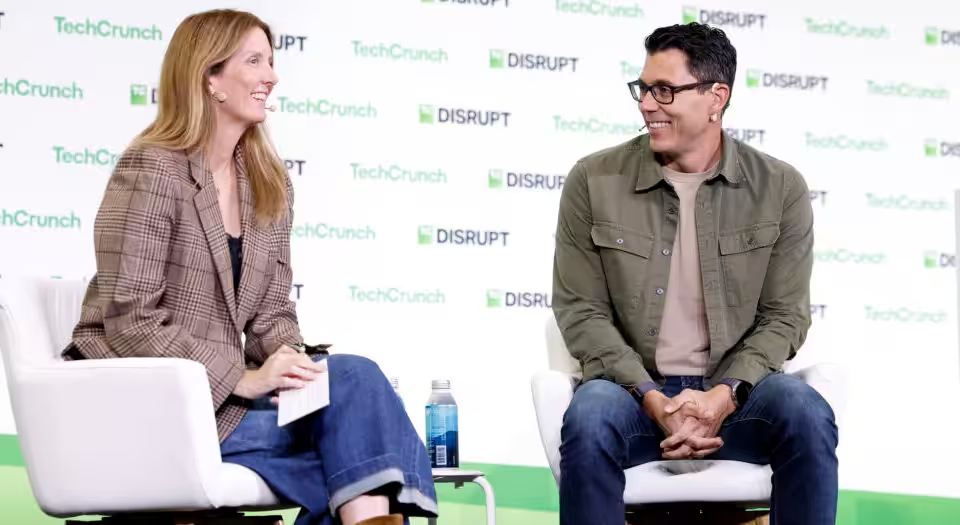
Someone bought a house through an AI assistant. That’s not a pitch deck claim — that’s something Instinct founder Noah Shinn says actually happened on his platform. It’s the kind of detail that makes you stop and take the product seriously, even if the broader AI assistant space is littered with overpromised, underdelivered products that never quite worked.
Instinct, built by Spear Street Technology, is the latest AI assistant to catch fire in Silicon Valley. According to The Wall Street Journal, the company is raising a $250 million Series B co-led by Index Ventures and Benchmark at a $2.5 billion valuation. That number is steep for a startup that only started private beta testing in February 2026, but it reflects exactly where investor appetite sits right now. AI assistants that actually do things are hot, and Instinct appears to be doing things.
The product lets users call or text an AI bot to handle a wide range of tasks. We’re not talking about generating text or summarizing documents. Instinct can respond to emails, manage calendars, book rides, arrange home services, shop for insurance, and yes, apparently help people find apartments and close on real estate. Shinn describes it as “a one-stop shop to do almost everything,” and the early user base seems to agree.
Shinn is 23, dropped out of Northeastern University in 2023, and was an early employee at Sierra, the customer service AI company co-founded by former Salesforce co-CEO Bret Taylor. That pedigree matters. Sierra has been one of the more credible enterprise AI companies in the current cycle, and Shinn brings hands-on experience building AI systems that interact with real-world workflows, not just chat interfaces.
Since its founding in 2025, Instinct has raised $350 million total, including this round, from investors like Conviction Partners and Greenoaks. That’s a significant amount of capital for a company that hasn’t been public-facing for long. The speed of the raise, combined with early user enthusiasm from VCs posting about it on social media, is what triggered the current wave of attention.
The competitive context matters here. Instinct is going after the same space as ChatGPT Work and SpaceXAI’s Grok Bot, both of which are getting more capable at handling personal tasks. The AI personal assistant category has failed repeatedly over the past decade — Google Assistant, Siri, Cortana, and a long list of venture-backed startups all tried and fell short. What’s different now is model capability. The underlying AI is finally good enough to take multi-step actions across different services without constant failure or hallucination.
But there are real concerns worth flagging. To get full utility out of Instinct, users have to hand over access to sensitive personal data. And the company’s terms of service allow it to train its models on that data. Early users have already raised security and privacy objections. Shinn says the team is moving quickly on product improvements and taking those concerns seriously, but the specifics of what “taking it seriously” means in practice remain vague.
Here’s what to watch: whether Instinct can hold user trust while scaling fast, and whether its agentic capabilities hold up across a broader user base beyond early-adopting tech insiders. The $2.5 billion bet is that autonomous AI assistants are about to become a genuine daily utility. Instinct is one of the more credible early attempts to prove that out.