Most AI agents still phone home. Every tool call, every reasoning step, every file lookup goes through a data center somewhere. Meta’s new Muse Glimmer is a direct challenge to that assumption. The company announced the model on August 10, releasing it under an Apache 2.0 license with weights available immediately on Hugging Face. At 30 billion parameters, it’s designed to fit on a single consumer GPU and run fast enough to feel like a real assistant rather than a batch job.
This matters because local inference has historically meant compromising on capability. You could run a smaller model offline, but the moment you needed reliable tool use, multi-step reasoning, or multimodal input, you were back in the cloud. Muse Glimmer is Meta’s attempt to close that gap for agentic workloads specifically, not just general chat or code completion.
What it’s built to do
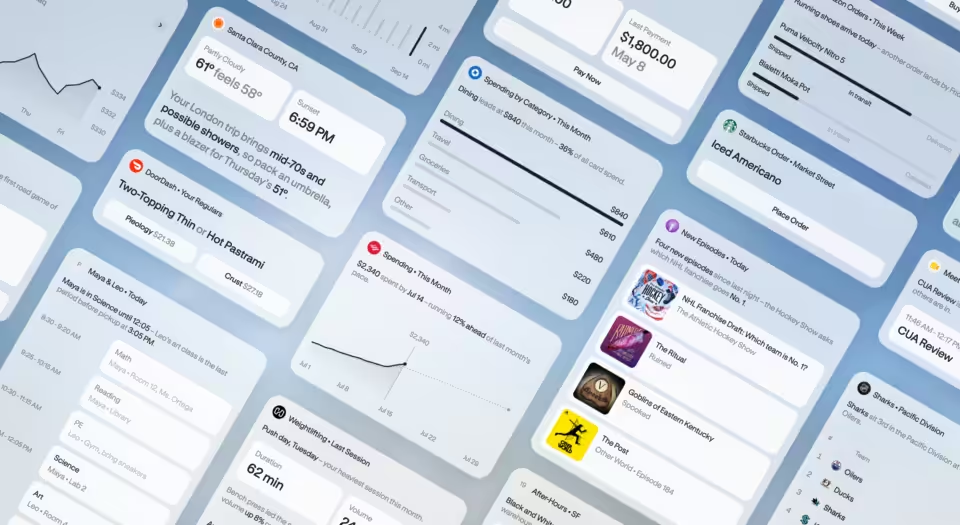
The model targets the kind of persistent, personal agent that manages your calendar, drafts messages, reads screenshots, and handles file operations. That profile requires a specific combination of skills that most small models handle inconsistently. Meta trained and evaluated Muse Glimmer across all of the following:
- End-to-end agentic task completion, benchmarked on DeepSearch QA, MCP-Atlas, tau-Bench, and SWE-Bench
- Reliable function calling with precise schemas across extended workflows
- Multi-step reasoning over long horizons without losing track of the plan
- Failure recovery, so when a tool call breaks, the model diagnoses and retries rather than stopping
- Multimodal input through a dedicated perception encoder that handles interleaved text and images
- Controllable reasoning effort, letting developers trade speed for quality depending on the task
- Support for more than 100 languages
Compared to Gemma4-31B and Qwen3-27B in its size class, Meta says Muse Glimmer performs strongly across widely used LLM benchmarks. The full evaluation report is available separately for anyone who wants to verify those claims rather than take the marketing at face value.
How Meta trained it
The training process has three stages. Pre-training used logit distillation from Muse Spark, Meta’s larger teacher model, with a similar data mix. Mid-training shifted toward longer-context, agent-heavy data with richer reasoning traces. Post-training combined supervised fine-tuning with on-policy distillation and reinforcement learning across general, reasoning, coding, and agentic domains. The distillation approach is worth noting because it’s how Meta transferred agentic reasoning capability from a much larger model into something small enough to run locally without gutting performance on the tasks that matter.
Making it actually fast enough to use
A local agent that takes 30 seconds to respond is not a useful agent. Meta addressed this with quantization to shrink the model’s memory footprint, and speculative decoding to speed up generation. The speculative decoding implementation ships with a lightweight companion model called DFlash, which proposes blocks of tokens in parallel. The main model verifies and corrects those proposals, producing identical output to standard generation but significantly faster. Meta provides quantized drafter versions to keep memory overhead low. Benchmarks were run on MacBook M4 Max, M5 Max, and an RTX 5090, with speeds described as sufficient for fluid conversation and real-time agent interaction.
Ecosystem and availability
Weights are live now. Local deployment support through Ollama, LM Studio, and Unsloth is coming in the next few days, along with optimized integrations for llama.cpp, MLX, and ExecuTorch. Cloud serving options include vLLM, SGLang, Together AI, Fireworks AI, and OpenRouter. Fine-tuning is supported via PyTorch’s TorchTitan. Hardware optimization work is ongoing with AMD, Arm, Dell, Intel, and NVIDIA.
So where does this sit in the broader picture? Models like Mistral Small, Phi-4, and Qwen3 have all pushed the capability-per-parameter ratio upward, but none of them were specifically architected around agentic workflows and local deployment the way Muse Glimmer appears to be. The Apache 2.0 license is also genuinely permissive, which removes the commercial friction that comes with some other open weight releases. For developers building personal agent products or enterprise tools that can’t send data to external APIs, this is worth a serious look.