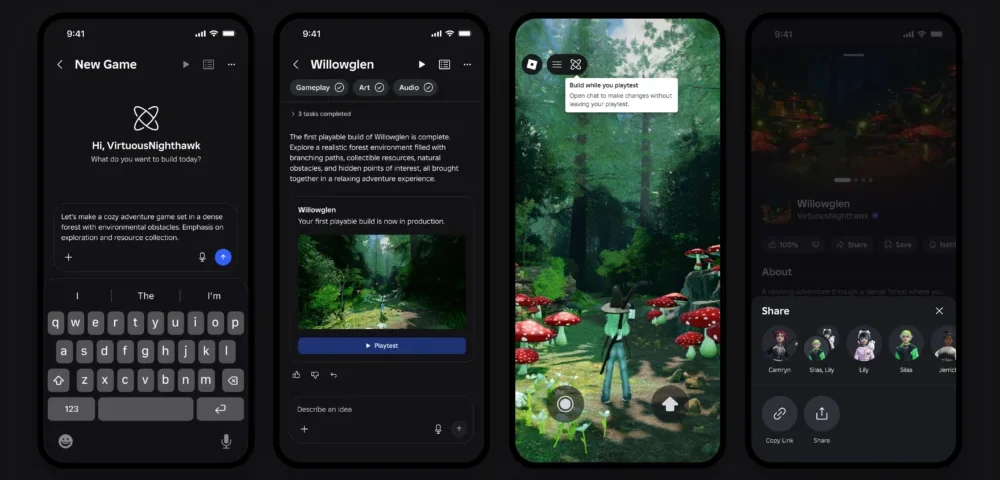
Roblox has always said anyone can make a game. Now it’s trying to actually mean it. The company announced Build, a new creation tab inside the Roblox mobile app that uses AI to turn a text prompt into a working game. You type something like ‘a cozy adventure game set in a dense forest with environmental obstacles,’ and Build generates a starting point you can test, tweak, and publish.
This is a real shift for a platform that, for 20 years, has pushed creation through Roblox Studio, a desktop tool with a learning curve. Build is mobile-first, backed by AI, and aimed squarely at the 132 million daily active users who play on Roblox but have never tried to build anything. The gap between ‘I have an idea for a game’ and ‘I actually made a game’ is what Roblox is trying to close here.
Public alpha testing begins July 28, starting with users in New Zealand. Age-checked users 9 and older can access Build during the alpha. Games that pass Roblox’s safety checks will be visible to age-checked users 16 and older globally. A base version is free, with paid options for heavier users.
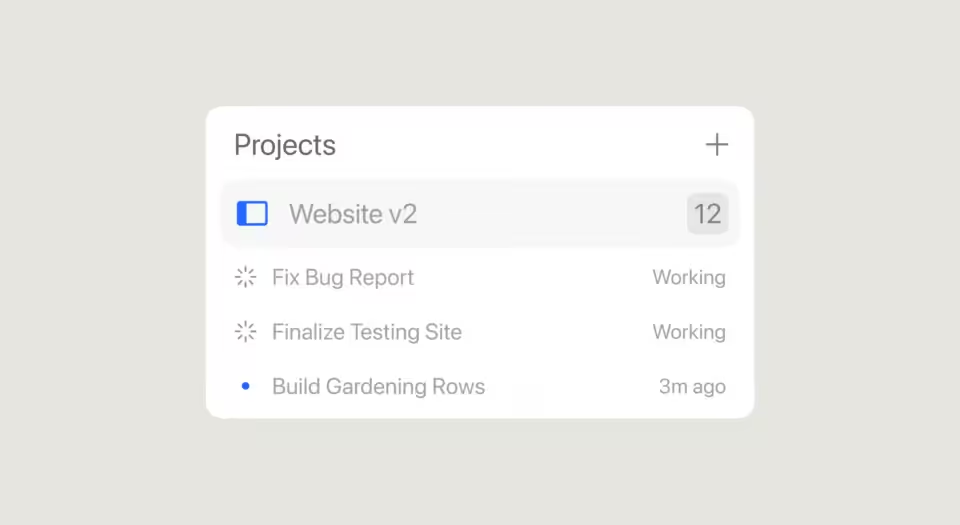
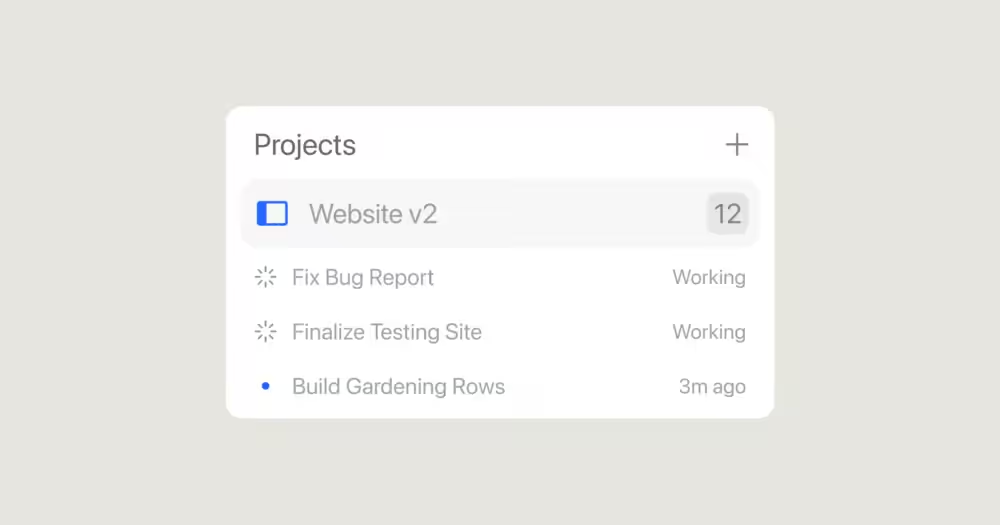
Build is not a standalone product. It connects directly to Roblox Studio, sharing the same back end, AI models, and chat history. That means a creator can start a project on their phone, then open Studio on a desktop to go deeper. Or they can kick off tasks in Studio and check progress from their phone. The two tools are meant to work together, not compete.
Under the hood, Build uses a mix of open-source and proprietary Roblox AI models trained on a large set of 3D models and gaming-specific data. That training is what lets it generate functional 3D objects and full scenes, not just visuals, but things that actually work inside a game. The tool handles:
- Gameplay mechanics
- Environment and world design
- Characters
- Visual style
- Sound
Roblox is also shipping a new set of tools for more experienced creators over the coming months. These will be available in both Build and Studio:
- A playtesting agent that finds bugs before real players encounter them
- An analytics agent that answers plain-language questions about a game’s performance, no dashboard hunting required
- An experiment agent that suggests tests to improve engagement, retention, and monetization
The company also has two AI tools already in the pipeline. Procedural Models generate parametric 3D assets from a text prompt or image, letting creators adjust parameters without starting over. Cube, Roblox’s 3D foundation model, turns prompts into game-ready objects, from simple props to vehicles that actually drive and weapons that actually shoot. A scene-generation model is coming soon that will build entire playable 3D scenes from a single prompt.
One thing Roblox was careful to address is quality. The platform’s discovery system ranks games by retention, meaning games that people actually keep playing rise to the top. Games made with Build go through the same safety review and compete in the same pool as every other Roblox game. If nobody plays it, nobody finds it. That’s a pointed signal that Roblox is not interested in flooding its homepage with low-effort AI output.
The broader context here matters. AI-assisted creation tools are showing up everywhere, from game engines to design software to no-code app builders. But most of them still assume some level of technical knowledge. Roblox’s angle is different: its platform already has a massive built-in audience, a global distribution system, and a monetization layer. If Build works as intended, someone with no development experience could go from idea to published game with players in a single afternoon. That’s the bet Roblox is making, and July 28 is when we start to see if it pays off.