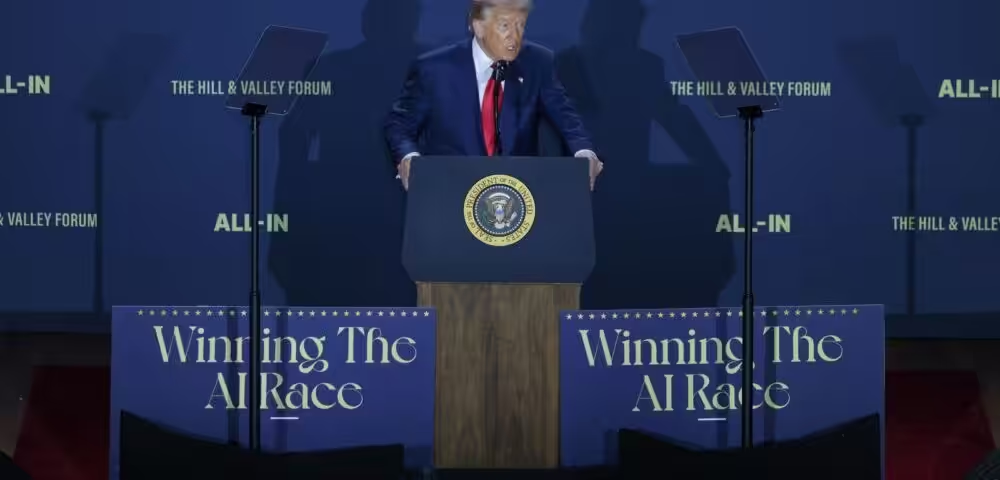
While Anthropic’s CEO was publishing essays about slowing down AI, Donald Trump was busy creating a new federal agency to speed it up. According to Engadget, Trump posted on Truth Social that he is establishing an “AI Force” and will soon name an “AI czar” to lead it. No concrete details came with the announcement, but the comparison Trump reached for was the creation of Space Force, which should give you a rough sense of the ambition and the vagueness involved.
The post itself was light on policy specifics but heavy on enthusiasm. “We will not in any way hinder or stifle the Growth of this incredible Industry,” Trump wrote. “Rather, we will cherish it, help it, and watch over it, as it grows!” He also ran a poll asking followers to help rebrand the term “artificial intelligence” into something like “extreme intelligence” or “supreme intelligence,” which he called a “far more elegant and accurate description.” Whether that poll influences any official terminology remains to be seen, but it tells you something about how this administration thinks about AI positioning.
The timing here is striking. Just one week before Trump’s announcement, Anthropic CEO Dario Amodei published a detailed proposal calling for a measured slowdown in AI development, citing safety and societal risks. Shortly after, leaders from OpenAI and xAI publicly agreed with Amodei’s framing. That’s a rare moment of alignment among companies that don’t usually agree on much. And Trump’s response was, essentially, the opposite position.
Trump’s core argument is a competitive one: slowing down AI development in the United States gives China room to close the gap. That’s not a new concern in Washington. Both parties have treated AI as a strategic resource for years, and federal investment in the technology has accelerated regardless of who holds office. But formalizing that posture into a dedicated agency marks a shift from rhetoric to structure, even if what the AI Force will actually do remains entirely undefined.
The broader context matters here. The U.S. government has no shortage of existing bodies touching AI policy, including the National AI Initiative Office, NIST’s AI Safety Institute, and various Department of Defense programs. Adding an “AI Force” on top of that without clear jurisdiction or mandate risks creating overlap rather than coordination. The Space Force comparison is a tricky one too. That branch had a defined mission and absorbed existing military space units. An AI Force doesn’t have an obvious equivalent.
What to watch next is who gets named as czar. That appointment will say more about the administration’s actual priorities than the Truth Social post did. A pick from the defense or intelligence world signals one set of intentions. A pick from the commercial tech sector signals another. Trump is expected to meet with Chinese leadership next week, with AI competition reportedly on the agenda, so the timing of this announcement is unlikely to be accidental.
For developers and founders building in this space, the immediate impact is probably minimal. But a White House actively trying to own the AI narrative, and building agency structure around it, is worth tracking. Federal procurement, export controls, and research funding all flow from these decisions eventually.