Most AI tools ask you to stop what you’re doing, open another app, and then come back. Acti thinks that’s the wrong approach. The Singapore-based startup has built a keyboard for iOS and Android that can take actions inside whatever app you’re already using, without making you switch tabs or open a chatbot.
The company launched on Tuesday, alongside news that it has closed a $5.3 million seed round led by BITKRAFT Ventures. The funding signals real investor appetite for a different theory of how people will use AI going forward, not through dedicated AI apps, but through the tools already built into their daily routines.
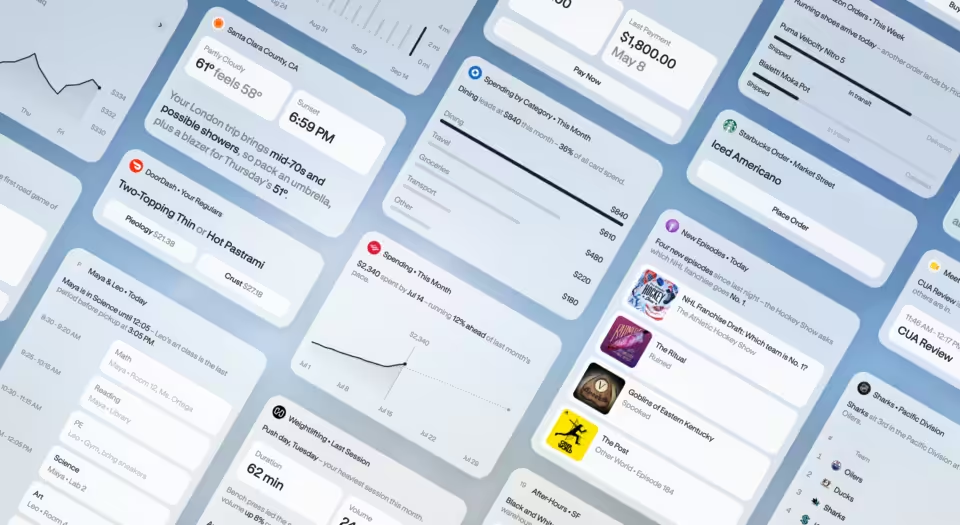
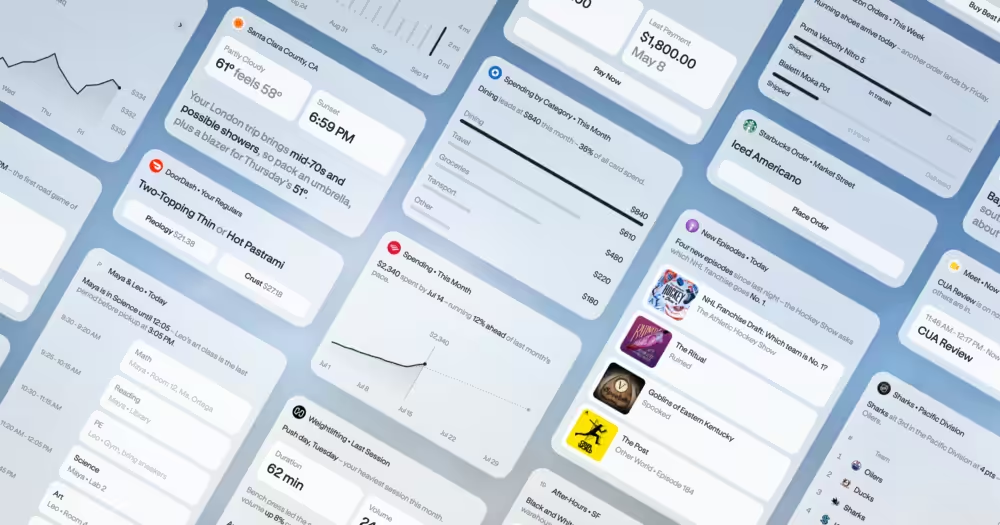
Acti’s name is short for “action,” and that framing tells you a lot about its ambition. This isn’t autocomplete. The keyboard can pull in live data, translate messages, share meeting links, and carry out multi-step tasks, all without leaving the app where the conversation is happening.
The core problem Acti is trying to fix is context-switching. Right now, if a friend asks for a restaurant recommendation mid-chat, you have to leave the messaging app, search somewhere else, copy the result, and come back. If someone mentions a stock, same problem. Acti wants to collapse that loop entirely. Its founder and CEO Young Wang put it plainly: “Today’s AI agents are fundamentally limited because user context stays fragmented across separate apps.” By sitting across all of them, he argues, Acti can build a context layer that belongs to the user rather than any single platform.
The timing matters. The keyboard is one of the most used pieces of software on any phone, yet it has barely changed in a decade. A handful of companies have tried to make keyboards smarter, but none have treated it as a serious platform for AI. Wang spent ten years at Baidu growing its Facemoji Keyboard to over 300 million daily active users, so he knows the scale this category can reach. When large language models arrived, he said he saw a chance to rebuild something foundational.
Under the hood, Acti runs on Google’s Gemini models, chosen for their speed, multilingual support, and cost efficiency. The standout feature is called Skills. These are custom shortcuts tied to a single key on the keyboard. Long-press the letter “T” and it translates your message. Press “C” and it fires off a meeting link. Users don’t need to write any code to create a Skill. They just describe what they want in plain language, and Acti builds it. In less than two weeks of early access testing, users had already created over 1,000 Skills.
Skills can be kept private or shared to a public Skills Hub, where anyone can browse and use what others have built. Early examples include Skills for pulling real-time World Cup scores and Polymarket prediction links. Acti sees this marketplace as a potential revenue stream down the line, alongside a subscription model that will offer more advanced AI features and higher daily usage limits.
Privacy is a real concern for any keyboard app, and Acti addresses it with a local-first design. Personal context stays on the device by default. The company says it does not access or store private messages or conversations unless a user explicitly triggers a feature that needs external processing. That’s an important distinction, because keyboards sit at a sensitive intersection between private communication and AI processing.
The team behind Acti has relevant experience beyond Wang. CTO Mike Sun was the founding technical lead for Yike Album, Baidu’s cloud photo platform, which grew to over 10 million daily active users. CSO Junbo Yang came from HashKey Capital, where he led consumer investments.
BITKRAFT Ventures partner Jonathan Huang said the firm backed Acti because the team “has a real shot at owning the next phase of human-computer interaction.” That’s a big claim, but the underlying logic is sound. If AI is going to become part of everyday life, it probably needs to meet people where they already are. And for most smartphone users, that place is the keyboard.