Most AI companies talk about transforming drug discovery. Anthropic is now pipetting. According to Reuters, the company behind Claude has quietly set up a physical biology lab in the San Francisco Bay Area, moving well beyond the computer-based evaluations that define most AI-in-biotech work today. This is not a simulation. It’s a wet lab, with real experiments, real samples, and real stakes.
Eric Kauderer-Abrams, Anthropic’s head of life sciences, confirmed the lab’s existence in a Reuters interview, framing it as a natural extension of serious biology work. “We believe that to do biology, the final test is still and will be for a while in real lab work,” he said. A company spokesperson later clarified the lab is not specifically for drug discovery, without elaborating further. That’s a careful distinction, but the broader intent is clear: Anthropic wants to run drug programs, and it’s building the physical infrastructure to do it.
The company’s life sciences strategy has been taking shape for months. It launched Claude Science software, acquired biotech startup Coefficient Bio for roughly $400 million in stock, and added Novartis CEO Vas Narasimhan to its board. It’s also hiring aggressively, posting roles for experts in protein and nucleic acid characterization and a procurement leader to scale up lab operations. One job listing stated the goal plainly: “to speed up progress in the life sciences by an order of magnitude.”
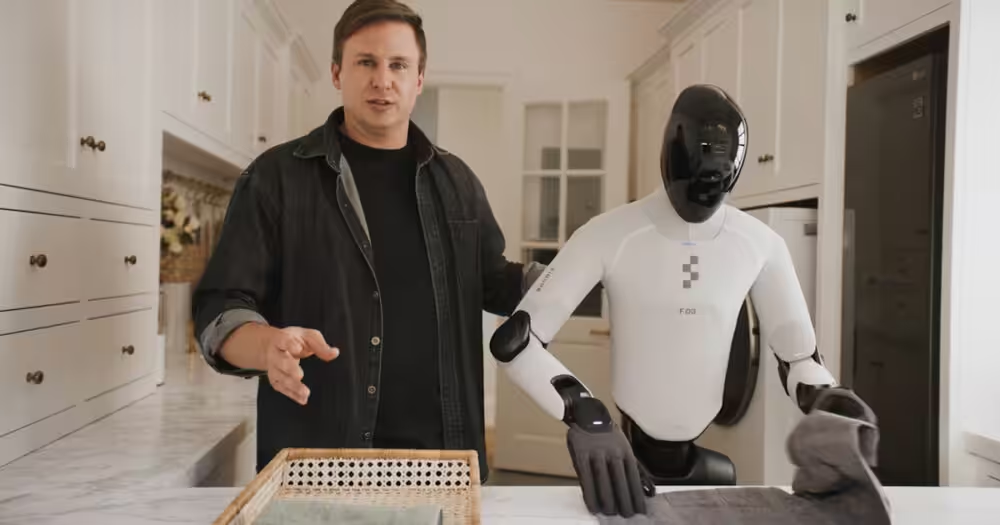
What makes the wet lab notable is the automation angle. Anthropic wants Claude to direct robotic lab units to carry out experiments with limited human intervention. In August, it released the Model Hardware Standard, a framework for AI systems to operate physical lab equipment. The vision is a largely automated research pipeline, where AI designs experiments, robots execute them, and Claude interprets the results. Human oversight remains part of the plan, the company says, but the direction is clear.
Kauderer-Abrams said Anthropic is focused on conditions that are “undruggable” by conventional methods, including complex molecules like bispecific and trispecific antibodies that target multiple points on a protein or cell. Traditional pharma avoids this territory partly because the economics are hard. Anthropic is betting AI can change that math. The company is working with major pharmaceutical partners including Genentech, Bristol Myers Squibb, and Novo Nordisk, though it has drawn a deliberate line at clinical trials for now, to avoid competing directly with the companies it also serves.
That tension is real. Pharma customers using Anthropic’s tools will reasonably wonder whether their proprietary research is being absorbed into Anthropic’s own drug programs, even with data walls in place. Kauderer-Abrams acknowledged the issue directly, saying the decision to stay out of clinical trials is partly a response to those competitive concerns.
For context, Alphabet’s Isomorphic Labs has been trying to get a drug to clinic for years and recently delayed that goal to late 2026. Anthropic is earlier in the process, but it’s moving with more resources and a more aggressive automation thesis than most pure-play biotech AI companies like Recursion or Exscientia.
All of this is happening as Anthropic’s own researchers have warned about AI extinction risks, the company found its models could theoretically assist in bioweapons development, and CEO Dario Amodei has publicly called for a slowdown in AI development. And yet Anthropic is also preparing for what could be a $2 trillion IPO. The contradiction is obvious. But Kauderer-Abrams put it directly: life sciences is the biggest opportunity Anthropic sees to justify the technology it’s building. A wet lab in the Bay Area is, in that framing, not a side project. It’s the point.