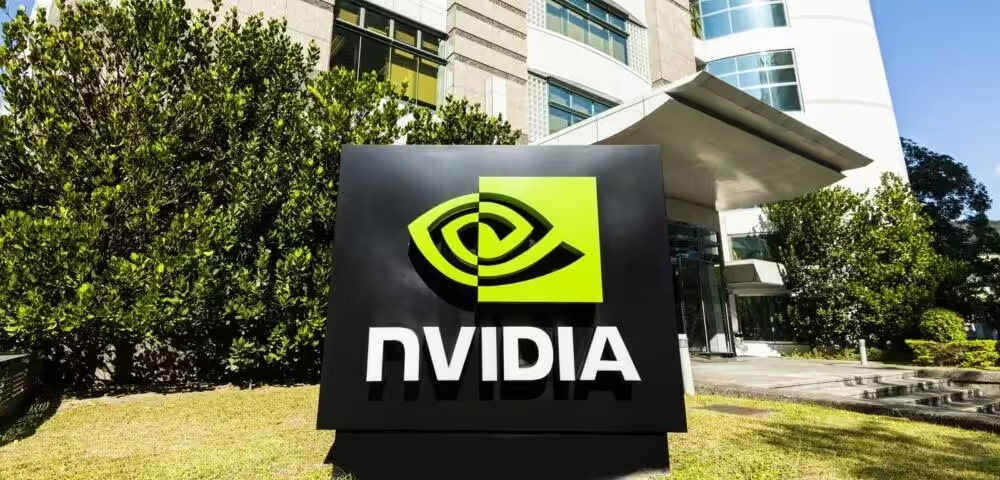
China is allowing two of its biggest tech companies to receive Nvidia H200 chips, but the fine print tells a more complicated story. According to Engadget, ByteDance and Tencent have each received 10,000 H200 processors over the past few weeks, with the Financial Times reporting that Beijing approved the imports to help local companies train competitive frontier AI models.
That 10,000-chip figure sounds significant, but it is a fraction of what both companies are authorized to buy. Each firm has approval to purchase up to 100,000 H200s. The catch is that Chinese authorities reportedly want the bulk of those chips kept off the mainland, directing companies to route shipments to Hong Kong instead, even though neither ByteDance nor Tencent currently operates data centers there. That is a strange condition, and it points directly to Beijing’s push to grow its domestic chip industry rather than deepen dependence on Nvidia hardware.
The backstory here matters. The US banned H200 exports to China citing military technology concerns, then walked that back in December 2025, allowing sales to approved Chinese customers. By that point, the H200 was already two years old. Reuters reported in January 2026 that China agreed to import several hundred thousand H200 chips, and by May, ten Chinese firms including ByteDance and Tencent had received explicit purchase approvals from Washington. So this latest development is less a policy shift and more the physical arrival of chips that were already authorized months ago.
Still, the timing is relevant. Both ByteDance and Tencent are actively building out AI models and agents. ByteDance is pushing hard on its Doubao AI products, while Tencent has been integrating AI across Weixin and its cloud services. Better hardware access closes some of the compute gap with American labs running on the latest Nvidia Blackwell GPUs, though the H200 is a generation behind the B200 and B300 chips that US companies are now deploying at scale.
China’s domestic chip sector is also worth watching here. Companies like Huawei, with its Ascend series, and startups such as Cambricon are racing to build chips that reduce reliance on Nvidia entirely. Beijing’s insistence that most imported H200s stay out of mainland data centers reads as a policy signal: use foreign chips as a bridge, not a foundation. For developers and AI teams at Chinese firms, this means working across a fragmented hardware stack for the foreseeable future, balancing Nvidia performance against pressure to adopt local alternatives.
For Western observers, the key question is whether this chip flow materially accelerates Chinese AI development. Probably yes, at the margin. But compute is only one variable. Data, talent, and model architecture still drive outcomes, and on those fronts the competition remains wide open.