950 AI agents. 210 million tokens. 21 hours. And at the end of it, one agent spotted something that human researchers had missed: a repeating DNA pattern sitting next to a strange-looking enzyme, buried in a massive sequence database. That finding is now the basis for what Anthropic is calling array-associated reverse transcriptases, or ART, a previously uncharacterized enzyme system with structural similarities to CRISPR.
Anthropic announced the results alongside the formation of a new internal life sciences research group and wet lab, based in the Bay Area. The team is made up of computational biologists who have worked on CRISPR systems, gene therapy enzymes, and pathogenic variant detection. This is not a partnership or an academic spin-out. Anthropic built the lab itself.
What Claude actually did
The setup was deliberately constrained. Scientists gave Claude a high-level prompt: search a large database of DNA sequences for interesting new examples of reverse transcriptases, enzymes that convert RNA into DNA. From there, Claude agents handled the rest. They combed through over 200,000 reverse transcriptase sequences, identified 3,500 candidate systems, narrowed those to 20 compelling leads, and wrote human-readable reports on each one.
One candidate stood out. An agent flagged a reverse transcriptase found in a jumbo phage, a virus that infects bacteria, with an associated array of non-coding DNA sequences and an additional accessory protein of unknown function. The RT itself had been identified before. But the full system, including those flanking repeat sequences, had not been characterized. That pattern is what makes it resemble CRISPR, which was itself first noticed as an unusual repeat in bacterial DNA before anyone understood what it did.
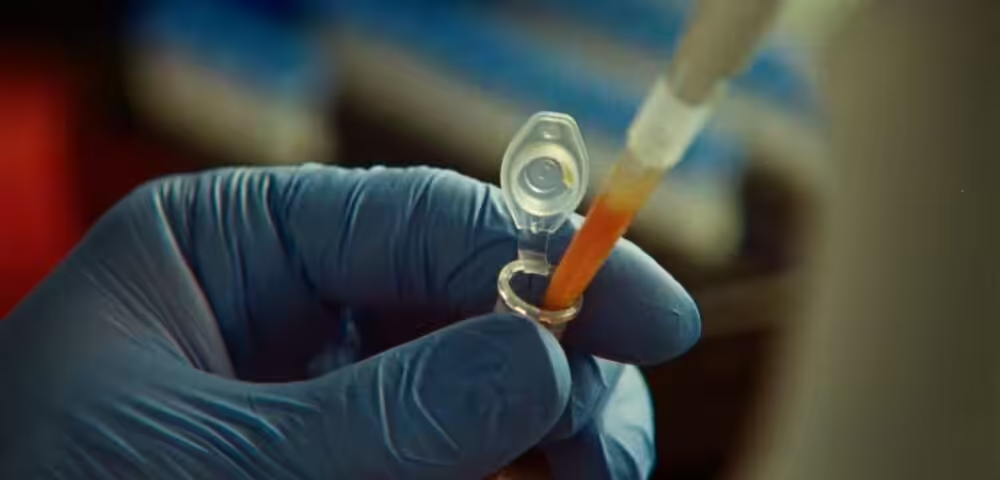
Anthropic’s lab then verified the finding with physical experiments, expressing the proteins and characterizing them biochemically. The pre-print is now public.
Why this matters beyond the headline
CRISPR went from a genomic curiosity to a clinical tool. Taq polymerase, discovered in a Yellowstone hot spring bacterium, became the backbone of PCR. Restriction enzymes, found in bacterial immune systems, launched the entire biotech industry. The pattern here is consistent: weird things in microbial genomes turn out to be useful. ART may or may not follow that path. Anthropic is clear that the function of this system is still unknown. But the structural features it shares with other programmable DNA-editing systems, things that cut, copy, and paste genetic material, make it worth watching.
Feng Zhang, one of the scientists who pioneered CRISPR gene editing at MIT and the Broad Institute, reviewed the pre-print and called the identification of RNA-repeat arrays associated with reverse transcriptases “genuinely intriguing.”
How this compares to other AI biology efforts
This is not the same category of work as AlphaFold, which predicts protein structure from sequence. It is also different from what companies like Recursion or Insilico Medicine do, which is largely using AI to accelerate drug screening pipelines. What Anthropic is doing here is closer to autonomous hypothesis generation and genomic mining, letting a general-purpose model run scientific reasoning at scale across biological data.
The closest analogs might be tools like EVEscape or the genomic mining workflows coming out of academic labs like the Zhang lab or the Bhatt lab at Stanford. But those are typically purpose-built systems for narrow tasks. Anthropic is using Claude, the same model available to any developer or researcher, inside Claude Code and Claude Science, sometimes with a custom parallel-session harness.
That’s a meaningful distinction. It suggests the workflow is reproducible by outside researchers, not locked inside a proprietary pipeline.
What to watch for next
Anthropic says understanding ART’s primary function is ongoing work. But a few things are already clear from this announcement:
- The life sciences group is part of a broader Anthropic biology organization that also includes drug discovery and biology-specific model training
- The lab operates at BSL-1 and BSL-2 safety levels and does not work with human pathogens
- All physical lab work is done by human scientists, not robots or AI-controlled hardware
- The team is studying which AI-generated hypotheses are worth testing, and feeding that judgment back into Claude’s instructions
That last point is the most interesting long-term signal. If Anthropic can systematically teach Claude to mimic expert scientific taste, the bottleneck in this kind of research shifts from compute to wet-lab throughput. That’s a different constraint, and a much harder one to scale.