Anthropic has quietly had a voice mode in Claude for over a year, but most people probably had no idea it existed. And those who did try it often found it underwhelming. The main reason was simple: voice queries were routed through Haiku, Anthropic’s smallest and fastest model, to keep response times low. That worked fine for basic questions, but anything more complex tended to fall short. Now Anthropic is fixing that.
As reported by Engadget, the company is rolling out a significant update to Claude’s voice mode that brings in more capable models and connects the feature to third-party apps for the first time. It’s a meaningful step forward, though the update also makes some of the feature’s current limits clearer than ever.
The update is launching in beta and is available to users across Claude’s desktop and mobile apps, as well as its web client. Free account holders can still access voice mode, but they’re limited to one connected app and all queries still run through Haiku.
Here’s what’s actually changing for paid users:
- Voice mode can now use Claude’s Sonnet and Opus models, not just Haiku
- It defaults to whichever model you last used for text chat
- You can switch between Haiku, Sonnet, and Opus mid-conversation using the model picker
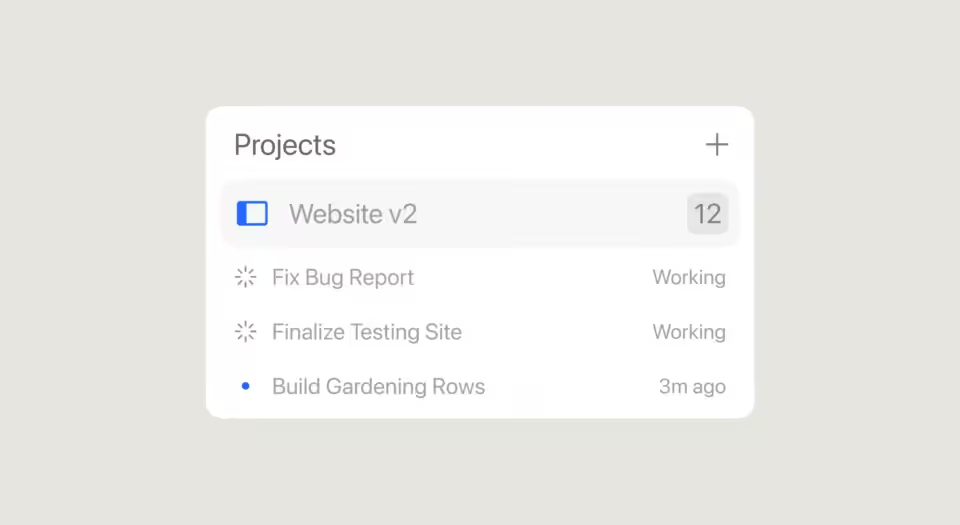
- Voice mode can pull context from connected apps like Gmail and Slack, with your permission
- Support has been added for more languages, including Indonesian
The app integration piece is worth paying attention to. Being able to ask Claude a voice question and have it pull in relevant emails or messages is a genuinely useful addition, not just a checkbox feature. It puts Claude’s voice mode closer to what people actually want from an AI assistant: something that knows your context, not just the words you’re saying.
That said, there are real limitations here that are worth being honest about. Anthropic confirmed to Engadget that voice mode uses a turn-based architecture. Claude listens, pauses to think, then responds. It’s not fully duplex. OpenAI’s GPT-Live system, by contrast, can process speech and generate output at the same time, which makes conversations feel more fluid and natural. Claude’s approach will feel more like a phone call with a slight delay than a real back-and-forth conversation.
There’s also a language-switching issue. If you decide to switch languages mid-conversation, Claude won’t pick up on that automatically. You have to either say out loud that you’re about to switch or manually select the language in the settings menu. For multilingual users, that’s a friction point that could get old fast.
Anthropic was direct about where its priorities are right now. “This release is focused on intelligence and tool access,” the company told Engadget, adding that more voice updates are coming later this year. That suggests the current release is more of a foundation than a finished product, with things like language detection and potentially a more conversational architecture still on the roadmap.
The broader context here matters. Voice is becoming a serious competitive front in AI. OpenAI has been pushing hard on GPT-Live, Google has its own voice capabilities in Gemini, and consumer expectations are rising fast. Anthropic has a reputation for building careful, high-quality AI, but voice is an area where it has visibly lagged. This update narrows that gap, even if it doesn’t close it. Whether Claude’s voice mode becomes something people actually use daily will depend on how quickly Anthropic can iron out the remaining rough edges.