Most AI startups are racing to put intelligence in the cloud. Ghost is going the other direction. The company, founded by 19-year-old Zain Javaid, has announced an $11 million seed round led by Andreessen Horowitz, along with its first product: Core, a dedicated personal computer built specifically to run AI agents locally, without sending your data to any cloud provider.
Core is a screenless box priced at $3,499. It ships with an Nvidia RTX Pro 4000 SFF Blackwell GPU already included in that price, which matters because buying that GPU separately would be a significant cost on its own. Three models come preinstalled out of the box: Qwen-3.8-Next, Qwen-3.8-27B, and Gemma-4-31B. Users can also load additional models from Hugging Face or bring their own fine-tuned versions. The device has its own software layer, browser, and filing system, and it runs AI agents continuously in the background without needing constant prompts. Preorders open this week, with shipping scheduled for the last week of October.
The pitch is straightforward: one piece of hardware that centralizes your data across your desktop, apps, and smart home devices, and runs AI agents that act on your behalf. Javaid described it as a “brain in a box.” You interact with it through a phone app or voice mode via the Core app. The models and your personal memory run locally. All data is encrypted, and Ghost says no third party, including Ghost itself, can access it in any meaningful way. If the company shuts down, the device is designed to keep working. All source code, model weights, and logic live on the hardware.
The obvious comparison is Apple’s Mac Mini, which plenty of developers already use as a low-footprint machine to self-host AI tools. Javaid’s answer to that comparison is fair: the Mac Mini is a general-purpose computer that you configure yourself, while Core ships pre-configured with models installed and software built around agent workflows from the start. That’s a real distinction, even if some technical users will reasonably prefer the flexibility of building their own setup.
What Ghost is really selling is a combination of things that don’t typically come together:
- Local model execution with no ongoing cloud fees
- A custom software layer built for agent tasks, not general computing
- Over-the-air model updates, similar to how Tesla pushes firmware
- A network firewall that monitors outgoing requests and blocks unauthorized agent actions
- Full user control over how much autonomy the agents are granted
That last point is worth paying attention to. Agentic AI is becoming a real category, and one of the consistent concerns from developers and security researchers is that agents with access to credentials and personal data are a serious attack surface. Ghost’s firewall approach, which flags any outgoing request the agent shouldn’t be making, is a practical response to that concern. It’s not a complete solution, but it’s more thought-out than most consumer AI products at this stage.
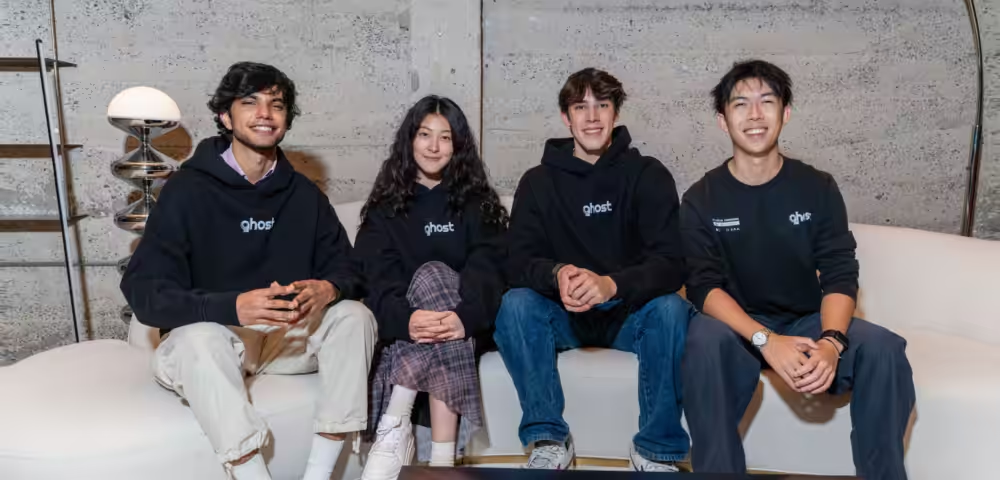
The funding round also includes Abstract, Audacious Ventures, SV Angel, and Nova. The founding team is young. Javaid is 19, as is co-founder Nicholas Chua. Yifei Chen is 24 and Gautam Sharda is 23. They’re building units at a San Francisco facility for now.
The broader context here is that local AI hardware is having a moment. Apple’s silicon push made on-device inference viable for consumers. Startups like Frame and Rabbit have explored personal AI hardware from different angles, with mixed results. What Ghost is attempting is more ambitious: not a wearable or an assistant gadget, but a full local compute node designed to know your life and act on it. Whether people will pay $3,499 for that is the real question. But the privacy angle alone may be enough to attract a serious first audience.