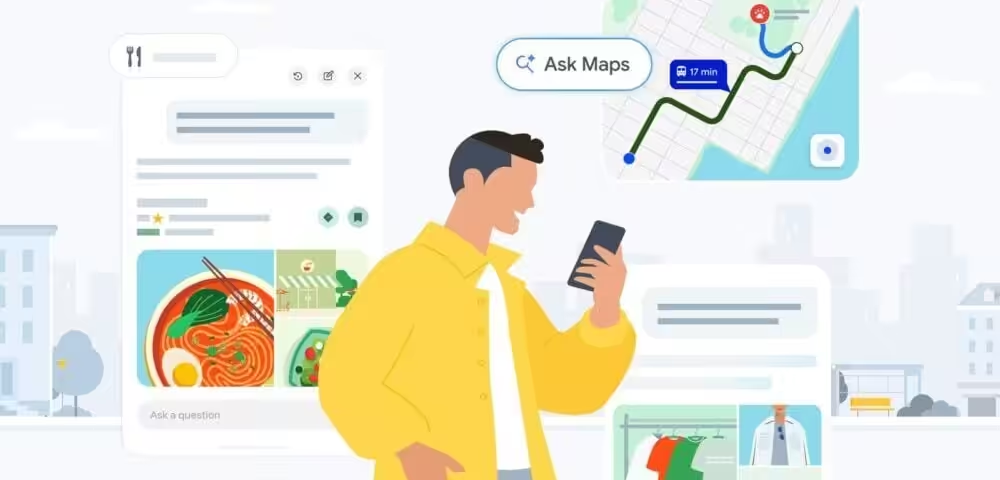
Google Maps has quietly been building something more ambitious than a search upgrade. When Google launched Ask Maps back in March, it looked like a conversational layer on top of traditional map data. Useful, sure, but nothing that would rattle competitors. What Google just announced is a different story.
The core addition is agentic functionality. Ask Maps can now take actions on your behalf, not just return information. The most immediate example is food ordering. You describe what you want, the chatbot surfaces recommendations, and you can kick off an order without leaving Maps. Google is partnering with Toast, Square, and Uber Eats for this. Toast and Square are live at launch, with Uber Eats to follow. The integration is built around the Universal Commerce Protocol, the agentic commerce framework Google introduced at I/O 2026, which hints at how far Google intends to push this.
Hotel booking works the same way. You tell Ask Maps your budget, preferred room type, and what you want nearby, and it checks availability and compares prices in real time. You still click through to a partner site to complete the booking, so Google isn’t taking over the transaction entirely. But it’s doing most of the legwork. The same pipeline also covers live events, so asking about concerts or comedy shows in your city pulls actionable results rather than a list of links.
Then there’s Personal Intelligence, which is the part that’s going to draw the most attention, and probably the most scrutiny. Ask Maps can now connect to your Gmail account to personalize responses. The example Google showed: you ask for restaurant recommendations near your hotel, and the chatbot checks your Gmail to confirm where you’re actually staying. Calendar integration is coming next. Google is being deliberate about framing the privacy angle here. The feature is off by default, and users have to actively turn it on. Still, connecting a mapping and commerce tool directly to your email inbox is a significant step, and users will reasonably want to understand exactly what’s being read and when.
Two smaller additions are worth noting. Ask Maps will now generate live transit widgets inside the chat interface, showing real-time wait times and delays for public transit routes. And Local Guides can now submit edits through the chatbot, including uploading a photo of a storefront sign to flag changed business hours. Google reviews these submissions the same way it handles manual edits.
The availability rollout is broad. Ask Maps is expanding to Australia, Brazil, Canada, Indonesia, Japan, Mexico, and 150 additional countries and territories. Personal Intelligence and live transit widgets are going global wherever Ask Maps is available. Food ordering, hotel booking, and event discovery are US-first for now, with more markets to follow.
The competitive context matters here. Apple Intelligence has been building toward deeper app integration. ChatGPT’s operator capabilities let it complete tasks across the web. And Perplexity has been quietly adding commerce features to its search product. Google is making a clear argument that Maps, with its existing location graph and user base, is a better starting point for agentic commerce than a general-purpose chatbot. Whether that holds depends on how well the food ordering and booking integrations actually work at scale, and how users respond to a mapping app that reads their email. But the direction is clear. Ask Maps is no longer just a map that talks back.