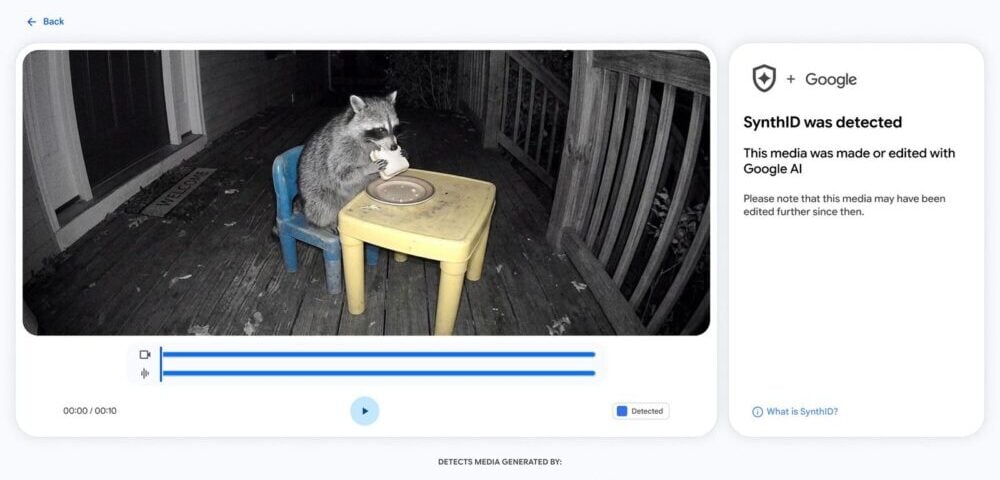
Apple Intelligence support in an AI detection tool built by Google. That’s a notable sentence to write in 2026, and it tells you something about where the industry is heading. Google has opened SynthID Detector to the public, making its web-based tool for identifying AI-created content free for anyone with a Google, OpenAI, or Apple account. The site, at synthid.com, can scan images, video, and audio for SynthID watermarks placed by tools from Google, OpenAI, NVIDIA, and Kakao. Apple Intelligence support, including Image Playground content, is listed as coming soon.
This matters because AI detection has been a fragmented, largely inaccessible space. Google had been running earlier versions of SynthID Detector for journalists and media professionals for over a year. Expanding access to the general public puts a real, cross-platform detection tool in front of ordinary users for the first time. That’s a meaningful shift. Most people encountering synthetic media online have had no practical way to verify it.
Still, the limitations are real and worth being direct about. SynthID Detector only works when content carries a SynthID watermark to begin with. Watermarks can be stripped. And the tool doesn’t tell you whether something was fully generated by AI or just touched up with it. You get a flag, not a breakdown. So anyone hoping for forensic-level detail will be disappointed.
The broader problem is that there is no universal watermarking standard. The industry runs on a patchwork. C2PA content credentials are one approach. SynthID is another. Meta has its own web tool for identifying images from its Muse Image models, but it doesn’t cover content from other companies or even older Meta models. Each detection tool is essentially a closed loop tied to the watermarking choices of specific companies.
Google is clearly trying to expand that loop. The company has confirmed ElevenLabs is adding SynthID watermark support, and its website states it is actively working to bring more partners on board. Google also already integrates SynthID detection into Circle to Search and the Gemini app, so this dedicated site is less a new capability and more a cleaner front door to existing ones.
For developers building content moderation pipelines, or founders working in media verification, SynthID Detector is worth adding to your toolkit. But it should sit alongside other signals, not replace them. The AI content problem is growing faster than any single detection standard can cover, and a free website from Google, however useful, doesn’t change that math.