Google Search is no longer just a place to find links. With five new updates rolling out across Search, AI Mode, and Google Lens, Google is pushing its flagship product closer to what NotebookLM already does — and that’s a strategic move worth paying attention to. As Chrome Unboxed reported, the company is bringing Gemini-powered research tools, interactive 3D models, and a persistent notebook feature directly into the Search experience.
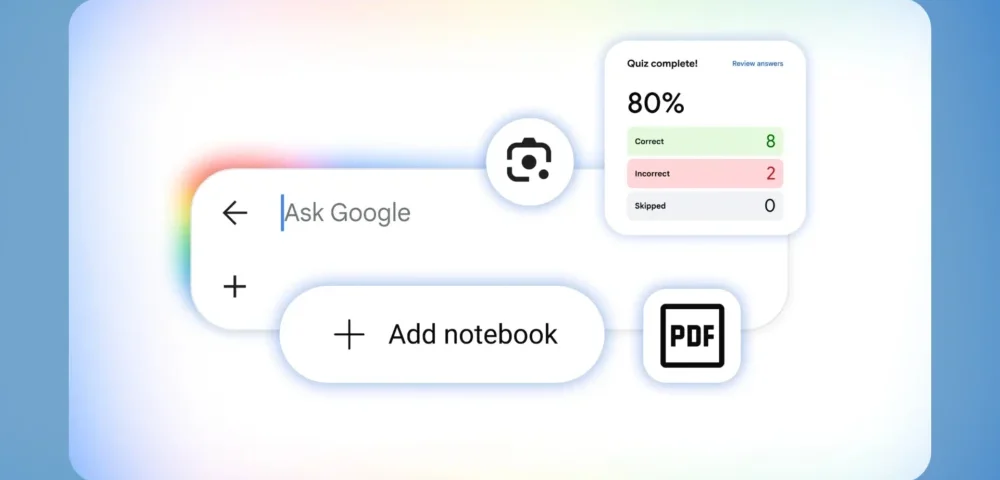
The most interesting addition is the notebook feature inside AI Mode. Users will be able to save sources, highlight key points, and build a working research document without ever leaving Search. That’s a direct overlap with NotebookLM’s core appeal, and it signals that Google wants Search to own the full research workflow, not just the discovery part. For students, journalists, and anyone doing serious topic research, this is a meaningful shift in how the product actually works.
On the visual side, Google Lens is getting 3D object rendering. Point your camera at a physical product or anatomical diagram, and Search can now surface an interactive 3D model alongside contextual information. This goes well beyond image recognition. It’s the kind of feature that makes Lens genuinely useful for education and professional reference, not just reverse image search. Google is clearly trying to close the gap between what you can see in the real world and what Search can explain about it.
The five updates also include improvements to AI Mode’s ability to handle complex, multi-step queries. Google’s AI Overviews have taken criticism for being too shallow and occasionally wrong, so deeper reasoning support is a necessary fix, not just a feature add. OpenAI’s SearchGPT and Perplexity have both built followings partly because they handle follow-up questions better than traditional Search. Google is responding directly to that pressure here.
- Notebook feature in AI Mode for saving and organizing research
- 3D visual rendering inside Google Lens
- Improved multi-step reasoning in AI Mode
- Deeper integration between Search and Gemini’s knowledge capabilities
- Expanded AI Overviews with more structured, sourced responses
The broader context matters here. Google’s core search business faces real competitive pressure for the first time in decades. ChatGPT’s browse mode, Perplexity’s answer engine, and Microsoft’s Copilot integration in Bing have all taken measurable share of the “research and question-answering” use case that used to default to Google. These updates are Google’s clearest statement yet that it intends to compete on that ground, not cede it.
Still, execution will be the real test. Google has announced AI features before that either rolled out slowly, got quietly pulled, or underperformed in practice. The notebook and 3D tools sound genuinely useful, but whether they work well at scale, across diverse queries and devices, is a different question entirely. Availability details are still limited, and there’s no confirmed timeline for global rollout.
But directionally, this is the right move. Google has the data, the model infrastructure through Gemini, and the existing user base. If these features ship well, Search stops being a starting point and becomes the whole workflow. That’s a significant product bet, and one that competitors will be watching closely.