
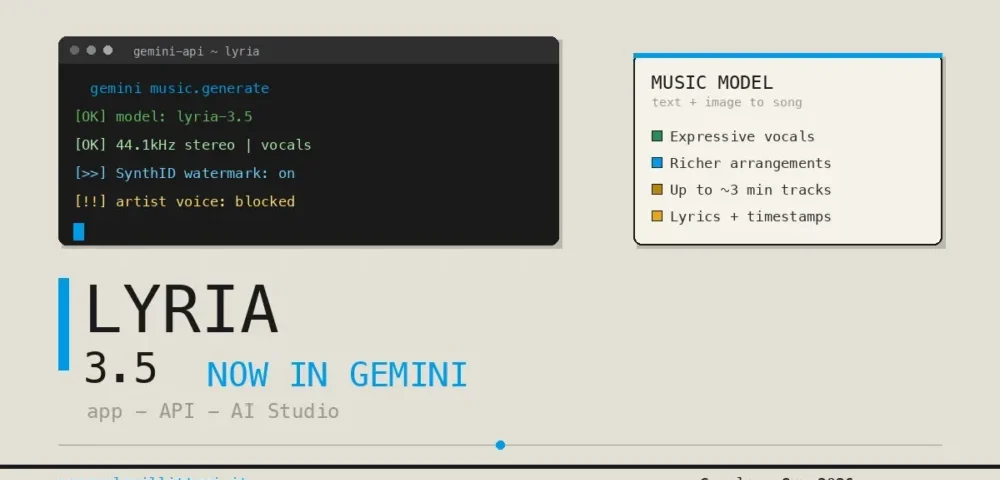
More than 90,000 fully synthetic tracks land on Deezer every single day. Real listenership for that content sits at 1-3%. That’s the market Lyria 3.5 is entering, and Google knows exactly what it’s doing. On September 4, 2026, Google rolled out Lyria 3.5 inside the Gemini app, the Gemini API, and Google AI Studio, pulling the model out of Flow Music, where it had been largely confined to musicians and creatives, and dropping it in front of an audience that crossed one billion monthly users earlier this year.
The model itself isn’t new. Lyria 3.5 debuted in late July inside Google Flow Music, bringing more expressive voices, cover generation, and an iOS app to a studio-oriented audience. What changed on September 4 is distribution. Flow Music is a professional environment. The Gemini app is where people set reminders, draft emails, and ask what to cook for dinner. Putting a music generator there shifts the potential user base from thousands to hundreds of millions, and that’s the whole point.
Google describes Lyria 3.5 as its best-sounding music model to date, with improvements across four areas: musicality, meaning more natural and complex melodies; vocal performance, with better pronunciation and emotional range; lyric accuracy, following prompt instructions more closely; and track length, now reaching up to roughly three minutes. Inside the Gemini app the experience is deliberately guided. Users pick a genre, choose between a sung or instrumental piece, and start from ready-made templates built around practical use cases.
- Custom backing tracks for video content
- Brand jingles
- Personalized ringtones
- Birthday or occasion-specific songs
- Short clips and longer full-length tracks
That list tells you exactly who Google is pitching this to. Not the producer trying to replace their session musician, but the content creator who needs a non-copyright-flagged background track in four minutes. The positioning is functional and personal, not artistic.
For developers, the API exposes two distinct models. The first, lyria-3.5, generates full tracks of a couple minutes, with duration controllable through the prompt. The second is a clip variant producing fixed 30-second snippets, suited to loops and transitions. Audio output is 44.1kHz stereo, delivered as MP3 by default or WAV. The model also accepts up to 10 images alongside a text prompt, enabling generation that starts from a visual cue rather than a description alone. Developers can insert their own lyrics using section tags like [Verse], [Chorus], and [Bridge], and use timestamps such as [0:00 – 0:10] to specify what happens at a precise point in a track. Two limitations are worth flagging: multi-turn editing through the API is not supported, and the same prompt can produce different results on every call.
Every output carries SynthID, Google’s imperceptible watermark for AI-generated content. It’s the same signal that pushed Apple Music to introduce a “Made With AI” label on generated tracks. SynthID doesn’t grant the person who generated the track any rights over it. What it does is help platforms like Deezer identify and filter synthetic content at scale, which, given those 90,000 daily uploads, is less of an ethical gesture and more of an operational necessity.
The guardrails Google built into Lyria 3.5 are specific: the model refuses requests that mimic a named artist’s voice and blocks generation of copyrighted lyrics. Those two restrictions map almost exactly onto the grounds on which Suno, the best-known competitor in AI music generation, was found liable by the Munich Regional Court on July 31, 2026. The court ruled that protected works were stored and reproducible in Suno’s models on German servers, rejected the argument that user prompts shifted responsibility away from the platform, and held Suno accountable for its outputs. The ruling can still be appealed. Google hasn’t said its guardrails are a response to Munich. But the overlap is precise enough that reading them as purely coincidental requires some effort.
For developers evaluating the API, the practical question is whether 44.1kHz stereo output with prompt-controlled structure is good enough for production use. For product teams building consumer apps, the question is simpler: can a user who has never opened a DAW describe what they want and get something usable back? Google is betting the answer to both is yes. Suno, Udio, and the broader field of AI music generators are about to find out whether Gemini’s distribution advantage makes the technical comparison largely irrelevant.


