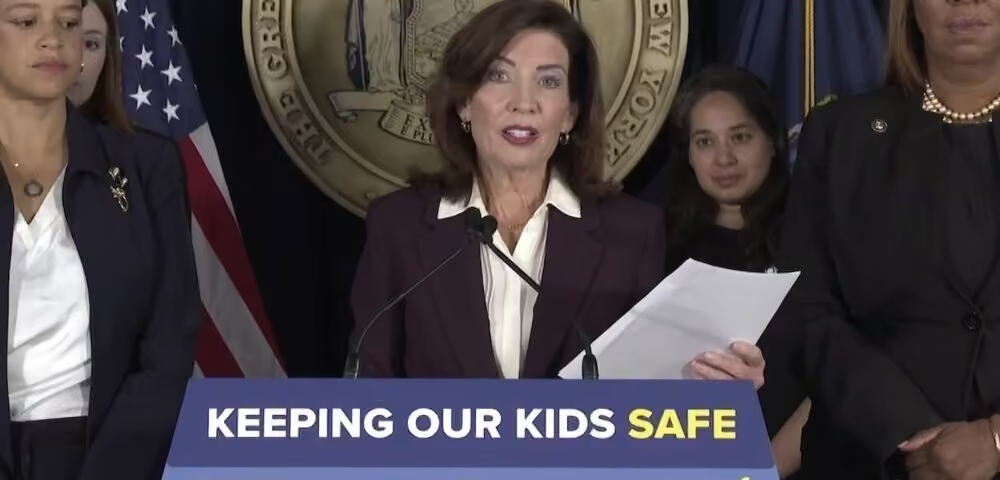
The most interesting part of New York’s new chatbot law isn’t the age checks. It’s the penalty: companies that collect data unlawfully may have to delete the models trained on it. That’s a real threat to anyone shipping a companion-style product.
Gov. Kathy Hochul signed the law this week. AI companies must verify user ages, and at least one method can’t rely entirely on government ID. Age data must be deleted after use. If a user is under 18, or hasn’t been confirmed as an adult, the chatbot can’t pretend to be human, claim a romantic or authority-figure relationship, or ask unprompted emotional questions. It also can’t use a child’s private health information from past chats, encourage secrecy or isolation, promote self-harm, eating disorders or drug use, or produce sexual content.
The attorney general will run a public complaint site. Violations carry civil penalties of up to $25,000 each, plus damages and restitution. The law takes effect in six months.
Why it matters: this targets the product design behind Character.AI-style companions and the friendlier modes of ChatGPT, not just content filtering. Any developer with a consumer chatbot now needs age assurance and a separate behavior mode for minors. Smaller startups will feel the compliance cost most. OpenAI, Meta and Google have more room to absorb it.
The timing is pointed. Eight states recently sued OpenAI over child safety, and Common Sense Media’s Jim Steyer called New York’s bill a template for the country. New York City also banned generative AI in public schools through eighth grade for a year. Expect copycat bills.
Hochul also signed a separate law requiring internet-connected baby monitors sold in the state to block unauthorized viewing and carry security warning labels. That one takes effect in 90 days.
Is this noise? No. State laws are filling the federal gap, and a patchwork is forming that AI companies will have to build around.