Rate limits have always been the quiet tax on free AI users. You hit a wall mid-conversation, get told to wait or upgrade, and the illusion of unlimited AI assistance collapses. OpenAI is now removing that wall, at least for text. Starting next week, free and Go tier ChatGPT users can send as many text prompts as they want, with no cap. That’s a bigger deal than it sounds.
As reported by Engadget, OpenAI confirmed the change alongside a broader set of updates rolling out this week and next. The limits on file uploads, image inputs, image generation, and voice mode remain. So free users aren’t getting everything. But pure text chat, which covers the vast majority of everyday use cases, is now effectively uncapped.
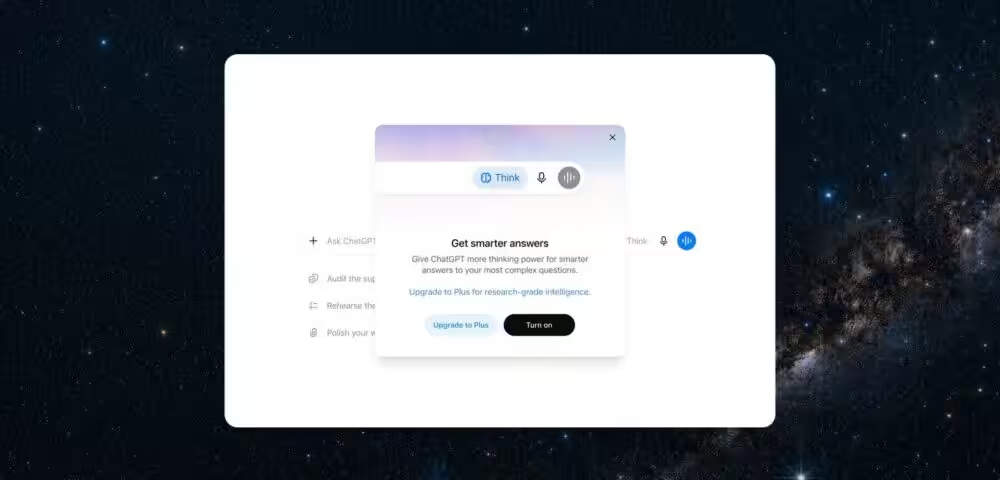
The model powering those free accounts is also changing. GPT-5.6 Luna, the smallest model in OpenAI’s new GPT-5.6 family, replaces GPT-5.5 Instant as the default for Free and Go tiers. That swap happens this week. Free users also get a new “Think” button, which prompts Luna to spend more time on a response before answering. For text-only queries, that feature is also unlimited. Combine it with image inputs or file attachments and it starts counting against a separate cap.
Paid users aren’t being ignored either. GPT-5.6 Sol, the current flagship model, is getting an update optimized for everyday conversation. According to OpenAI, the updated version delivers more focused answers, skips unnecessary formatting, calibrates detail to the complexity of the question, and pushes back instead of just agreeing when agreement isn’t useful. Plus and Pro users also get a new effort slider, similar to the one Anthropic introduced with Claude, letting them control how much reasoning the model applies to a given response.
The inference cost angle is what makes this announcement worth paying attention to beyond the feature list. Rate limits exist because processing AI queries costs real money, and free users don’t pay. Removing those limits for text chat suggests OpenAI has made meaningful progress on driving down the cost of running these models. A report from The Information earlier this year suggested the company was close to a significant cost reduction breakthrough. This looks like the follow-through.
For competitors, this creates a real problem. Google’s Gemini free tier, Anthropic’s Claude.ai free tier, and Meta’s free access to Llama-based tools all still operate with meaningful usage restrictions. If OpenAI can sustain unlimited free text chat without degrading quality or burning cash, the others will face pressure to match it. Free tiers have historically been acquisition tools with intentional friction built in. OpenAI is now removing that friction, which changes the competitive math considerably.
For developers and founders evaluating which AI platform to build on or recommend to users, this shift matters in a practical sense. A free tier with no text cap is a much easier sell for onboarding, prototyping, and low-frequency production use cases. The remaining limits on multimodal features are still real constraints, but the baseline experience for most users just improved significantly. OpenAI framed it as “access shapes opportunity.” The less charitable read is that it’s also a market share play. Both things can be true.