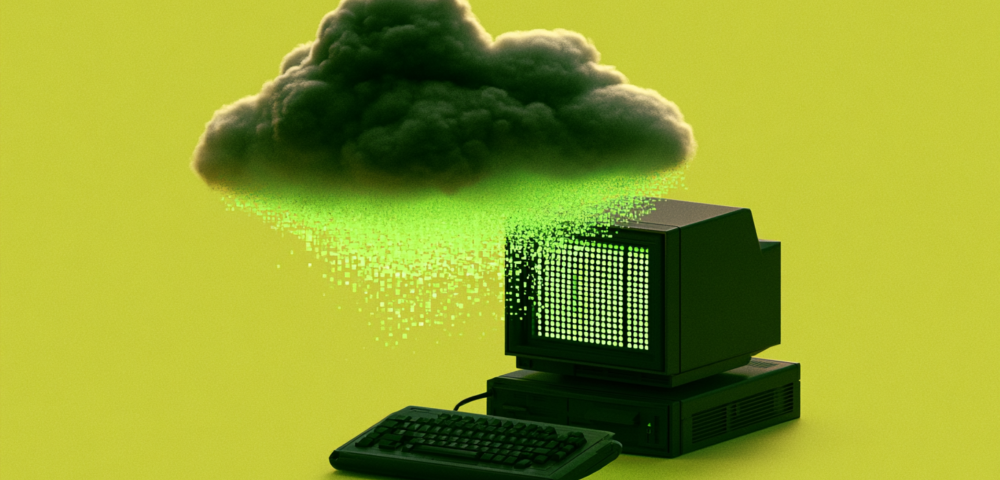
The token counter sitting at zero during a live demo is probably the most honest summary of what Perplexity is going for here. The company has announced Portable Computer, a version of its agentic “Computer” platform that runs entirely on local hardware, starting with Nvidia’s DGX Spark desktop supercomputer and Linux machines with Nvidia RTX GPUs. No cloud billing. No data leaving the device unless you explicitly approve it. Just an AI agent working through your files on your machine.
This matters because AI agents are not like chat. A single conversation costs pennies. An agent that spends hours reviewing folders of financial documents, iterating on analyses, and verifying its own outputs can rack up serious API costs in the cloud. That economics problem has quietly been one of the bigger adoption blockers for enterprise agent deployments. Portable Computer is a direct answer to it. Perplexity’s vice president of engineering for infrastructure, Nate, put it plainly during a press briefing: “This incorporates the entirety of the agent harness and inference and everything needed to do work locally.”
For Nvidia, the partnership is strategically pointed. The company has spent years selling the world on large-scale AI infrastructure, but this announcement signals that it sees local AI crossing from enthusiast hobby into practical tool. Nader, Nvidia’s director of developer technology, was direct about the shift: “For the longest time, it was hobbyists running quantized models that were tiny. But all that changed with the new open source models that are super useful.” Nvidia wants to sell the hardware that runs those models, and a polished consumer product from Perplexity gives that hardware a concrete use case.
The product itself is a bundled stack: local models, agent orchestration, inference engine, app connectors, and a security sandbox, all packaged together. That bundling is the actual product decision. Anyone who has tried to run a local AI agent today knows the process involves downloading model weights separately, standing up an inference server, wiring together tools, and then debugging performance. Perplexity has collapsed that into a single install. “Historically it’s just been really painful to bring up the local AI stack,” Nate said.
There is also a hybrid mode. In one demo, an agent analyzed a CSV of startup funnel data locally, then pushed the finished output to Slack using Perplexity’s connector ecosystem. The system also connects to Google Drive, Gmail, and GitHub, and can escalate to a cloud frontier model when the local model hits its limits. So local-first does not mean isolated.
At launch, users can run Qwen 3.8 27B or PPLX 27B, a version Perplexity post-trained on its own agent harness. Nvidia’s Nemotron 3.5 Lightning is coming soon. The minimum bar is an RTX GPU with at least 24GB of VRAM, roughly a GeForce RTX 3090 or newer. Perplexity described that as a deliberate balance between performance and broad availability. Windows support follows in September.
Perplexity also published a research paper alongside the launch arguing that small local models need a purpose-built agent harness, not a general-purpose framework designed for frontier models. The core finding: models like Qwen 3.8 27B advertise 260,000-token context windows but start to struggle past 100,000 tokens in practice. So the company built a minimal harness with a short system prompt, a small core toolset, and capabilities that load as on-demand skills rather than sitting permanently in context. It also converted connectors like Gmail and GitHub from token-heavy MCP servers into compact command-line tools.
The benchmark numbers Perplexity reports are notable, though they come from the company’s own evaluations. On its internal Local Knowledge Work Bench, covering 53 tasks across research, financial analysis, and document creation, Computer running Qwen 3.8 27B scored 82.6%, against 77.6% for the Pi harness and 74.0% for Hermes on the same model. PPLX 27B pushed that to 85.4%. On BrowseComp, a web research benchmark, Computer hit 66.7% versus 50.2% for Pi and 43.9% for Hermes, while using 51% less time and 70% fewer tokens than Pi.
- Runs fully local on Nvidia DGX Spark and Linux machines with RTX GPUs (minimum 24GB VRAM)
- Zero token billing for tasks completed on-device
- Supports Qwen 3.8 27B, PPLX 27B at launch, with Nemotron 3.5 Lightning coming soon
- Connects to Google Drive, Gmail, GitHub, and Slack via compact command-line connectors
- Can escalate individual steps to cloud frontier models with user permission
- Available now for Pro, Max, Enterprise Pro, and Enterprise Max subscribers on Linux; Windows in September
The competitive context here is real. Open-source frameworks like Open Interpreter, Aider, and various LangChain-based setups already let developers run local agents. But they require assembly. Perplexity is betting that the people who actually want to use agents for knowledge work, not build them, will pay for a product that just works. And with Nvidia’s backing giving it hardware credibility and a distribution channel into the growing DGX Spark install base, that bet has more support than it might from a standing start.