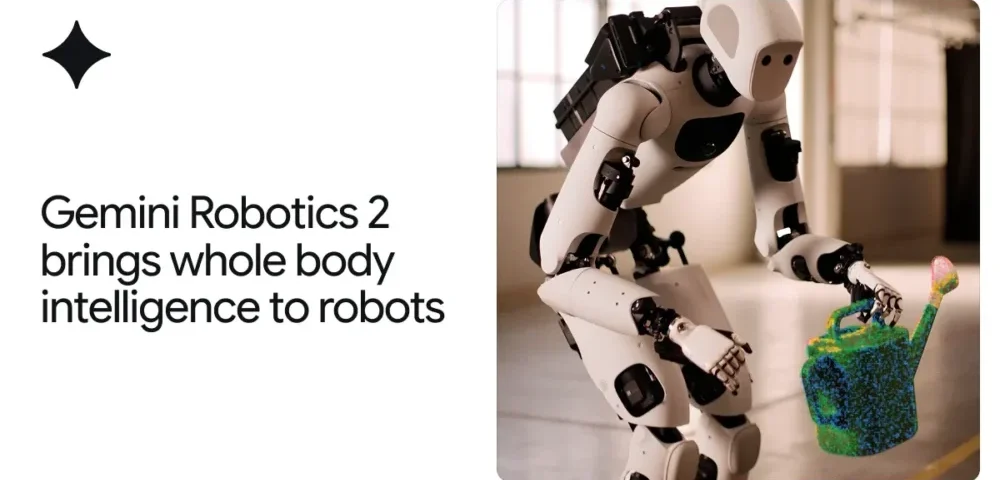
Most robot demos are carefully staged. Controlled lighting, pre-cleared surfaces, a narrow task the system has rehearsed hundreds of times. So when Google DeepMind says its new model can tell an Apollo 2 humanoid to put a watering can on the bottom shelf and have it walk over, pick it up, and place it correctly without being pre-programmed for that exact sequence, that’s worth paying attention to. Google DeepMind announced Gemini Robotics 2 on July 30, and it’s the most complete robotics AI stack the company has released.
Three models, one stack
The release is actually three separate models, each targeting a different layer of the robotics problem. Together they cover perception, reasoning, action, and on-device inference.
- Gemini Robotics 2 is the flagship vision-language-action (VLA) model. It converts visual and language input directly into motor commands and now controls full humanoid bodies, including legs, plus bi-arm platforms with both multi-finger hands and standard grippers.
- Gemini Robotics ER 2 is the embodied reasoning model. It acts as the high-level brain, planning multi-step sequences, communicating with humans, coordinating with the VLA, and self-correcting when a step fails. It’s available now on Google AI Studio and in private preview on the Gemini Enterprise Agent Platform.
- Gemini Robotics On-Device 2 is the efficient VLA built to run locally, without network connectivity. It can adapt to a completely new robot body in a few hours using fewer than 200 examples.
The VLA and On-Device models are currently in early-access partner programs. So this isn’t a public product yet, but the architecture decisions here signal where things are going.
Whole-body control is the real leap
Previous versions of Gemini Robotics focused on upper-body manipulation, table-top tasks, gripper control. Gemini Robotics 2 extends that to the full kinematic chain. The model handles walking, crouching, stretching, and object manipulation as a unified behavior, not separate pre-programmed modules bolted together. That matters because real environments, homes, warehouses, labs, don’t accommodate robots that can only operate at a fixed height with a clear path.
The dexterity side is also more interesting than it first sounds. The model controls the SharpaWave hand, a 22 degree-of-freedom five-fingered hand on the Apollo 2, well enough to tie knots and seal a ziplock bag. It also handles standard two-fingered parallel grippers on the Franka Duo for tight packing tasks. That’s a wide range of end effectors from a single model checkpoint, which is genuinely hard to do.
Why the reasoning layer matters more than the arms
The embodied reasoning model, ER 2, is arguably the most strategically significant piece here. Robots that can only react to immediate inputs are brittle. ER 2 is designed to plan sequences lasting several minutes, track whether steps have completed, and hand off to the VLA at the right moment. It also introduces multi-robot collaboration, meaning different robot types can communicate and divide tasks that no single robot could complete alone.
This is the direction the whole field is moving. Physical Intelligence, known as Pi, has been building similar reasoning-action pipelines with its pi0 and pi0.5 models. Boston Dynamics has Spot doing inspection workflows with autonomy stacked on top. Figure and Apptronik are both betting on general-purpose humanoids that need exactly this kind of persistent task management. DeepMind’s advantage is the Gemini foundation underneath, which gives ER 2 strong language understanding and multimodal reasoning from day one.
Fast adaptation changes the hardware calculus
The on-device adaptation story is worth highlighting separately. Getting a trained robot model to work on a new hardware body has historically required months of new data collection and retraining. Gemini Robotics On-Device 2 claims to do it in a few hours with under 200 examples, even across hardware with very different sensor setups and degrees of freedom. DeepMind demonstrates this on the Dexmate, SO101, and Trossen platforms, which are quite different from each other.
If that holds up outside of controlled demos, it changes how robot hardware companies think about software. Instead of building proprietary AI stacks, more of them may treat a foundation model like this as infrastructure and focus engineering resources on the mechanical side. That’s a significant shift, and it’s the same pattern that played out in language AI over the past three years.
Safety work keeps pace with capability
DeepMind also introduced ASIMOV-Agentic, a new benchmark for agentic safety in robotics, specifically measuring whether the reasoning model can refuse unsafe tool calls from the VLA and handle uncertainty correctly. It’s early work, but building evaluations alongside capabilities rather than after the fact is the right approach, and it’s something the robotics field has been slower to do than the language model world.
The trajectory here is clear. Full-body control, persistent reasoning, fast hardware adaptation, and safety evaluations are all advancing together. Whether the deployment partnerships keep pace with the research is the real question to watch.