Forget the umbrella debate. Google may have just made it significantly harder to get caught in the rain. According to TechCrunch, Google DeepMind and Google Research have released WeatherNext 3, an AI weather forecasting model that outperforms every major competitor currently tested on Operational WeatherBench, the benchmark used by meteorologists and AI researchers to compare forecast accuracy. That includes models from Microsoft, Nvidia, ECMWF, and Google’s own previous work. It also beats traditional forecasts from the U.S. National Weather Service.
What makes this more than a benchmark win is the deployment plan. Google senior staff engineer Samier Merchant confirmed to TechCrunch that WeatherNext 3 will feed directly into Google Search, Google Maps, and Gemini. That’s a meaningful shift. For the first time, core variables from an AI-native weather model will power the weather information that hundreds of millions of people see daily. The model will also be available to researchers and developers via Google Cloud.
To understand why that matters, some background helps. Most weather forecasts still come from government supercomputers running physics-based simulations. These systems are accurate but expensive and slow. After ECMWF released over 50 years of historical weather data in 2018, deep learning researchers started training models that could produce forecasts far faster and at lower cost. The accuracy gap between AI and traditional models has been narrowing ever since. European and U.S. weather agencies are already folding AI outputs into their official products.
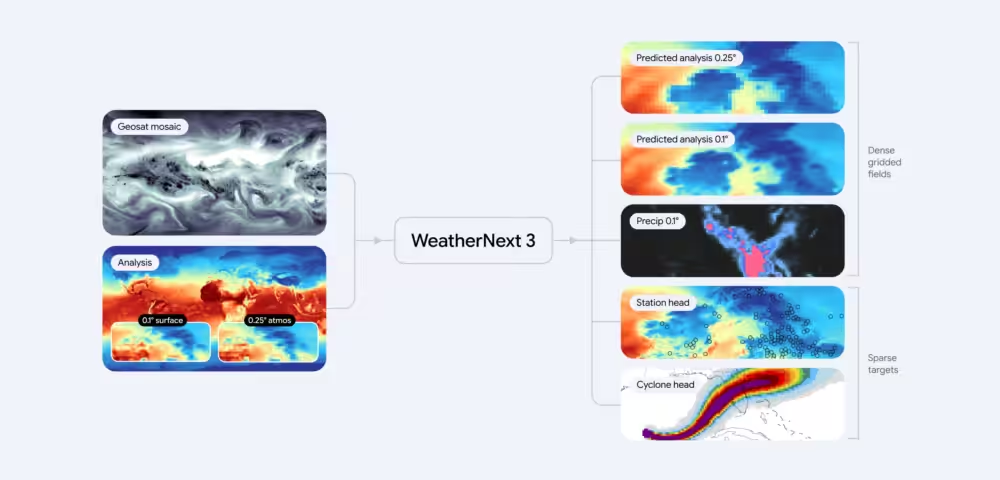
But AI weather models have had consistent weaknesses: low spatial resolution, poor rain prediction, and dependence on pre-processed government datasets. WeatherNext 3 directly addresses all three.
- Resolution drops from 15-25 km (typical for most AI models) to 5 km on key variables
- Rain prediction is 60% better than WeatherNext 2
- Forecasts are now hourly instead of every six hours
- The model is the first to directly incorporate raw satellite observations for a high-resolution global forecast, according to Google
That last point is contested. Weather AI startup WindBorne says its WeatherMesh 6 model has been ingesting raw observations from its balloon fleet since late 2025. Google’s counter is that its global resolution is higher. Both models still rely partly on national weather datasets, so full direct data assimilation remains a work in progress for everyone in the space.
The technical gains come from deliberate architectural choices. WeatherNext 3 has 2.4 times more parameters than its predecessor. The model was also trained to target specific weather station readings, which improves granularity and gives researchers real-world ground truth to evaluate against. This is the same logic behind DeepMind’s earlier work visualizing cyclone tracks: get the model predicting something concrete, not just abstract grid averages.
The broader implications extend well beyond consumer apps. Bill Gates has pointed to AI weather forecasting as one of the clearest near-term benefits of the technology, particularly for crop planning in developing regions where supercomputer infrastructure is out of reach. Ferran Alet, a staff research scientist manager at DeepMind, noted that higher-resolution wind and cloud cover forecasts will also make renewable energy projects more reliable. So while large language models absorb most of the public attention, the transformer architecture has quietly reshaped meteorology in ways that have measurable economic consequences. WeatherNext 3 is the clearest proof yet of how far that shift has gone.