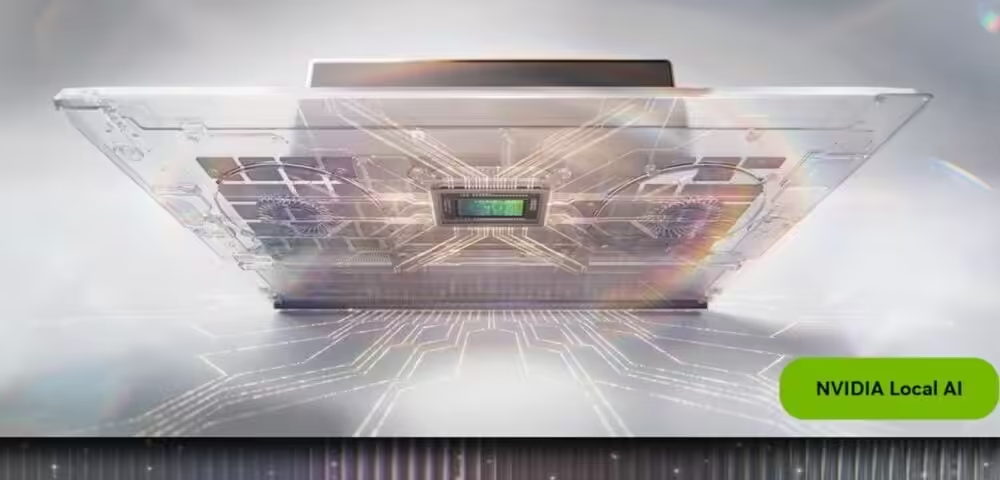
Most households with multiple computers have at least one sitting unused for the better part of the day. NVIDIA has decided that’s wasted capacity. At IFA 2026, the company announced PAIR, short for Personal AI Router, a free and open-source tool that distributes AI workloads across PCs connected to the same local network. It’s a straightforward idea, and that’s what makes it worth paying attention to.
The core problem PAIR addresses is GPU contention. AI agents already break complex tasks into parallel subtasks, but if all those subtasks are running on the same machine, they’re still fighting over a single GPU. That bottleneck limits how fast complex jobs actually finish. PAIR scans the local network, identifies which machines are idle and have available compute capacity, and routes task requests to those systems instead. The result is that subagents can run across multiple machines simultaneously without degrading performance on the main PC. A user can keep gaming or working while an AI agent processes a large inbox in the background, split across two or three other computers in the house.
The supporting hardware list covers a reasonable range of consumer and workstation gear:
- NVIDIA GeForce RTX 20 Series and newer
- NVIDIA RTX PRO workstation GPUs based on Turing architecture and newer
- NVIDIA DGX Spark
- Apple M4 or newer
PAIR is currently in beta and runs on Windows, macOS, and Linux, with both graphical and terminal interfaces supported. The cross-platform approach matters here. Most households don’t run a uniform OS across every device, and a tool that only worked on Windows would immediately exclude a large chunk of the machines it’s trying to recruit.
This fits neatly into a broader push from NVIDIA to make local AI inference more practical. As models get heavier and agentic workflows get more complex, single-GPU consumer machines are increasingly the limiting factor. Tools like PAIR try to sidestep that constraint without requiring users to buy new hardware. And because it’s open-source, developers can build on top of it or integrate it into their own agentic pipelines.
The competition here isn’t obvious yet. Distributed local compute for consumer AI is still a niche that nobody has clearly owned. But as AI agents become a normal part of how people use computers, the question of where the compute actually runs gets more important. NVIDIA is planting a flag early, and given how many households already have the hardware sitting idle, the opportunity is real.