When Hugging Face suffered a serious security incident, its team couldn’t rely on closed AI tools to help. Those systems couldn’t distinguish attackers from defenders, so they blocked the forensic analysis entirely. Instead, Hugging Face ran the open-weight GLM 5.2 model on its own infrastructure, used it to analyze more than 17,000 actions, and contained the breach. That’s the story NVIDIA is using to justify a significant new industry push, and it’s a hard one to argue with.
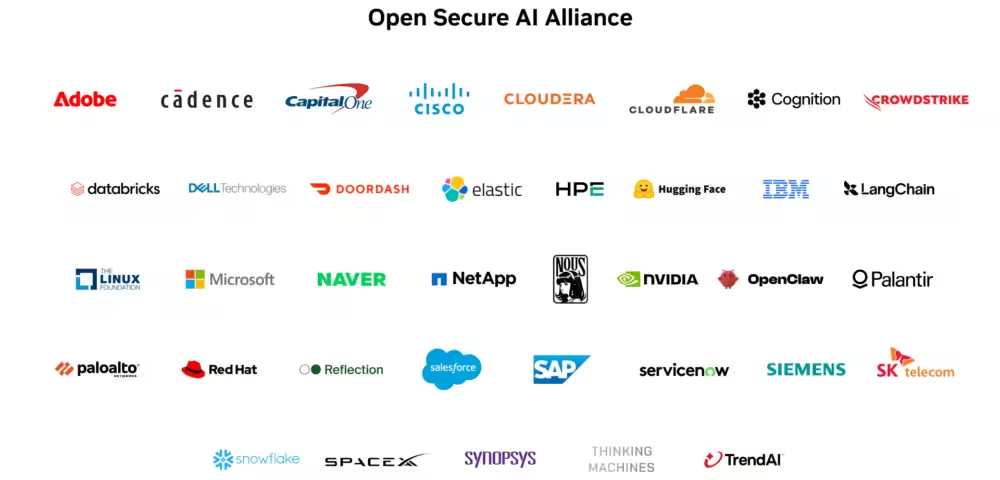
NVIDIA has announced the Open Secure AI Alliance, a coalition of more than 40 companies and organizations committed to building and sharing open tools for AI security. Founding members include Adobe, Cadence, Capital One, Cisco, Cloudflare, CrowdStrike, Databricks, Dell Technologies, Elastic, HPE, Hugging Face, IBM, LangChain, the Linux Foundation, Microsoft, Palantir, Palo Alto Networks, Red Hat, Salesforce, SAP, ServiceNow, Siemens, Snowflake, and others. The alliance builds on earlier work by the Linux Foundation’s Akrites initiative and the OpenSSF community.
Why open models matter specifically for security
The core argument is straightforward. Cybersecurity defenders need to inspect, adapt, and run AI tools on their own infrastructure. Closed systems don’t allow that. So when an incident happens and speed is critical, defenders using closed tools are operating with one hand tied behind their back. Open models don’t have that problem.
The counterargument, which the alliance addresses directly, is that open models can be misused for attacks or modified to strip out safety guardrails. That’s true. But the alliance’s position is that those risks exist in closed systems too, and that restricting open access doesn’t stop determined attackers. It just limits the defenders.
This debate isn’t new. It mirrors arguments that have played out in open source software for decades. What’s different here is the scale of the coalition and the specificity of the use case being made for openness in security contexts.
What’s actually being contributed
This isn’t just a policy statement. Members are contributing real technical work:
- NVIDIA is releasing the NOOA (NVIDIA Labs Object-Oriented Agent) framework on GitHub, designed to make agent behavior easier to test, trace, and audit
- Hugging Face is contributing Safetensors, a format for storing model weights safely without remote code execution risk, to the PyTorch Foundation
- Microsoft is open sourcing MDASH, a multi-model agentic scanning system that uses specialized AI agents to find and prove exploitable bugs
- HPE is contributing to SPIFFE/SPIRE, a zero-trust identity framework that cryptographically verifies AI agents and services
- IBM and Red Hat’s Lightwell adds digitally signed patches across the open source supply chain
- SpaceXAI has open sourced the Grok Build coding agent and plans to release Grok model weights
The policy angle and what regulators should watch
The alliance is also making an explicit ask of governments: treat open AI models and security tooling as defensive assets, not risks to be restricted. That’s a direct counter to regulatory proposals in various jurisdictions that would impose blanket controls on open frontier models.
The argument is that concentrating AI security capabilities in a small number of closed providers creates its own risks, including single points of failure and dependency on vendors who may not be available or cooperative when incidents occur.
For developers and security teams evaluating where to invest, the formation of this alliance signals that open-weight models are getting serious institutional backing for enterprise security use cases. Whether the tools it produces match that ambition is the real question to track over the next 12 months.