Exa
A fancy tool designed to enhance AI applications by connecting them to web-based knowledge
Exa is a fancy tool designed to enhance AI applications by connecting them to web-based knowledge. It provides a sophisticated search engine that understands semantic meaning, allowing AI systems to retrieve the most relevant information without being bogged down by irrelevant data. This capability is useful for avoiding so-called “hallucinations” and ensuring AI responses are based on accurate, up-to-date information.
The platform supports deep research and competitive analysis by enabling comprehensive searches across the web. Exa’s API can return extensive datasets tailored to specific needs, such as lists of companies or detailed industry reports. This, in turn, makes it valuable for training AI models with high-quality, curated data — thus improving their performance and reliability.
Furthermore, Exa integrates with popular AI frameworks and tools, facilitating easy implementation with minimal coding effort. In that sense, developers can quickly set up Exa to scrape content, perform similarity searches, and filter results based on various parameters. This allows for the creation of customized AI solutions that leverage the full potential of web-based information.
In a nutshell, Exa empowers AI applications by providing intelligent, scalable access to the world’s knowledge. Its advanced search capabilities and integration options make it a standout tool for developers aiming to build smarter AI systems. By streamlining the data retrieval process, Exa helps ensure that AI applications deliver accurate results — enhancing their overall utility and effectiveness.
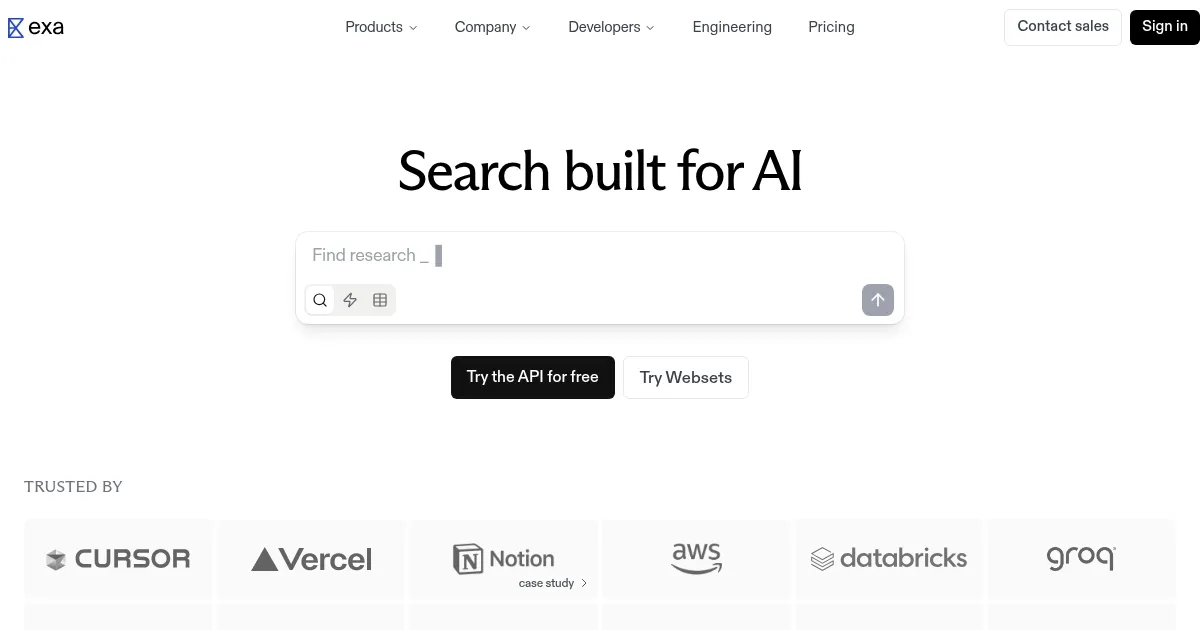
Homepage Screenshot 📸
Video Overview 🎬

What are the key features? ✨
- Semantic search: Exa offers a search engine that understands the semantic meaning behind queries to provide more accurate and relevant results.
- Embedding search: It allows AI to search for and process content based on embeddings, making it possible to find information related to complex queries.
- Data scraping: Exa can scrape and clean data from any webpage to provide comprehensive and high-quality data sets.
- Up-to-date information: New URLs are crawled continuously to ensure the data provided is always current.
- Scalability: Exa can handle up to 1 million search results, making it suitable for extensive data analysis and AI training.
Who is it for? 🤔
Examples of what you can use it for 💡
- Researchers can use it to find and synthesize reliable sources on a given topic
- Developers can use it to gather high-quality data sets for training AI models
- Businesses can use it to pull in detailed information about competitors from various online sources
- Summarize the latest news or any given topic for quick insights
- Provide up-to-date and contextual information to enhance the performance of AI chatbots
Pros & Cons ⚖️
- Makes it easy to improve AI apps with accurate data
- Content scraping with just a few lines of code (with the API)
- Helps remove AI hallucinations
- It takes some effort to fully benefit from Exa
FAQs 💬
Ready to try Exa?
A fancy tool designed to enhance AI applications by connecting them to web-based knowledge
Visit ExaExa alternatives 🔗