logo-darklogo-darklogo-darklogo-dark
  • Tool Categories
    • ๐ŸŽจArt & Creative Design505
    • ๐ŸขBusiness Management644
    • ๐Ÿ’ปCoding & Development515
    • ๐Ÿ‘ฎDetection83
    • ๐Ÿง General Use727
    • ๐ŸฅHealth & Wellness55
    • ๐Ÿ“ทImage & Photo Analysis100
    • ๐Ÿ–ผ๏ธImage Generation & Editing618
    • ๐Ÿ“Interior & Architectural Design37
    • ๐ŸŽ“Learning & Education483
    • โš–๏ธLegal & Finance90
    • ๐ŸŽญLifestyle & Entertainment236
    • ๐Ÿ“ขMarketing & Advertising627
    • ๐ŸŽงMusic & Audio138
    • ๐Ÿ‘”Office & Workplace1,014
    • ๐Ÿ”ฌResearch & Data Analysis372
    • ๐Ÿ‘ฅSocial Media245
    • ๐ŸŽฅVideo Generation & Editing426
    • ๐Ÿ‘ง๐ŸปVirtual Companion135
    • ๐ŸŽคVoice Generation & Editing381
    • โœ๏ธWriting & Editing808
    • All Categories
    • AI Use Cases
  • News
  • Events
    • Academic Conferences
    • Developer Conferences
    • Expos / Trade Shows
    • Industry Summits
    • Workshops / Training
    • All Events
    • Past Events
  • Saved Tools
  • Suggest a Tool
โœ•
Home › General Use › Search Engine› Vespa
Vespa

Vespa

Powers real-time AI-driven search and recommendation at scale

Vespa is a powerful, open-source platform for real-time AI-driven search, recommendation, and data processing, designed for enterprise-scale applications. It combines vector search, lexical search, and structured data queries, enabling complex, low-latency operations across billions of data items. Supporting thousands of queries per second with sub-100ms response times, Vespa powers applications for companies like Spotify, Yahoo, and Wix. Its core strength lies in its ability to integrate machine-learned ranking and tensor operations directly into the data layer, ensuring high relevance and performance.

The platform’s Hybrid Search feature allows simultaneous querying of vectors, text, and structured data, making it ideal for use cases like e-commerce search or personalized recommendations. Vespa’s Tensor Operations support complex ranking models, such as ONNX or XGBoost, executed where data resides to minimize latency. Streaming Search mode optimizes cost for personal data applications by bypassing traditional indexing. The platform scales linearly, automatically distributing data across clusters, and supports real-time updates without downtime. Vespa is available as an open-source solution under Apache 2.0 or as a managed service via Vespa Cloud.

Compared to competitors like Elasticsearch and Milvus, Vespa excels in AI-driven tasks with its tensor framework and real-time inference. Elasticsearch offers robust aggregation but lacks Vespa’s native tensor support, while Milvus focuses on vector search but doesn’t match Vespa’s hybrid capabilities. Vespa’s open-source model is cost-effective, though its managed cloud service likely aligns with industry-standard pricing for enterprise solutions.

Drawbacks include a steep learning curve for configuring clusters and schemas, which may challenge teams without search expertise. Documentation, while comprehensive, can be hard to navigate for beginners. High query volumes may require significant compute resources, potentially increasing costs for large-scale deployments. Vespa’s community, while active, is smaller than Elasticsearch’s, which may limit peer support.

To get started, deploy a sample application using Vespa’s Docker-based guide. Focus on the Hybrid Search and Ranking documentation to leverage its AI capabilities. Join the GitHub community for updates and troubleshooting. For enterprise use, evaluate Vespa Cloud to simplify management.

Visit Vespa ↗
Categories
๐Ÿง  General
๐Ÿ” Search Engine ๐Ÿฆ™ Open Source Model ๐Ÿง  Large Language Model
๐Ÿ’ป Coding
๐Ÿ‘จโ€๐Ÿ’ป Development
๐Ÿ”ฌ Research
๐Ÿ“Š Data Analytics
๐Ÿข Business
๐Ÿข Enterprise

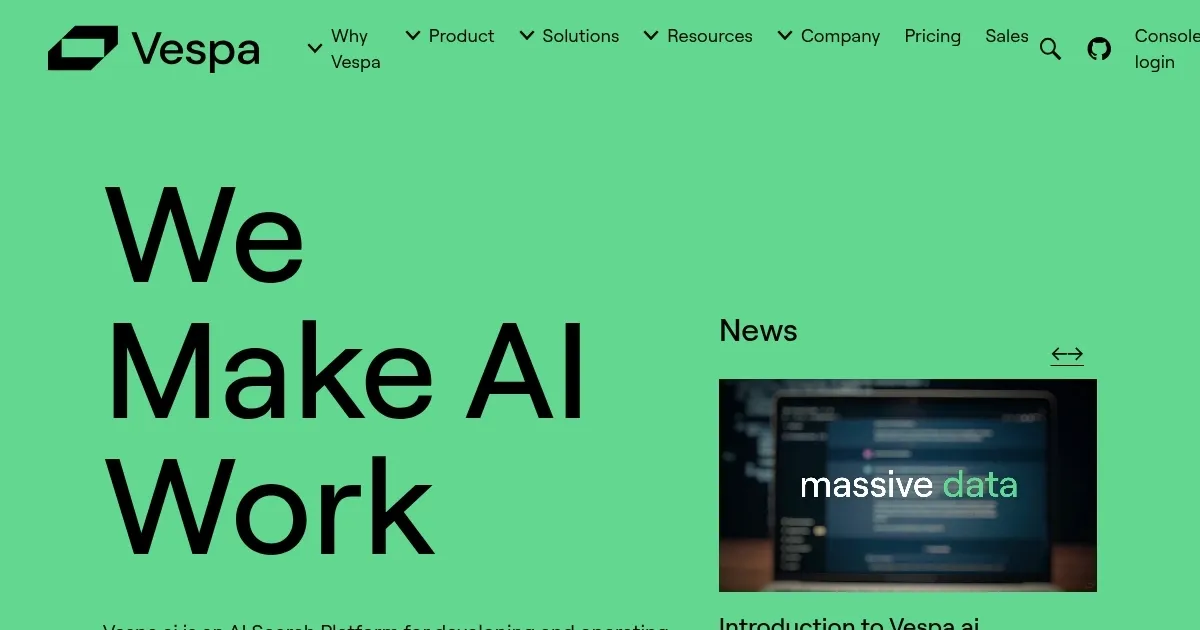
Homepage Screenshot 📸

Vespa screenshot

Video Overview 🎬

Vespa - Video Overview

What are the key features? ✨

  • Hybrid Search: Combines vector, text, and structured data queries in one operation for high relevance.
  • Tensor Operations: Supports complex ranking and inference with native tensor support for models like ONNX.
  • Streaming Search: Optimizes cost for personal data searches by avoiding traditional indexing.
  • Scalability: Automatically distributes data across clusters for linear scaling with no downtime.
  • Real-Time Updates: Handles continuous data changes while maintaining query performance.

Who is it for? 🤔

Vespa is made for developers, data scientists, and enterprises building large-scale, real-time AI applications like search engines, recommendation systems, or RAG solutions. It suits organizations handling massive datasetsโ€”think billions of documentsโ€”needing low-latency, high-relevance results, such as e-commerce platforms, media companies, or financial services. Its open-source nature appeals to technical teams comfortable with Java or C++ environments, while Vespa Cloud caters to those seeking managed scalability.

Examples of what you can use it for 💡

  • E-commerce Developer: Builds a search system combining product descriptions, images, and structured data for fast, relevant results.
  • Data Scientist: Deploys machine-learned models for real-time recommendation systems with high query throughput.
  • Media Company Engineer: Powers personalized content delivery across millions of users with sub-100ms latency.
  • Financial Analyst: Searches billions of documents instantly using hybrid queries for fraud detection.
  • AI Researcher: Implements RAG systems with multi-vector embeddings for enhanced contextual search.

Pros & Cons ⚖️

  • Fast query speeds under 100ms
  • Scales to billions of data items
  • Supports hybrid search types
  • Steep learning curve
  • Complex setup process

FAQs 💬

What is Vespa used for?
Vespa powers real-time AI applications like search, recommendations, and RAG for large-scale data.
Is Vespa open-source?
Yes, Vespa is open-source under the Apache 2.0 license, with a managed Vespa Cloud option.
What data types does Vespa support?
Vespa supports vector, text, and structured data, combinable in hybrid queries.
How does Vespa compare to Elasticsearch?
Vespa excels in AI-driven tasks with tensor support, while Elasticsearch is better for aggregations.
Can Vespa handle real-time updates?
Yes, Vespa manages continuous data changes without impacting query performance.
What is Vespa's Streaming Search mode?
It optimizes cost for personal data searches by bypassing traditional indexing.
Does Vespa support machine learning models?
Yes, Vespa integrates models like ONNX and XGBoost for real-time inference.
Is Vespa suitable for small teams?
Small teams may find Vespa's setup complex but can start with sample apps.
How scalable is Vespa?
Vespa scales linearly, handling billions of data items with automatic distribution.

Ready to try Vespa?

Powers real-time AI-driven search and recommendation at scale

Visit Vespa ↗

Vespa alternatives 🔗

  1. ChatGPT ChatGPT All-round AI assistant generating human-like responses to user queries and tasks
  2. Gemini Gemini Generates responses from text, images, audio, and video inputs using advanced multimodal AI
  3. Grok Grok Delivers witty, real-time AI responses with advanced reasoning and image generation
  4. Perplexity Perplexity Delivers cited AI answers from web searches instantly
  5. Poe Poe Aggregates top AI models for seamless chatting and bot creation
  6. Bing Bing Empowers searches with AI-driven insights and creative generation
Share
Vespa screenshot enlarged
Promote Vespa
light badge
Copy Embed Code
dark badge
Copy Embed Code
neutral badge
Copy Embed Code
Best AI Tools

Discover the best AI tools for any use case

Explore
  • Tool Categories
  • AI Use Cases
  • AI Events
  • AI News
  • Saved Tools
Company
  • About Us
  • Contact Us
  • Media & Partnerships
  • Suggest a Tool
Legal
  • Privacy Policy
  • Terms of Service
Copyright © 2026 Best AI Tools 415 Mission Street, 37th Floor, San Francisco, CA 94105