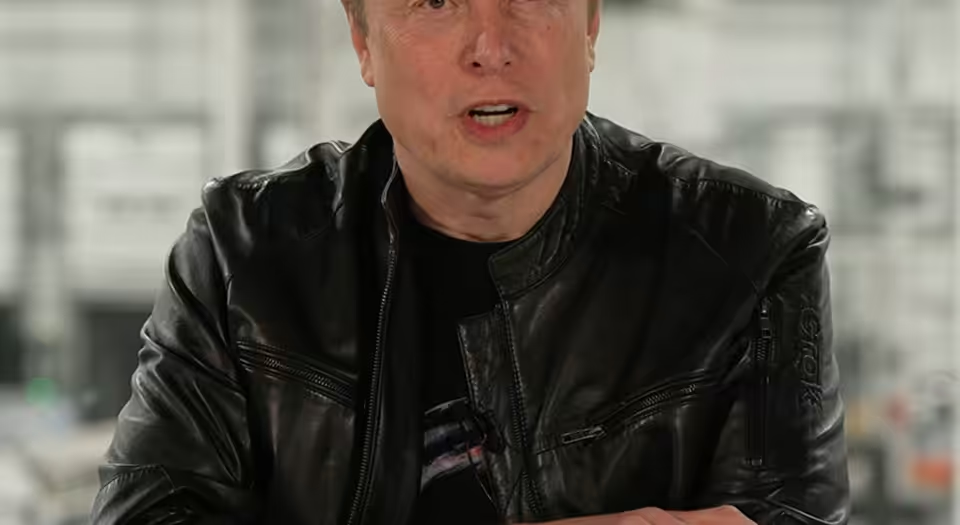
The person most responsible for making Google’s custom chip program a serious infrastructure force is now working for one of Google’s biggest AI rivals. Anthropic has confirmed it hired Amir Salek, former head of Google’s Tensor Processing Unit program, to join its compute team as the company pushes toward designing its own semiconductors. He will report to James Bradbury, Anthropic’s head of compute.
Salek’s resume is hard to argue with. He founded Google’s custom chip program in 2013 and ran it through 2022, shipping the first seven generations of TPUs into Google’s data centers. Before that, he spent eight years at Nvidia building out its system-on-a-chip organization. Most recently he held a senior managing director role at private equity firm Cerberus Capital Management, which makes his return to active chip development a notable signal about where Anthropic thinks the leverage is.
And the reasoning isn’t subtle. Building inference chips specifically tuned for Claude’s architecture could meaningfully reduce latency and cost per query, two metrics that directly affect both API pricing and end-user experience. Right now, Anthropic, like most AI labs, depends heavily on Nvidia GPUs and cloud compute from Amazon Web Services and Google. That dependency has real consequences: supply bottlenecks, pricing pressure, and limited ability to optimize hardware for specific model workloads. Designing in-house silicon is how you fix that, at least in theory.
The cost of getting there is not small. Industry estimates put the price of designing a modern AI processor from scratch at roughly $500 million. But the major labs are clearly deciding that cost is worth it. OpenAI already moved in this direction with its inference chip called Jalapeño, co-developed with Broadcom. Google has its TPUs. Amazon has Trainium and Inferentia. Anthropic, until now, has been conspicuously absent from that list.
Still, Anthropic isn’t burning its existing relationships. The company signed a deal with Amazon in April committing to spend over $100 billion on AWS over the next decade, which includes access to Amazon’s custom AI chips. It also recently put $250 million toward chips from UK startup Fractile, and has compute agreements with Riot Platforms and Volta Infra Holdings. So the strategy is diversification, not replacement.
Hiring Salek suggests Anthropic wants someone who has actually done this before to sit at the center of those decisions. Building a chip program is different from buying compute. It requires org-building, vendor relationships, and multi-year planning. That’s exactly what Salek did at Google. Whether Anthropic can replicate that success with a smaller team and tighter timeline is the real question, but this hire at least puts credible leadership behind the effort.