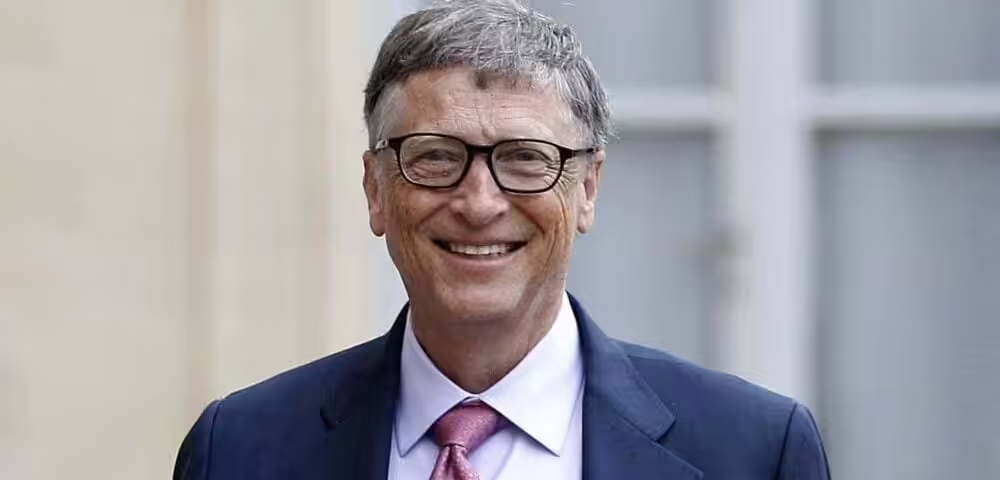
Bill Gates thinks the AI industry knows exactly how dangerous this technology is, and has chosen not to say so publicly. That’s the sharpest claim buried inside a sweeping 6,000-word essay the Microsoft co-founder published on his personal website, followed by a candid interview with The New York Times. According to Android Headlines, Gates is warning that AI could become “the worst source of injustice” the world has seen if governments and companies fail to act.
Gates points to recent breakthroughs, specifically Anthropic’s Claude Code and conversation models that now outperform humans on several cognitive benchmarks, as evidence that the pace of progress has outrun any serious policy response. He isn’t the first to raise this concern. Geoffrey Hinton, Sam Altman, and Elon Musk have all made similar noise at various points. But Gates is doing something most of them haven’t: proposing concrete economic and regulatory mechanisms, and naming Silicon Valley’s financial incentives as the reason those conversations keep getting buried.
His core economic argument is worth taking seriously. Past waves of automation, from textile looms to enterprise software, disrupted specific sectors while leaving others intact. Workers could retrain and move. Gates argues AI is different because it hits white-collar and blue-collar industries at the same time, across every sector simultaneously. There’s no adjacent industry to absorb the displaced. That’s a structural problem, not just a transitional one.
To address it, he proposed a set of policy ideas that are specific enough to draw real criticism:
- A tax on AI computation tokens and physical workplace robots, to raise the cost of replacing human workers and fund retraining programs
- Designated “Human Reserved” job categories, covering roles like mental health counselors, primary care physicians, and personal caregivers, where AI would be banned from replacing humans
- An international oversight body modeled on nuclear and aviation agreements, focused on systemic risks like AI-assisted bioweapon synthesis
The token tax idea has already drawn pushback. Oren Etzioni, a computer science professor, compared it to taxing keystrokes on a typewriter, and warned that taxing American AI usage would just push companies toward foreign models, handing competitors an advantage. That’s a fair structural objection. Several policy researchers have suggested working through existing federal agencies rather than building new bureaucratic layers from scratch.
But the debate over specific mechanisms risks missing the bigger point Gates is making. He’s arguing that voluntary self-regulation from AI companies is not coming, because the financial incentives run in the opposite direction. That’s not a fringe view. It’s increasingly the consensus among researchers who study AI governance, even if the industry prefers to frame safety work as proof that self-regulation is working.
Gates says he plans to raise AI equity and regulation in every upcoming meeting with Washington lawmakers and heads of state. Whether that translates into actual policy movement is a different question. Still, having one of the most credible voices in tech history publicly accuse the industry of hiding known risks for profit changes the terms of the conversation. That matters, even if the solutions aren’t fully worked out yet.