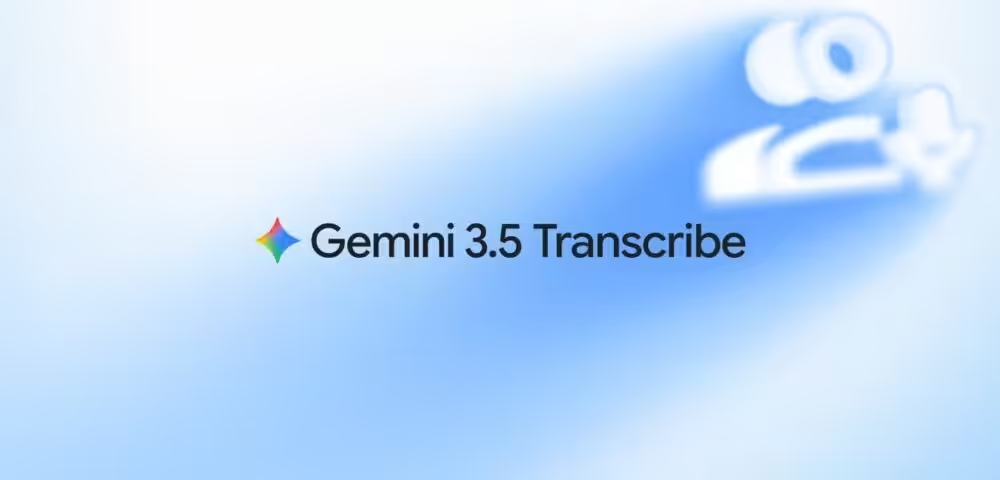
Google just drew a hard line between conventional speech recognition and what it thinks transcription should look like in 2026. The company announced Gemini 3.5 Transcribe on August 26, and the benchmark numbers are the kind that make competing products uncomfortable. A 2.6% word error rate on pre-recorded audio, a 70% improvement in time-to-final-transcription over its predecessor Chirp 3, and sub-second latency on live streaming. That’s not incremental progress.
The model is available now in public preview through the Gemini API in Google AI Studio and the Gemini Enterprise Agent Platform. It runs across two distinct APIs depending on your use case: the Live API for real-time streaming using the gemini-3.5-transcribe-live model identifier, and the Interactions API for pre-recorded audio using gemini-3.5-transcribe. That split matters because the performance profiles differ. Streaming clocks in at a 4.0% WER; non-streaming hits 2.6%. Both numbers were measured by Artificial Analysis on the FLEURS benchmark.
What it actually does differently
Most speech-to-text tools, including older versions of Whisper, Deepgram, and AssemblyAI at standard tiers, convert audio into raw transcripts and stop there. Gemini 3.5 Transcribe does more processing before the text hits your application. It strips filler words, handles self-corrections like “let’s meet Tuesday, no, Wednesday” automatically, and auto-formats output. For developers building voice agents or call analytics pipelines, that means less post-processing code on your end.
The feature set also includes:
- Custom vocabulary support for domain-specific jargon and unusual spellings
- Multi-speaker attribution with word-level timestamps for up to three speakers (experimental above three)
- Automatic language detection across 85+ languages with regional accent handling
- Function calling, which lets the model hand off tasks like image generation or file analysis to other Gemini models in the background
- Strong alphanumeric entity recognition, covering postal codes, order IDs, and similar structured data that trips up generic models
Where it shows up for end users
Google is not keeping this confined to API access. The model is already powering Rambler, a new Android feature inside Gboard that converts spoken thoughts into cleaned-up formatted text and lets users make voice edits inline. On macOS, the Gemini app uses 3.5 Transcribe to handle voice commands that can interact with screen context, summarize local files, and generate images at the cursor position. Chrome support is coming, which would bring talk-to-type functionality to any web input field.
Google Antigravity, the company’s agent workspace product, also integrates the model with screen context and chat history to improve accuracy on file names and document-specific terminology. That context-aware layer is what separates this from generic transcription. So when you’re dictating inside a specific document, the model has some awareness of what’s in that document.
How it compares and why it matters
AssemblyAI’s Universal-2, Deepgram’s Nova-3, and OpenAI’s Whisper large-v3 are the main competitors at this tier. Deepgram has strong real-time latency. OpenAI’s Whisper has broad language coverage but no native streaming mode without additional infrastructure. AssemblyAI has competitive accuracy with good speaker diarization. Gemini 3.5 Transcribe is attempting to combine all three strengths in one model, and the Chirp-to-3.5 latency improvement of 70% suggests Google has closed a meaningful gap in the live use case.
But the bigger picture here is distribution. Google is embedding this model across Android, Chrome, Gboard, and its enterprise agent stack simultaneously. That’s not something a standalone API provider can match. For enterprise developers already working inside Google’s ecosystem, the integration path is shorter than it would be with any third-party provider. And platforms like LiveKit, Pipecat, LangChain, and Vercel already have Live API integrations in place, which means adoption friction is low for teams already using those tools.
For developers evaluating speech-to-text options right now, Gemini 3.5 Transcribe belongs on your shortlist. The WER numbers are strong, the latency is competitive, and the function-calling capability is genuinely new territory for transcription models.