Frequently Asked Questions
How accurate are AI content detectors?
AI content detectors are useful but far from reliable. They flag plenty of genuine human writing as AI, especially work by non-native English speakers, and they miss text that has been edited or paraphrased. Accuracy varies by tool and by how the writing was produced, so treat any score as a probability, not a verdict.
What is the best AI content detector?
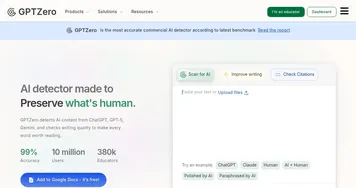
No detector is consistently best, since results swing with the text and the model that wrote it. GPTZero and Copyleaks are widely used for general checks, while Turnitin dominates academic submissions through institutional access. Running a sample through more than one gives a fuller picture than trusting a single tool's score.
Can AI detectors give false positives?
Yes, and this is their biggest weakness. Detectors regularly flag original human writing as AI-generated, particularly clear, formulaic, or non-native prose that happens to resemble model output. A false positive can wrongly accuse a real author, which is why a flag should prompt a closer review rather than an automatic penalty.
How do AI content detectors work?
AI content detectors measure how predictable a passage is. Machine text tends to choose very likely words and keep an even rhythm, while human writing varies more. The tools score these patterns, often called perplexity and burstiness, and estimate the chance the text came from a model. They infer, they do not prove.
Is there a difference between AI detection and plagiarism checking?
Yes. AI detection estimates whether text was machine-generated, while plagiarism checking compares text against existing sources to find copied passages. A piece can be fully original yet flagged as AI, or human-written yet plagiarized. They answer different questions, so many platforms run both checks side by side.