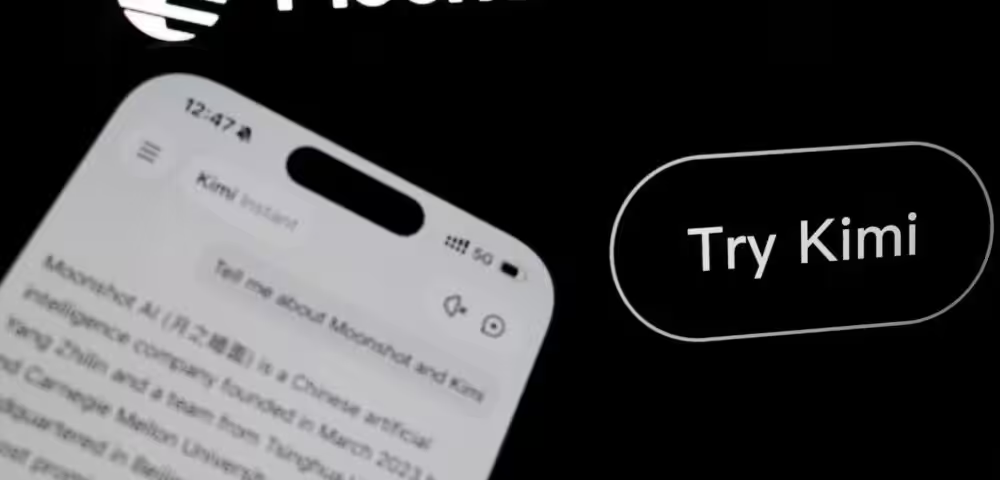
The most interesting thing about Moonshot’s IPO filing isn’t the size of the raise. It’s that a Chinese AI startup accused of using restricted Nvidia chips and distilling capabilities from Anthropic’s models is now working with Goldman Sachs, CICC, and Deutsche Bank to go public in Hong Kong. As reported by Reuters, the Beijing-based developer of the Kimi large language model has confidentially filed for a Hong Kong listing, targeting $3 billion in proceeds.
Moonshot is currently valued at $50 billion, according to two sources familiar with an ongoing funding round. That puts it behind domestic rivals DeepSeek, valued at roughly $74 billion, and Z.AI, which has a market cap of $66 billion. Still, $50 billion is a serious number for a company founded in 2023 by Yang Zhilin, a Carnegie Mellon-trained AI researcher. The company has raised more than $5.5 billion to date, including a $2 billion-plus round in May from investors such as Meituan, China Mobile, and private equity firm CPE. Earlier backers include Alibaba, Tencent, IDG Capital, and HSG, formerly Sequoia Capital China.
The flagship product driving the listing is Kimi K3, released in July and positioned as the world’s largest open-weight model at 2.8 trillion parameters. That’s a significant technical claim. For context, Meta’s Llama models and Mistral’s open releases operate at a fraction of that scale. If the parameter count holds up to scrutiny, Kimi K3 is in a different weight class entirely. But Moonshot has acknowledged that demand for K3 has strained its computing capacity, which is a real operational problem when you’re trying to convince public market investors of your unit economics.
The geopolitical angle here matters. U.S. Treasury Secretary Scott Bessent has indicated Moonshot could be added to a trade blacklist over allegations it used restricted Nvidia chips and distilled model capabilities from Anthropic. Moonshot disputes the distillation claim. But the cloud partnership angle cuts both ways: sources say the company is in talks with Microsoft, Amazon, and Google on revenue-sharing agreements to host Kimi K3. If any of those deals close, it would be the first major revenue-sharing pact between a Chinese AI firm and a U.S. cloud provider, which would be a meaningful signal that commercial relationships can survive the political pressure, at least at the infrastructure layer.
To get the Hong Kong listing done, Moonshot had to restructure its corporate domicile, unwinding its offshore red-chip structure and reincorporating onshore in China. That’s not a trivial process and it signals how seriously the company is treating this filing.
The broader context is worth keeping in mind. Hong Kong listings have raised $41.2 billion as of mid-August, up 142% year-on-year, with Chinese tech companies driving most of that volume. Z.AI and MiniMax both listed in Hong Kong this year. Anthropic is reportedly planning its own offering by October. The window for AI IPOs is open right now, and Moonshot is moving to get through it.
The timeline remains subject to regulatory approvals, and the $3 billion target could shift with market conditions. But the filing itself confirms that Moonshot is serious about the public markets, and that investors, despite the U.S. scrutiny risk, are still interested in getting exposure to Chinese frontier AI at scale.