Web search just got meaningfully faster inside ChatGPT, and that’s probably the detail most users will notice first. OpenAI has announced a global rollout of its GPT-6 architecture across all ChatGPT tiers, replacing the engine that has powered the product for the past several months. The headline number: GPT-6 Instant returns live web search results 44% faster on average than GPT-5.6 Instant. For a product that competes daily against Perplexity, Google’s AI Overviews, and Microsoft’s Copilot, that’s a real differentiator, not a minor spec bump.
The rollout splits across two model variants. Paid users on Plus, Pro, Business, or Enterprise get GPT-6 Sol immediately inside the main Chat tab. Free and Go users get GPT-6 Luna starting October 8. Enterprise timing depends on individual admin configurations. Both GPT-6 variants now replace the “Latest” option in the model picker, though GPT-5.6 Sol stays available if you want to compare outputs directly.
The reasoning experience also changes in a way that matters for anyone running longer research tasks. Previously, ChatGPT would finish its entire reasoning cycle before showing you anything. GPT-6 streams the answer to your screen while it continues working in the background. You get text almost immediately. This approach is closer to how Anthropic’s Claude and Google’s Gemini have handled streaming for some time, so OpenAI is catching up on user experience as much as raw capability.
The model also makes smarter decisions about when to pull live web data. Rather than defaulting to a web search on every query, GPT-6 reads whether a question actually needs real-time information and fetches supporting facts only when it helps. That selectivity should reduce noise in responses and make citations more reliable for difficult research questions.
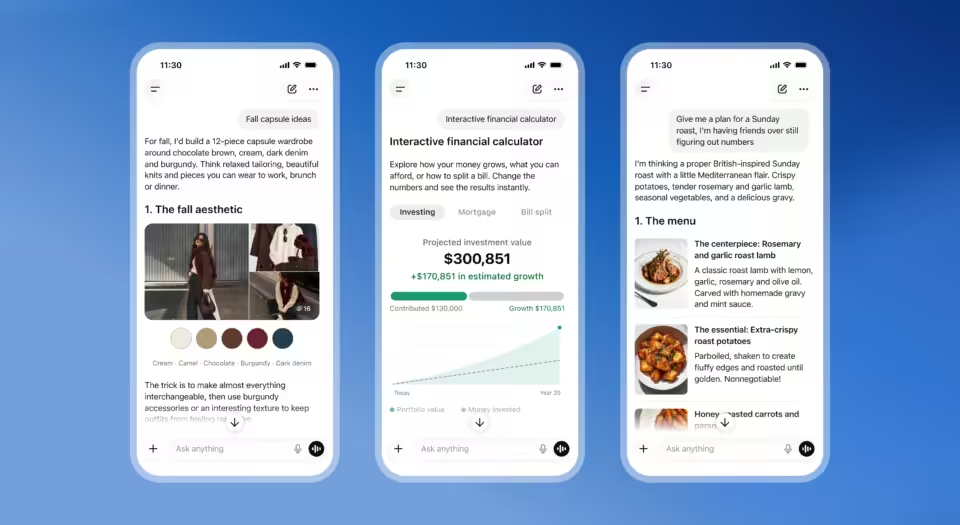
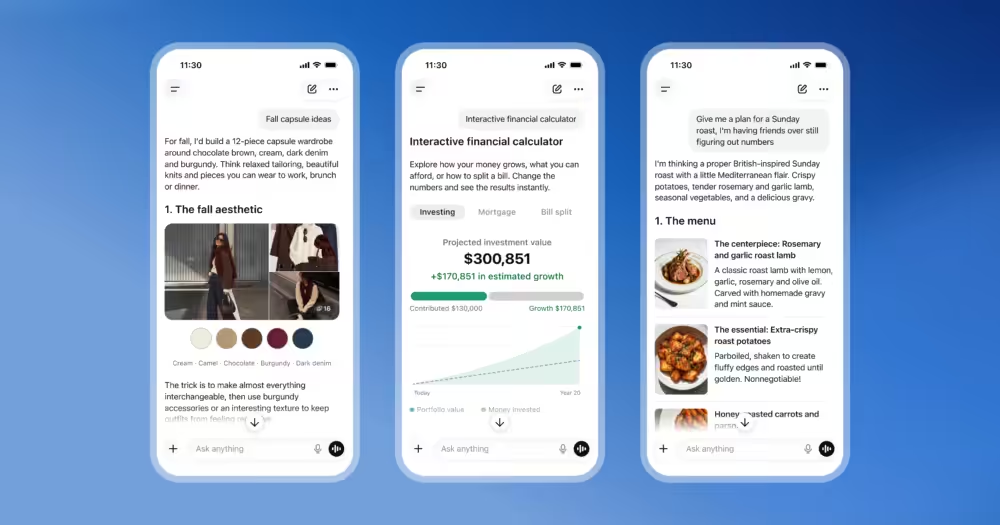
There’s also a new optional feature called Intelligent UI. Ask for a recipe or a technical breakdown and ChatGPT may generate a clickable diagram, a portion-adjustment widget, or a bill-splitter tool directly inside the chat window, rather than just returning plain text. The feature is rolling out gradually on web and updated mobile apps. Current macOS and Windows desktop apps don’t support it yet, and users who prefer clean text responses can turn it off in web settings.
The broader context here is that OpenAI is under more competitive pressure than it was a year ago. Google has been aggressive with Gemini updates, Anthropic shipped Claude 4 earlier this year, and Perplexity has carved out a serious niche in AI-assisted search. Rolling GPT-6 to free users on day one, not just locking it behind a paywall, signals that OpenAI is prioritizing scale and retention. Keeping casual users on the free tier engaged with a faster, more capable model makes switching less appealing. That’s a defensive move as much as a product one, and it’s the right call given where the competition is heading.