LAION
Provides open-source datasets and models for AI research
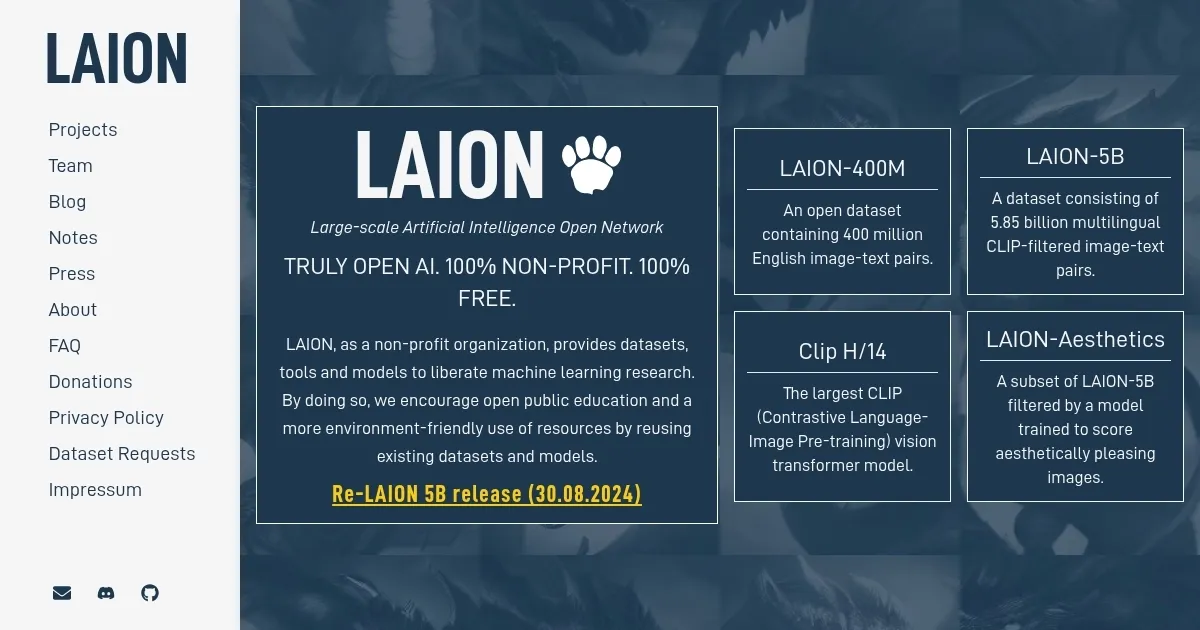
LAION is a German non-profit providing open-source datasets and tools for machine learning research. Its flagship LAION-5B dataset includes 5.85 billion CLIP-filtered image-text pairs, scraped from Common Crawl, with URLs for images rather than hosted files. Released in March 2022, it’s the largest freely available dataset of its kind, supporting models like Stable Diffusion and Google’s Imagen. LAION-400M, with 400 million pairs, is another key offering, alongside subsets like LAION-Aesthetics for high-quality images and LAION-COCO with 600 million BLIP-generated captions. Tools include OpenCLIP, an open-source CLIP implementation, and img2dataset, which processes URLs into datasets efficiently.
The organization’s mission focuses on accessibility and sustainability, funded by donations and grants. Researchers can access datasets and tools like Clip Retrieval, which computes embeddings quickly, even on consumer hardware. LAION’s GitHub hosts projects like CLAP for audio-text pretraining and watermark detection, fostering community collaboration via Discord and open-source contributions.
Compared to Hugging Face, which provides hosted datasets and a user-friendly platform, LAION’s approach is less polished, requiring users to download images and clean data. Kaggle offers similar open datasets but focuses more on competitions than raw research resources. LAION’s datasets, being web-scraped, include problematic content like explicit or biased pairs, requiring additional filtering. Broken URLs can also hinder access.
LAION’s strengths lie in its scale and openness, making it invaluable for researchers and developers. Its community-driven model and tools like OpenCLIP are standout features. However, the lack of hosted images and need for data cleanup can be barriers for less experienced users.
To use LAION effectively, explore their GitHub for documentation, start with smaller datasets like LAION-400M, and leverage community support on Discord for troubleshooting.
Homepage Screenshot 📸
What are the key features? ✨
- LAION-5B: Offers 5.85 billion multilingual image-text pairs for AI training.
- OpenCLIP: Provides an open-source CLIP model for image-text pretraining.
- img2dataset: Converts large sets of image URLs into datasets efficiently.
- LAION-Aesthetics: Curates visually appealing images from LAION-5B.
- Clip Retrieval: Computes CLIP embeddings for fast dataset processing.
Who is it for? 🤔
Examples of what you can use it for 💡
- Academic Researcher: Uses LAION-5B to train text-to-image models for studies.
- AI Developer: Leverages OpenCLIP to build custom image classification tools.
- Data Scientist: Employs img2dataset to process web-scraped images for analysis.
- Open-Source Contributor: Enhances LAION’s GitHub projects like CLAP for audio tasks.
- Startup Founder: Utilizes LAION-Aesthetics to develop visually appealing AI applications.
Pros & Cons ⚖️
- Massive open-source datasets
- Free tools like OpenCLIP
- Active community support
- Supports diverse AI tasks
- Messy web-scraped data
- No hosted images
FAQs 💬
LAION alternatives 🔗