Pythagora
An AI-powered tool that helps developers build web applications quickly
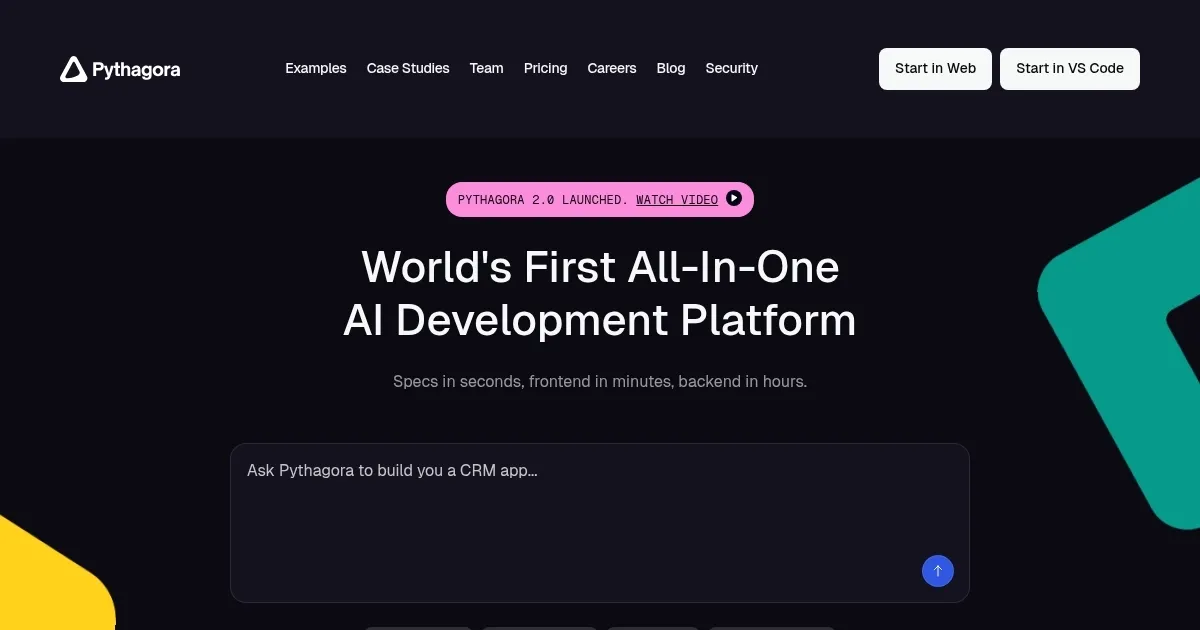
Pythagora is an AI-powered tool that helps developers build web applications quickly. It works as an extension for Visual Studio Code, allowing you to create apps by simply describing what you want in plain English. This means you don’t need to write code manually, making the development process faster and more accessible.
Pythagora can generate production-ready, modular code. Moreover, it doesn’t just write the code — it also runs it, checks for errors, and fixes any issues it finds. This ensures that the applications you build are not only functional but also reliable.
If you’re a developer, Pythagora could help you develop a fully functional app in just a few hours — instead of a few days. The AI can handle most of the coding, allowing you to focus on refining the app’s features and design. This efficiency can be particularly beneficial for startups and small teams looking to bring products to market quickly.
At the moment (January 2025), Pythagora is free to use, making it an attractive option for developers and entrepreneurs looking for cost-effective solutions. Its user-friendly interface and powerful AI capabilities make it a valuable tool for anyone looking to streamline their app development process. If that includes you, now’s the time to check it out.
Homepage Screenshot 📸
Video Overview 🎬
What are the key features? ✨
- Natural language interaction: Pythagora allows developers to describe application requirements in plain English, translating these descriptions into functional code.
- Autonomous code generation: Leveraging advanced AI models, Pythagora can autonomously generate production-ready, modular code, handling up to 95% of the development tasks.
- Self-debugging & error detection: Pythagora can identify bugs, propose solutions, and implement fixes during the development process.
- Automated testing: The tool generates automated unit and integration tests, ensuring that the application functions as intended and meets quality standards without manual test writing.
- Version control integration: Pythagora seamlessly integrates with Git, enabling efficient version tracking and collaboration within development teams.
Who is it for? 🤔
Examples of what you can use it for 💡
- Developers can quickly create functional prototypes to test and validate ideas
- Organizations can build custom internal tools, such as management dashboards or HR applications, tailored to their specific operational needs
- Students and educators can utilize Pythagora to learn and teach web development concepts
- Startups can efficiently develop minimum viable products to test market viability
- Create tools for testing and evaluating API performances, including automated test generation, ensuring robust and reliable integrations
Pros & Cons ⚖️
- Natural language programming feels surreal
- Creates production-ready code
- Good for different kinds of users
- Limited language support
Ready to try Pythagora?
An AI-powered tool that helps developers build web applications quickly
Visit Pythagora