snyk
Scans and fixes vulnerabilities in code, dependencies, containers, and IaC
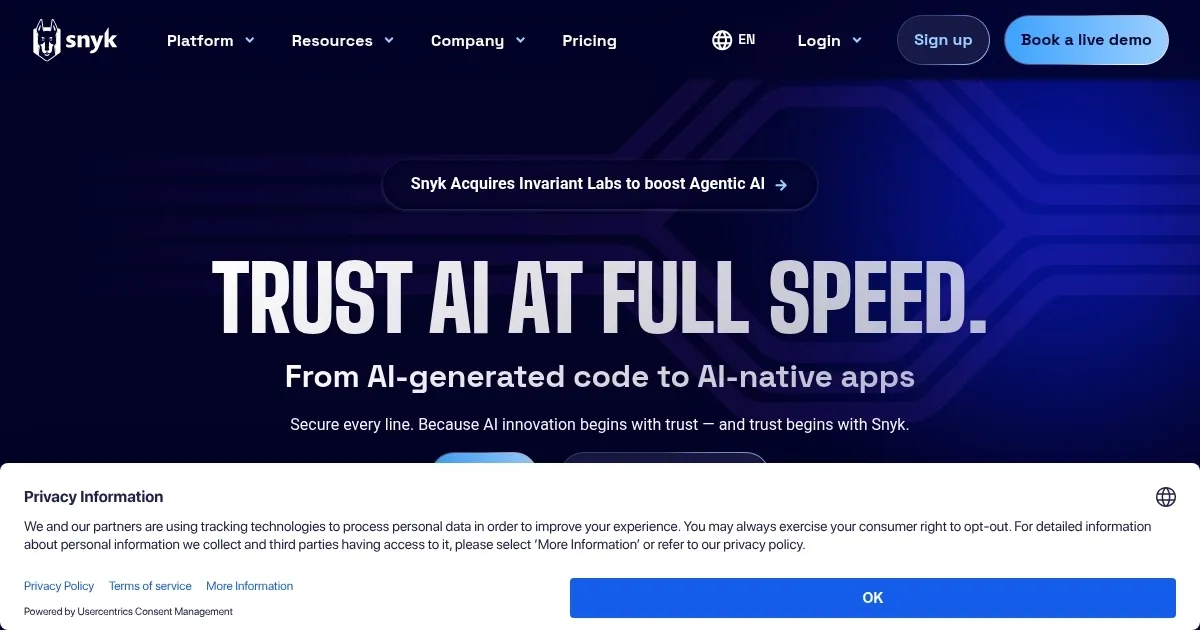
Snyk is a developer-focused security platform that scans and prioritizes vulnerabilities in custom code, open-source dependencies, container images, and infrastructure-as-code (IaC) configurations. It integrates with tools like GitHub, Jenkins, and VS Code, enabling real-time security checks within developer workflows. Snyk’s core products include Snyk Code for SAST, Snyk Open Source for dependency scanning, Snyk Container for image security, and Snyk IaC for configuration checks. Its DeepCode AI engine powers fast, accurate scans, leveraging a comprehensive vulnerability database. In 2025, Snyk acquired Invariant Labs to enhance AI-native app security, addressing emerging threats in AI-driven development.
The platform’s CLI and IDE plugins allow local and CI/CD pipeline scanning, with commands like “snyk test” and “snyk monitor” providing detailed reports and continuous monitoring. Users appreciate the actionable remediation advice, such as specific library upgrades or configuration fixes. Snyk’s free tier supports unlimited public repository scans, while paid plans (Team and Enterprise) offer unlimited private repository scans and advanced features like Snyk AppRisk for risk prioritization. Compared to Veracode, which offers broader DAST capabilities, or Jit, which emphasizes cost-effective scanner coverage, Snyk excels in developer integrations and speed, scanning up to 2x faster than some competitors, per user feedback.
However, setup can be complex for non-standard project structures, requiring manual file path specifications. False positives occasionally clutter reports, and enterprise pricing lacks transparency, requiring sales contact for teams over 10 developers. Users on platforms like Reddit note that alternatives like Aikido Security may offer similar features at lower costs. Snyk Learn, an educational tool, provides interactive security training, which is valuable for onboarding teams.
To get started, create a free account and install the CLI or IDE plugin. Run “snyk test” to scan your project and review the dashboard for prioritized fixes. For complex setups, use the “–file” flag to specify manifest locations. Compare pricing with Jit or Aikido if budget is a concern, and leverage Snyk Learn to upskill your team.
Homepage Screenshot 📸
Video Overview 🎬

What are the key features? ✨
- Snyk Code: Performs real-time SAST to identify vulnerabilities in custom code.
- Snyk Open Source: Scans and fixes vulnerabilities in open-source dependencies.
- Snyk Container: Detects security issues in container images and Kubernetes apps.
- Snyk IaC: Identifies misconfigurations in Terraform and Kubernetes code.
- Snyk Learn: Offers interactive security training for developers.
Who is it for? 🤔
Examples of what you can use it for 💡
- Solo Developer: Scans open-source dependencies in a public repo to ensure secure libraries.
- DevOps Engineer: Integrates Snyk into CI/CD pipelines to catch container vulnerabilities.
- Security Analyst: Uses Snyk IaC to audit Terraform configs for misconfigurations.
- Team Lead: Leverages Snyk Learn to train developers on secure coding practices.
- Enterprise Developer: Monitors AI-native apps for vulnerabilities with Snyk AppRisk.
Pros & Cons ⚖️
- Fast scans, 2x quicker than some tools.
- Deep integrations with GitHub, Jenkins.
- Free tier for public repos.
- Complex setup for non-standard projects.
FAQs 💬
Ready to try snyk?
Scans and fixes vulnerabilities in code, dependencies, containers, and IaC
Visit snyk