Thesify
Enhances academic writing with real-time feedback and citation tools
Thesify isn’t just another AI tool cluttering the digital landscape, it’s a polished companion for anyone wrestling with the beast of academic writing. Imagine a tireless editor, one that doesn’t roll its eyes when you ask for feedback at 2 a.m. That’s Thesify, built from the ground up to elevate essays, theses, and research papers with a laser focus on academic rigor. Its standout feature, Expert Feedback, delivers granular insights into your document’s structure, argument strength, and clarity, almost like a professor marking up your draft, but without the coffee stains. You upload your work, specify its type — say, a dissertation or a grant proposal — and Thesify’s AI, affectionately named Theo, churns out suggestions that feel eerily human, pointing out weak transitions or flimsy evidence with startling precision.
What makes Thesify shine is its commitment to academic integrity. Unlike tools that might tempt you to let AI write your paper (looking at you, ChatGPT), Thesify keeps you in the driver’s seat. It’s not about generating content, it’s about sharpening your own. The Effortless Citation feature is a godsend, tapping into a database of over 200 million references to help you find and cite sources without the usual slog through academic databases. Highlight text, search, and bam — relevant articles appear, ready to be cited or saved for later. The Intelligent Paper Digest is another gem, breaking down dense journal articles into concise summaries that save hours of squinting at jargon-heavy PDFs. I think it’s particularly useful for students new to research, who might feel overwhelmed by the academic firehose.
But it’s not perfect. The Agile Editor, which lets you rearrange text and add in-document notes, feels innovative but occasionally clunky, especially if you’re used to the seamless drag-and-drop of tools like Notion. Some users on X have noted that the editor’s interface could be more intuitive, requiring a bit of a learning curve to master its block-based system. Also, while Thesify’s Journal and Conference Finder is a clever idea, suggesting venues for your work based on your manuscript, it sometimes feels overly optimistic, recommending journals that might be a stretch for early-career researchers. Still, the tool’s heart is in the right place, aiming to demystify the publication process.
The pricing structure is another consideration. Thesify offers a free plan with 10 credits monthly (20 if you use a university email), which is generous for dipping your toes, but heavy users might need to spring for a paid plan. Compared to competitors like Grammarly, which focuses more on grammar than academic depth, or Blainy, which leans heavily into style, Thesify’s pricing feels reasonable for its specialized academic focus. Some posts on Reddit suggest it’s seen as a fair trade-off for the depth of feedback, though some wish the credits system was clearer.
Here’s the surprise element: Thesify’s Pre-Submission Assessment. It’s like a dress rehearsal for your paper, catching logical gaps or weak arguments before your professor does. For anyone who’s ever submitted a draft only to get back a sea of red ink, this feature alone might be worth the price of admission. My advice? Start with the free plan, upload a short essay, and test Theo’s feedback. Play with the Agile Editor to see if it fits your workflow. If you’re a grad student or researcher, check your institution’s AI policy first, Thesify’s designed to play nice with academic rules, but better safe than sorry.
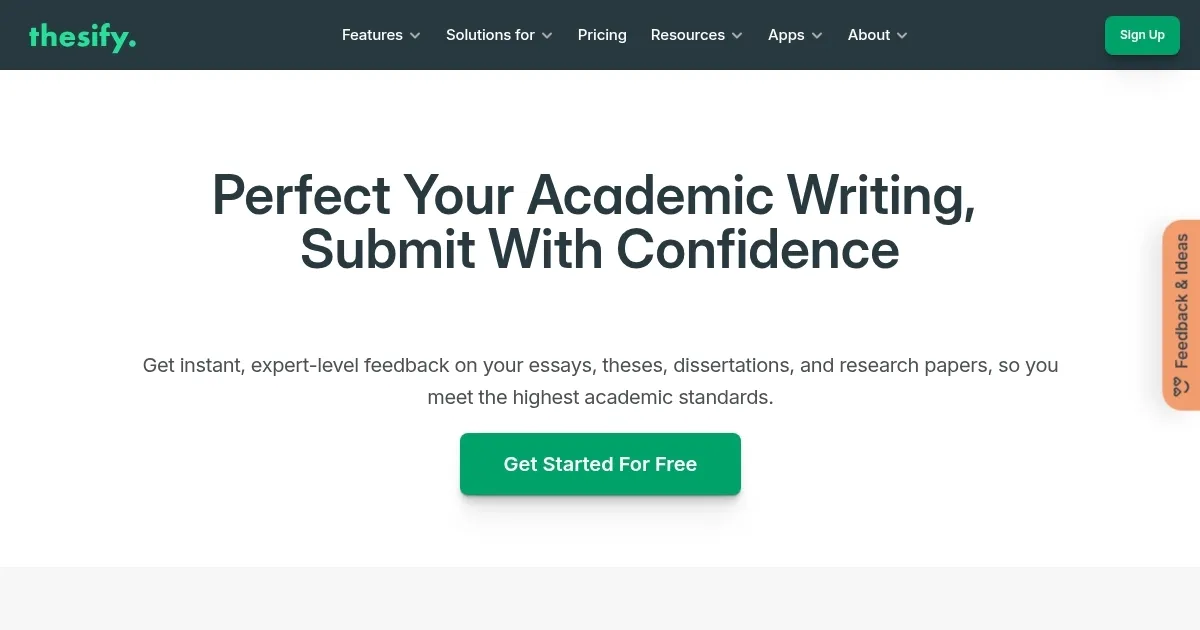
Homepage Screenshot 📸
Video Overview 🎬
What are the key features? ✨
- Expert Feedback: Provides real-time, detailed suggestions on structure, arguments, and clarity.
- Effortless Citation: Searches 200+ million references for easy citation integration.
- Intelligent Paper Digest: Summarizes complex journal articles into concise overviews.
- Journal and Conference Finder: Recommends publication venues tailored to your manuscript.
- Agile Editor: Enables flexible text rearrangement and in-document note-taking.
Who is it for? 🤔
Examples of what you can use it for 💡
- Graduate Student: Uses Expert Feedback to strengthen thesis arguments before submission.
- PhD Candidate: Employs Intelligent Paper Digest to summarize articles for literature reviews.
- Early-Career Researcher: Leverages Journal Finder to identify suitable publication venues.
- Undergraduate Student: Utilizes Effortless Citation to streamline essay referencing.
- Academic: Applies Agile Editor to organize and refine complex grant proposals.
Pros & Cons ⚖️
- Vast reference database
- Summarizes complex research
- Flexible editing tools
- Ambitious journal suggestions
- Credit system may confuse
FAQs 💬
Ready to try Thesify?
Enhances academic writing with real-time feedback and citation tools
Visit Thesify