Vapi
Builds and deploys AI voice agents for real-time conversations
Vapi is the kind of tech that makes you wonder why it took so long to get here. Imagine a platform that lets you whip up a voice AI agent — think a super-smart, endlessly patient phone operator — without months of coding. That’s Vapi’s pitch, and it delivers with a swagger that’s hard to ignore. This platform, born in San Francisco’s startup crucible, lets developers build voice agents that sound so human you might double-check if there’s a real person on the line. It’s not just about answering calls; it’s about creating conversational experiences that feel natural, whether you’re scheduling doctor appointments or cold-calling leads. The secret sauce? A modular API that’s as flexible as a yoga instructor, letting you plug in your own language models, voices, or transcription services.
What’s genuinely exciting is how Vapi abstracts the messy stuff. Building a voice AI from scratch is like assembling a spaceship in your garage — think turn-taking, interruption handling, and keeping latency so low you don’t notice it. Vapi handles all that, so you can focus on what your agent says, not how it says it. The dashboard is a gem, offering templates to get you started and visual controls to tweak your agent’s personality. Want it to speak Mandarin or sound like a chipper sales rep? Done. It’s also scalable, handling millions of calls without breaking a sweat, which is a big deal for businesses drowning in customer inquiries. And the low-latency promise — around 800 milliseconds end-to-end — means conversations flow without awkward pauses.
But it’s not all smooth sailing. Vapi’s flexibility comes at a cost, literally and figuratively. You’re paying for external services like Deepgram for transcription or OpenAI for language models, plus Vapi’s own fees. It’s not cheap, especially if your call volume spikes. Some users on Reddit have griped about the pricing model being confusing, with costs piling up from multiple vendors. For small teams without deep technical chops, the setup can feel like assembling IKEA furniture with half the instructions missing. You’ll need to manage API keys, connect services, and maybe even wrangle a Twilio account for phone numbers. Competitors like Bland AI or PlayAI offer similar voice agent capabilities, sometimes with simpler pricing or more out-of-the-box features, which might appeal to less tech-savvy teams.
The surprise element? Vapi’s enterprise-grade security. It’s HIPAA and SOC 2 Type 2 compliant, making it a rare bird for healthcare or finance, where data privacy is non-negotiable. I wasn’t expecting that level of polish from a startup, but it’s a game-changer for regulated industries. Still, some users on X have noted occasional hiccups with function calling — where the AI fails to trigger actions mid-conversation — which can disrupt complex workflows. It’s not a dealbreaker, but it’s a reminder that Vapi’s still evolving.
If you’re diving in, start with Vapi’s templates to get a feel for what’s possible. Test your agent with their simulated call suites to catch glitches before going live. And don’t skimp on your knowledge base — upload detailed FAQs and support docs to make your agent sound like it’s been with your company for years. If you’re not a developer, consider a white-label platform like Vapify to simplify things. It’s all about making the tech work for you, not the other way around.
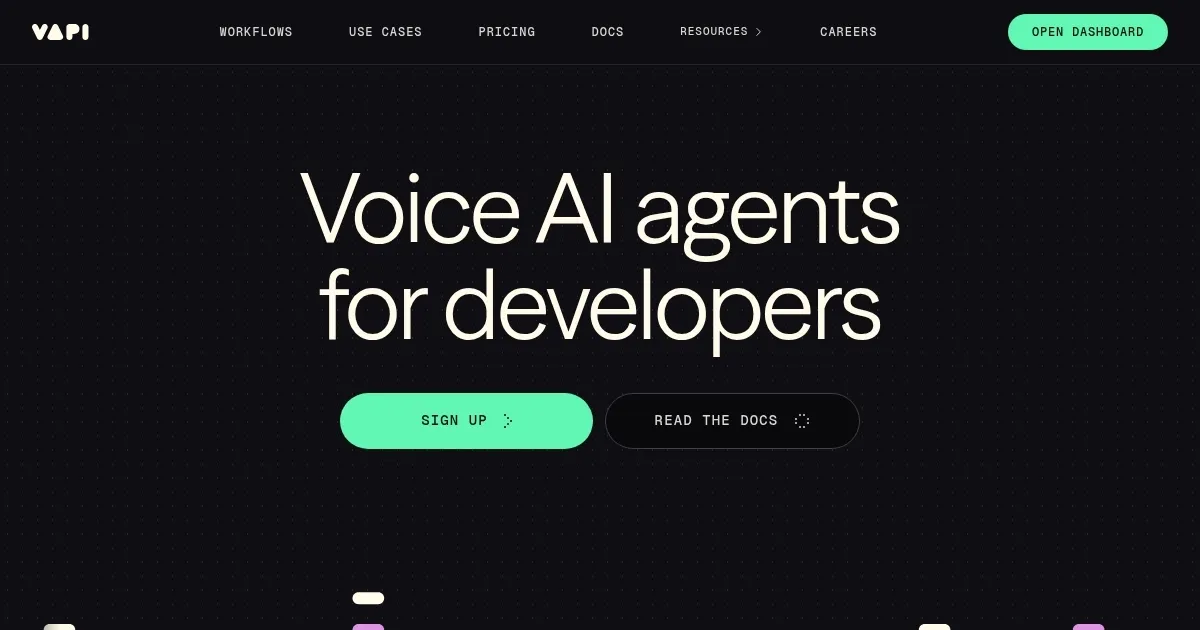
Homepage Screenshot 📸
Video Overview 🎬
What are the key features? ✨
- Voice AI API: Enables custom voice agent creation with minimal coding.
- Multi-Platform SDKs: Supports web, iOS, Android, and React Native apps.
- Low-Latency Processing: Achieves ~800ms end-to-end voice processing.
- Scalability: Handles millions of concurrent calls via Kubernetes.
- Enterprise Security: HIPAA and SOC 2 Type 2 compliant for sensitive data.
Who is it for? 🤔
Examples of what you can use it for 💡
- Customer Support Manager: Deploys AI agents to handle inquiries 24/7, reducing wait times.
- Sales Professional: Uses outbound call agents for lead qualification and follow-ups.
- Healthcare Provider: Automates appointment scheduling with HIPAA-compliant agents.
- E-commerce Business: Integrates voice agents for order tracking and support on websites.
- Market Researcher: Conducts automated surveys via voice calls for data collection.
Pros & Cons ⚖️
- Human-like voice quality
- Scalable to millions of calls
- Supports 100+ languages
- Complex setup for beginners
FAQs 💬