Arize
Monitors and evaluates AI models for performance and reliability in production
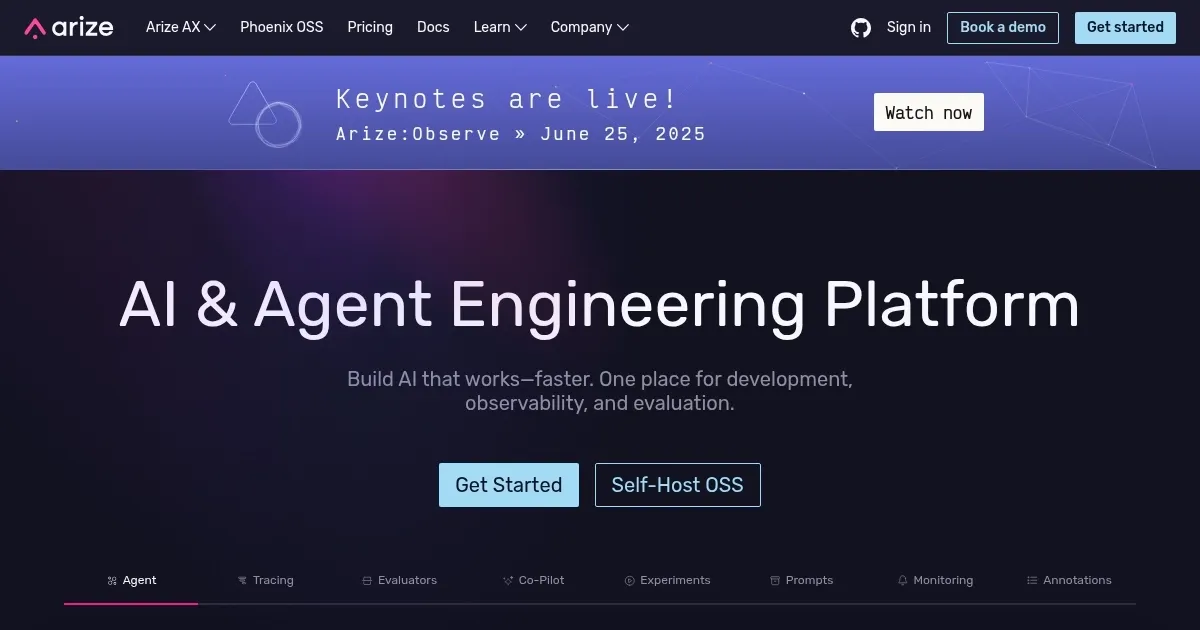
Arize AI is a machine learning observability and evaluation platform designed to monitor, troubleshoot, and improve AI models and LLM applications in production. Founded in 2020 and headquartered in Mill Valley, California, Arize supports teams at companies like Flipkart and Clearcover by providing real-time insights into model performance. It integrates with major LLM providers like OpenAI, Bedrock, and VertexAI, and is built on open-source standards like OpenTelemetry for seamless compatibility with existing AI infrastructure.
The platform’s core offering, Arize AX, provides enterprise-grade tools for performance tracing, drift detection, and evaluation of AI models, including ranking models, computer vision, and NLP. Its Performance Tracing feature identifies problematic predictions and highlights specific features causing issues, enabling quick debugging. The open-source Phoenix tool supports prompt management, model comparison, and visualization of LLM behaviors, such as hallucinations or incorrect generalizations. Arize logs over 1 trillion inferences monthly, showcasing its scalability for large-scale deployments.
Compared to competitors like Deepchecks and Datadog, Arize excels in LLM-specific observability, particularly for multi-agent systems. However, its cloud-only deployment may not suit organizations requiring on-premises solutions, unlike Databricks. The interface can also be complex for new users, requiring time to master. Pricing for Arize AX is available through custom quotes, while Phoenix is free, making it accessible for smaller teams.
Arize’s open-source tools, like OpenInference, support frameworks such as LlamaIndex and LangChain, ensuring flexibility across diverse AI stacks. The platform’s community resources, including a Slack channel and learning hubs, provide extensive support through tutorials and example notebooks. Recent updates, as of April 2025, include enhanced agent visibility for frameworks like CrewAI and AutoGen, improving multi-agent system monitoring.
For teams adopting Arize, begin with the Phoenix tool to explore its capabilities without cost. Review the documentation on Arize’s website for setup guides, and leverage the community for troubleshooting tips to streamline your onboarding process.
Homepage Screenshot 📸
Video Overview 🎬
What are the key features? ✨
- Performance Tracing: Identifies and diagnoses problematic predictions in AI models.
- Phoenix: Open-source tool for visualizing and evaluating LLM performance.
- OpenInference: Instrumentation package for tracing LLM applications across frameworks.
- Prompt Management: Enables systematic testing and version control for prompts.
- Real-Time Monitoring: Automatically detects drift, data quality, and performance issues.
Who is it for? 🤔
Examples of what you can use it for 💡
- AI Engineer: Uses Performance Tracing to debug model predictions in real time.
- Data Scientist: Leverages Phoenix to visualize LLM hallucination patterns.
- DevOps Team: Monitors drift across thousands of features with automated alerts.
- Startup Founder: Tests prompt variations in Playground for cost-effective iteration.
- Enterprise Manager: Evaluates multi-agent systems with Agent Visibility tools.
Pros & Cons ⚖️
- Robust LLM observability
- Open-source Phoenix tool
- Flexible framework support
- Complex interface initially
- Cloud-only deployment
FAQs 💬
Ready to try Arize?
Monitors and evaluates AI models for performance and reliability in production
Visit Arize