MediSearch
An AI-powered search engine that provides direct, science-based answers to medical inquiries
Finding accurate and up-to-date answers to health-related questions is often a daunting task. That’s probably the key reason why MediSearch was created, offering an AI-powered search engine that provides direct, science-based answers to medical inquiries. By filtering through extensive databases of scientific papers and medical publications, it aims to efficiently deliver trustworthy information.
One of MediSearch’s coolest features, Smart Information Extraction, automatically highlights key information from scientific articles — including summaries and critical statistics — allowing users to grasp essential details without going through entire documents. In addition, MediSearch offers Advanced Follow-ups, which enable users to explore related studies, identify contradicting evidence, and delve into real-world discussions with a single click.
Also worth noting is that MediSearch’s commitment to accuracy is noteworthy. The platform has achieved a 94.2% accuracy score on the United States Medical Licensing Examination (USMLE), thus surpassing many other AI models in medical knowledge and reasoning. This high level of precision makes MediSearch a reliable tool for both medical professionals and individuals looking for credible health information. Furthermore, the platform continuously updates its database, integrating new medical publications within hours of their release to ensure users have access to the latest scientific evidence.
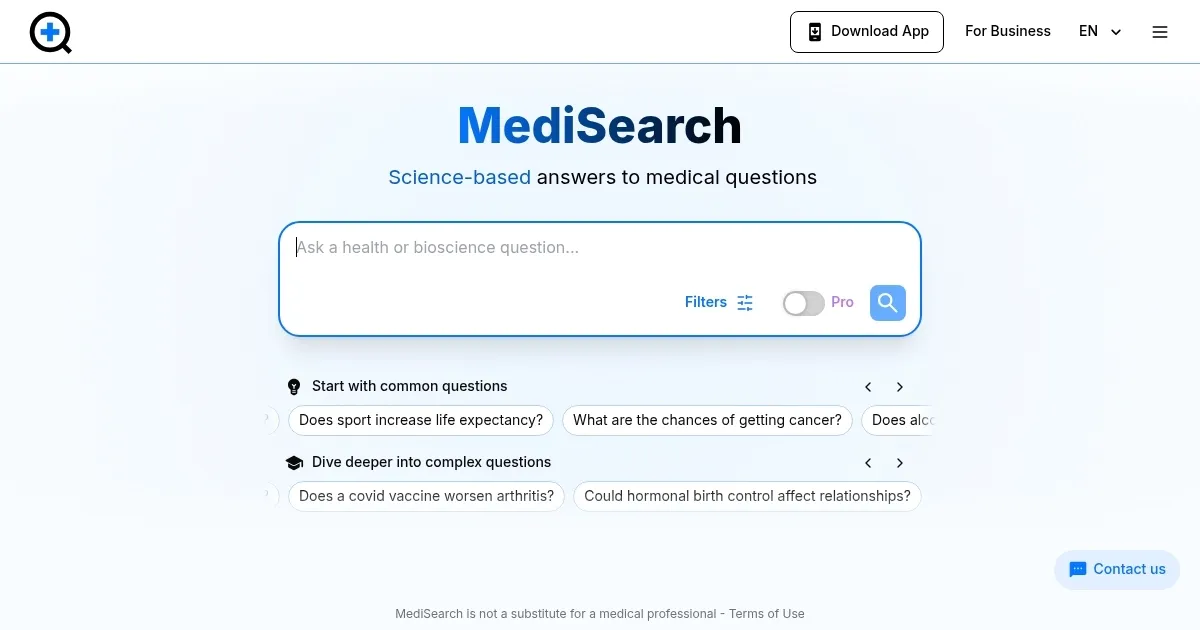
MediSearch is accessible from the web as well as through dedicated iOS and Android applications. It is easy to use, featuring an intuitive design and the clarity of information presented.
The bottom line is – MediSearch is a robust and reliable tool for accessing medical information. Its blend of advanced AI features, commitment to accuracy, and user-centric design makes it useful for anyone seeking trustworthy medical insights.
Homepage Screenshot 📸
Video Overview 🎬

What are the key features? ✨
- Smart Information Extraction: Automatically highlights key details from scientific articles, including summaries and critical statistics.
- Advanced Follow-ups: Offers one-click access to related studies, contradicting evidence, and real-world discussions.
- High accuracy: Achieved a 94.2% score on the USMLE, demonstrating superior medical knowledge and reasoning.
- Continuous updates: Integrates new medical publications within hours, ensuring users access the latest scientific evidence.
- User-friendly interface: Provides an intuitive design accessible via web, iOS, and Android apps.
Who is it for? 🤔
Examples of what you can use it for 💡
- Medical professionals can quickly access accurate medical information to support clinical decisions and patient care
- Researchers can efficiently gather and analyze scientific literature for studies and publications
- Students can use it as a study aid to understand complex medical concepts and stay updated with recent developments
- Health enthusiasts can seek reliable answers to personal health questions and make informed decisions
- Policy makers can access evidence-based information to inform health policies and guidelines
Pros & Cons ⚖️
- Reduces the need to sift through numerous articles by highlighting key information
- Provides answers rooted in scientific research
- Available on the web and mobile
- AI is NOT a replacement for a doctor
Ready to try MediSearch?
An AI-powered search engine that provides direct, science-based answers to medical inquiries
Visit MediSearchMediSearch alternatives 🔗