logo-darklogo-darklogo-darklogo-dark
  • Tool Categories
    • 🎨Art & Creative Design505
    • 🏢Business Management644
    • 💻Coding & Development514
    • 👮Detection83
    • 🧠General Use728
    • 🏥Health & Wellness55
    • 📷Image & Photo Analysis100
    • 🖼️Image Generation & Editing618
    • 📐Interior & Architectural Design37
    • 🎓Learning & Education483
    • ⚖️Legal & Finance90
    • 🎭Lifestyle & Entertainment236
    • 📢Marketing & Advertising627
    • 🎧Music & Audio138
    • 👔Office & Workplace1,014
    • 🔬Research & Data Analysis373
    • 👥Social Media245
    • 🎥Video Generation & Editing426
    • 👧🏻Virtual Companion135
    • 🎤Voice Generation & Editing381
    • ✍️Writing & Editing808
    • All Categories
    • AI Use Cases
  • News
  • Events
    • Academic Conferences
    • Developer Conferences
    • Expos / Trade Shows
    • Industry Summits
    • Workshops / Training
    • All Events
    • Past Events
  • Saved Tools
  • Suggest a Tool
✕
Home › Coding & Development › Development› Portkey
Portkey

Portkey

Streamlines AI integration with unified API, observability, and guardrails for over 1600 LLMs

Portkey is a platform that simplifies AI integration by providing a unified API for over 1600 LLMs, along with observability, guardrails, and prompt management tools. It serves as a control panel for businesses and developers building generative AI applications. The AI Gateway allows seamless switching between models from providers like OpenAI, Anthropic, and Google, supporting multimodal use cases like text, image, and audio. Integration takes just two lines of code, making it accessible for developers familiar with OpenAI’s SDK.

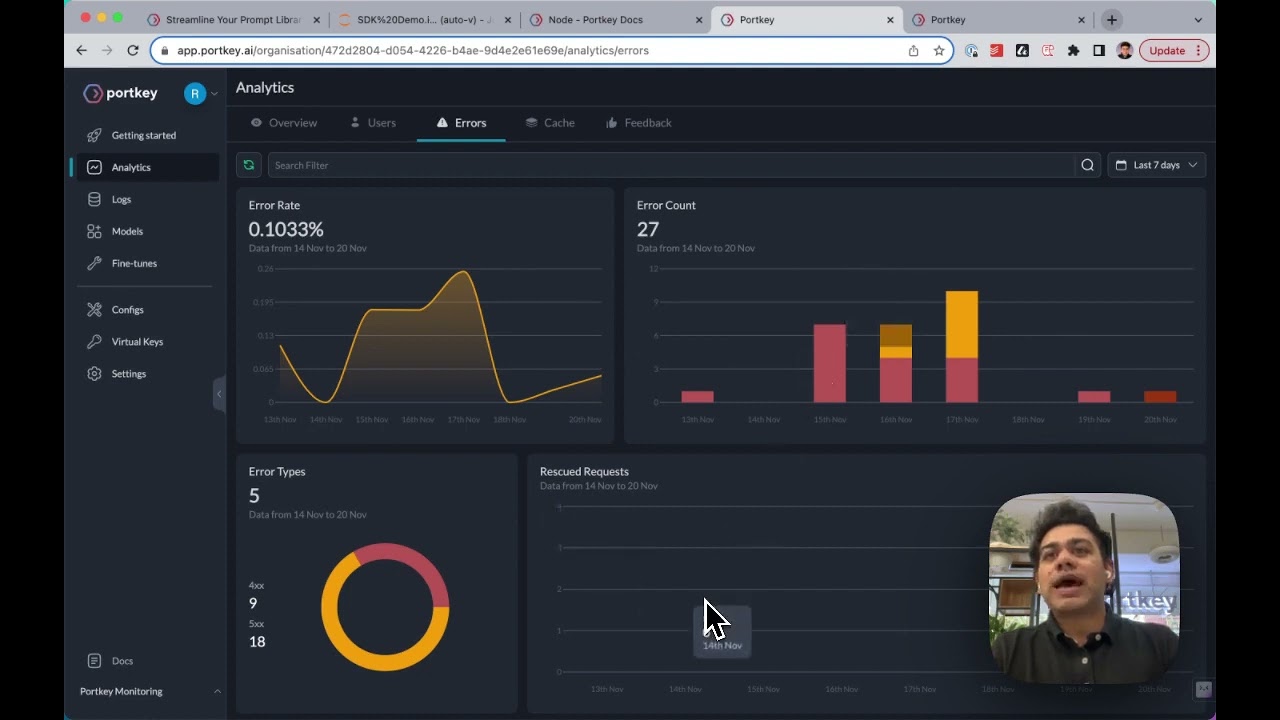
The observability suite offers real-time monitoring of latency, costs, and errors, with detailed logs and analytics for over 40 production-critical metrics. Semantic Caching reduces latency and costs by storing repetitive query results, while load balancing and automatic retries ensure reliability. Prompt Management centralizes prompt storage and optimization, and the platform supports enterprise-grade security with AES-256 encryption, virtual keys, and compliance with ISO, SOC2, HIPAA, and GDPR.

Compared to LangChain and LlamaIndex, Portkey excels in multi-provider integration and observability but may not match their depth in specific chaining or indexing tasks. The free plan includes 10,000 requests per month, with paid plans offering higher limits and advanced features like private cloud deployment. Some users report a learning curve due to the platform’s extensive features, and occasional bugs have been noted, though support is responsive.

Portkey’s open-source AI Gateway, available on GitHub, allows developers to test and contribute to the platform, while the commercial version caters to enterprises with high-volume needs. The Model Catalog feature enables role-based access control, ensuring teams use approved models. Over 1,000 organizations, including Postman and Turing, use Portkey to manage millions of daily requests.

For best results, you’ll want to start with the free plan to test integration. Use the observability dashboard to monitor costs and performance, and leverage Semantic Caching for repetitive tasks. Lastly (or in between), check the documentation for setup guides and reach out to support for any issues.

Visit Portkey ↗
Categories
💻 Coding
👨‍💻 Development
🧠 General
🧠 Large Language Model
👔 Work
📡 Monitoring 🔗 Agent
🔬 Research
📊 Data Analytics

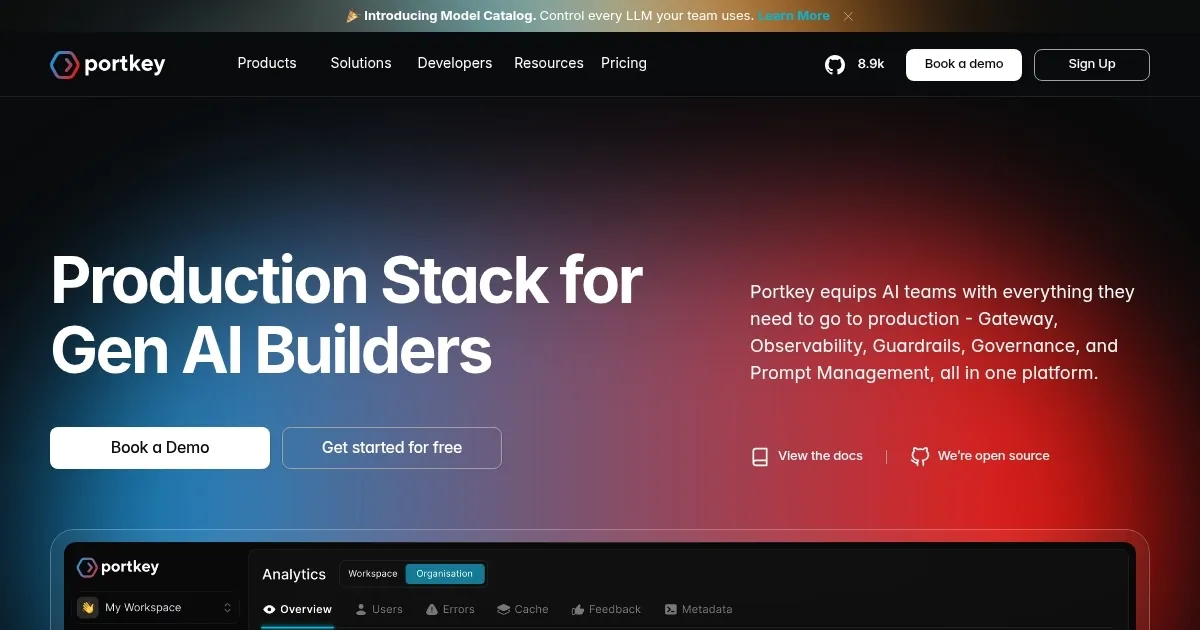
Homepage Screenshot 📸

Portkey screenshot

Video Overview 🎬

Portkey - Video Overview

What are the key features? ✨

  • AI Gateway: Connects to 1600+ LLMs via a unified API for seamless model switching.
  • Observability Suite: Provides real-time monitoring of latency, costs, and errors with detailed logs.
  • Semantic Caching: Stores repetitive query results to reduce latency and costs.
  • Prompt Management: Centralizes prompt storage and optimization for efficient AI interactions.
  • Security Vault: Uses virtual keys and AES-256 encryption for secure API key management.

Who is it for? 🤔

Portkey is ideal for developers, AI teams, and enterprises building generative AI applications, especially those managing multiple LLMs across providers like OpenAI, Anthropic, or Google. It suits organizations with high-volume AI workloads needing observability, cost control, and compliance with standards like SOC2 or HIPAA. Small startups benefit from the free open-source Gateway, while enterprises leverage its scalability and private cloud options.

Examples of what you can use it for 💡

  • SaaS Developer: Integrates multiple LLMs into a chatbot with minimal code changes.
  • Enterprise AI Team: Monitors latency and costs across 25+ AI use cases daily.
  • Startup CTO: Uses Semantic Caching to cut costs on repetitive API calls.
  • DevOps Engineer: Sets up load balancing to ensure uptime during model outages.
  • Compliance Officer: Manages secure API key access with role-based controls.

Pros & Cons ⚖️

  • Unified API for 1600+ LLMs.
  • Cost-saving Semantic Caching.
  • Free open-source Gateway option.
  • Learning curve for new users.
  • Limited depth in chaining tasks.

FAQs 💬

What is Portkey?
Portkey is a platform that integrates over 1600 LLMs via a unified API with observability and security tools.
Is Portkey free to use?
The open-source Gateway is free, with a managed plan offering 10,000 free requests monthly and paid options.
Which AI models does Portkey support?
It supports models from OpenAI, Anthropic, Google, Cohere, and more, including multimodal models.
How does Portkey ensure security?
It uses AES-256 encryption, virtual keys, and complies with ISO, SOC2, HIPAA, and GDPR standards.
Can I switch models easily?
Yes, the AI Gateway allows seamless model switching without code changes.
Does Portkey add latency to API calls?
It adds 20-40ms, often offset by caching and routing optimizations.
Is there a learning curve for Portkey?
New users may find the feature set complex but manageable with documentation.
Can Portkey handle high-volume requests?
It supports over 25 million daily requests with 99.99% uptime.
Does Portkey offer enterprise support?
Yes, with private cloud deployment and custom compliance options.
How do I get started with Portkey?
Sign up at portkey.ai, grab an API key, and follow the two-line integration guide.

Ready to try Portkey?

Streamlines AI integration with unified API, observability, and guardrails for over 1600 LLMs

Visit Portkey ↗

Portkey alternatives 🔗

  1. Black Forest Labs Black Forest Labs Generates high-quality images from text prompts with precision and speed
  2. Cursor Cursor Supercharges coding with AI agents that build, edit, and review code autonomously.
  3. Windsurf Windsurf Empowers developers with AI-driven code generation and real-time collaboration.
  4. Lovable Lovable Builds apps and websites via AI chat prompts.
  5. Replit AI Replit AI Transforms natural language prompts into fully deployable apps using AI agents
  6. GitHub Copilot GitHub Copilot Enhances coding with AI-driven completions and chat assistance
Share
Portkey screenshot enlarged
Promote Portkey
light badge
Copy Embed Code
dark badge
Copy Embed Code
neutral badge
Copy Embed Code
Best AI Tools

Discover the best AI tools for any use case

Explore
  • Tool Categories
  • AI Use Cases
  • AI Events
  • AI News
  • Saved Tools
Company
  • About Us
  • Contact Us
  • Media & Partnerships
  • Suggest a Tool
Legal
  • Privacy Policy
  • Terms of Service
Copyright © 2026 Best AI Tools 415 Mission Street, 37th Floor, San Francisco, CA 94105